
For most pet birds, wings need re-trimming every 1 to 3 months once feathers start growing back, but the honest answer is: check your bird, not the calendar. Feather regrowth speed varies so much between species and individuals that a fixed schedule will almost always be either too early or too late. A small passerine can regrow functional flight feathers in just a few weeks, while a large parrot's primaries can take two months or more to replace fully. The real trigger for a re-trim is observable feather growth, not a date circled on the wall.
How Often to Clip Bird Wings: Timing by Species & Moult

Marcus Chen
17 Jul 2026
Why owners clip wings in the first place
The goal of clipping is almost always safety management. Inside a home, an unclipped bird can fly into windows, ceiling fans, open doors, hot stovetops, and toward other pets. Outdoors, an unclipped bird that escapes often doesn't come back. For backyard poultry and waterfowl, clipping reduces the chance of birds clearing a fence and ending up in a predator's path. In all these cases, the owner is trying to buy time and reduce risk in an environment the bird wasn't evolved to navigate.
It's worth being honest about what clipping is not. It is not training. It is not bonding. And it is not a permanent solution to any of those safety concerns, because feathers grow back. The Association of Avian Veterinarians (AAV) and the International Association of Avian Trainers and Educators (IAATE) both flag that repeated trimming requires repeated handling, carries welfare implications, and should be weighed against alternatives like secure enclosures and flight training. Clipping is a tool, not a default, and understanding that helps you decide how often you actually need to do it.
What wing clipping actually changes (and what it doesn't)
Flight mechanics and balance
When you clip a bird's primary feathers, you are mainly reducing thrust and vertical lift because the primaries are the feathers that generate propulsive force. The secondaries, which attach to the ulna bone and contribute more to overall lift and glide, are usually left intact during a standard trim. This means a clipped bird can still glide, gain limited lift, and in some species still achieve a surprising amount of controlled airtime depending on how many primaries were removed and how the bird is built. A trim does not flip a bird into a ground-bound animal overnight.
Balance is a real concern, especially in heavier birds. Aggressive or asymmetric trims can cause hard landings that injure the keel (the bony ridge running along the sternum that anchors flight muscles). Clinical avian medicine sources specifically mention sternal ulcers and keel injuries in heavy-bodied parrots that have been trimmed too short, because they lose enough control to hit surfaces at bad angles. This is why most clinicians recommend trimming both wings symmetrically and taking a conservative approach to how many primaries you remove.
What clipping does not fix
A clipped bird is not a safe bird if the environment is dangerous. Falls, drafts, open water, other animals, and escape routes through open doors are all still real hazards. Research in domestic chickens has shown that clipping primary feathers reduces access to elevated resources and measurably reduces pectoral muscle thickness within weeks, which tells you that chronically preventing flight has real physical consequences beyond just the feathers themselves. Clipping is a short-term intervention that works best alongside environmental changes, not instead of them.
A quick map of wing anatomy: the feathers that matter for clipping
You don't need a degree in ornithology to understand this, but knowing which feathers do what makes the whole clipping rationale click. Bird wings have several distinct feather groups, and only some of them are relevant to a trim. For more detail on wing structure and composition, see what are bird wings made of.
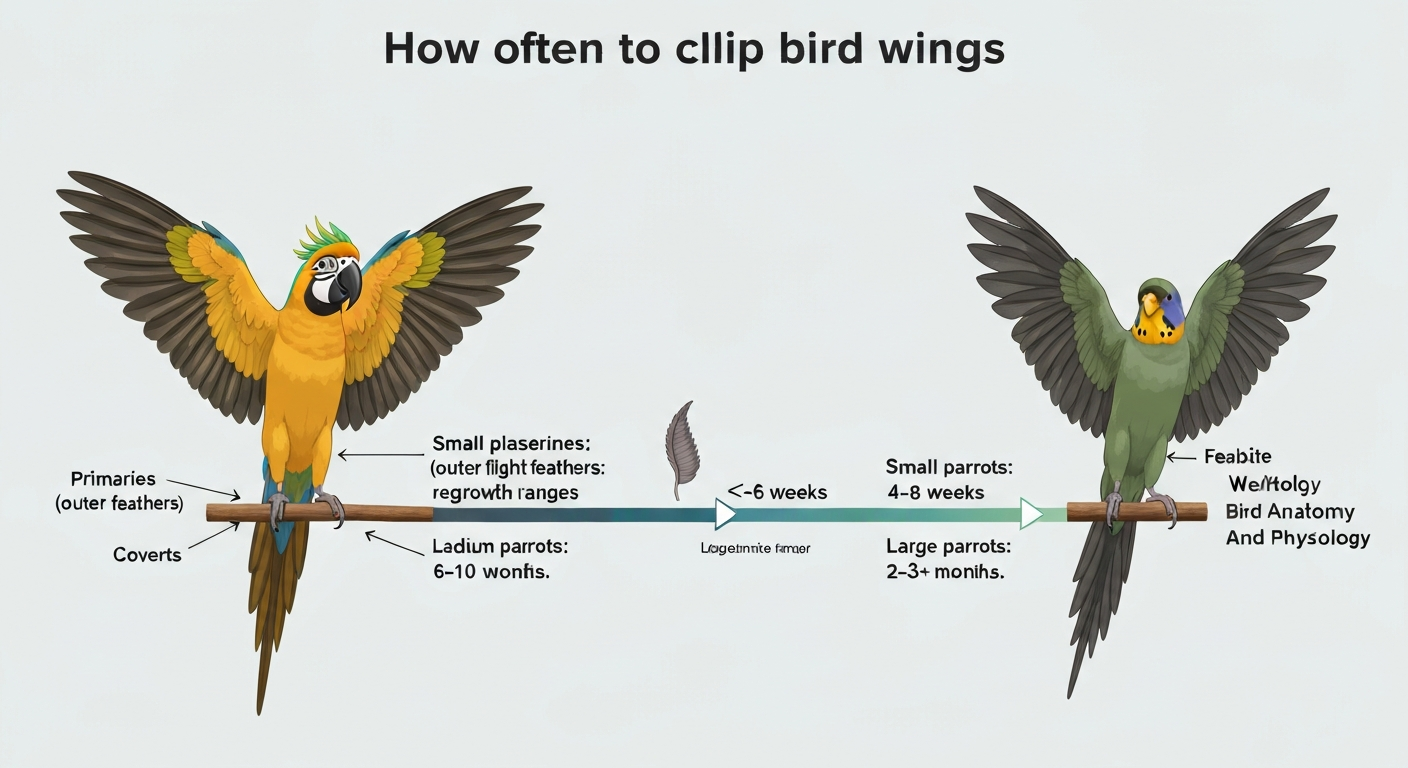
- Primary feathers (remiges): the long outer flight feathers attached to the 'hand' bones (carpometacarpus and digits). These are the main target of clipping because they generate thrust. A typical parrot has 10 primaries per wing.
- Secondary feathers: the inner flight feathers running along the ulna (forearm bone). They contribute lift and glide. Standard trims usually leave these alone.
- Covert feathers: shorter feathers that lie over the bases of the primaries and secondaries, streamlining the wing surface. They're not trimmed but serve as a visual reference point: when primary tips grow past the coverts, regrowth is becoming functionally significant.
- Blood feathers (pin feathers): new feathers actively growing in. They contain a blood supply running through the shaft, which is why they're called blood feathers. Cutting one causes significant bleeding and serious pain. Identifying these before any trim is the single most important safety check.
It's also worth knowing that bird wings are sensitive structures. The nerves and blood vessels running through growing feather shafts mean the wing is not just mechanically complex but neurologically active. A bird absolutely feels what's happening to its feathers, which matters both for how you handle the bird and for why you never cut a pin feather.
How the wing works, and why that shapes clipping rationale
Birds generate lift and thrust through a combination of wing shape, downstroke power, and feather positioning. For a clear, concise overview of how bird wings work, see how do bird wings work. During the downstroke, the primaries splay and generate forward thrust; during the upstroke, they rotate to reduce drag. The whole system depends on those outer primaries being the right length and stiffness. When you shorten them, you disrupt the aerodynamic profile enough to reduce the bird's ability to generate sustained powered flight, but not enough to prevent all air movement, which is exactly why a 'clipped' bird can still get lift under the right conditions. The wing also folds tightly when not in use, with the primary and secondary feathers layering over each other in a sequence driven by the elbow and wrist joints. If you want more detail on the folding sequence and how primaries and secondaries layer during rest, see our piece on how do bird wings fold. When new feathers grow in after a trim, they gradually restore the wing's aerodynamic geometry, which is why you need to recheck rather than assuming the trim holds indefinitely.
Moult cycles: the biological clock behind every re-trim
Moult is the process by which birds shed and replace feathers. It's not random. Moults are regulated by photoperiod (day length), nutrition, hormonal cycles, and sometimes breeding status, and the pattern varies significantly by species. Some birds undergo a full moult annually, replacing all flight feathers in sequence. Others have partial moults that replace only some feathers at a time. What this means practically is that the timing and pace of feather regrowth after a clip isn't just about the bird growing new feathers in a vacuum, it's tied to where the bird is in its natural moult cycle.
The key rule: never clip during an active moult when pin (blood) feathers are coming in. This is both a safety issue (cutting blood feathers causes bleeding) and a welfare issue (you're cutting feathers that haven't even finished forming). You should wait until a new cohort of feathers has fully matured before trimming them. Conversely, if a bird has just completed a moult and all new primaries are fully grown and hardened, that's your window.
Primary feather growth rates vary by species and feather length. Across many bird species, primaries grow at roughly 2 to 6 mm per day. Feather (flight feather) growth rates are constrained biologically and, across many species, primary growth rates cluster in the range ~2–6 mm per day (Determinants and constraints of feather growth, PLOS ONE, 2020). For canaries and other small passerines, growth rates closer to 2 mm per day still mean short feathers can be replaced relatively quickly given their smaller absolute length. For medium to large parrots, primaries growing at roughly 3 to 5 mm per day but measuring up to 190 mm or more in length can take 7 weeks or longer per feather to fully replace. This is the biological basis for the 1-to-3-month recheck window that avian hospitals commonly cite.
Species and life stage make a big difference
One thing I had to learn the hard way (conceptually, at least) is that 'bird' is doing a lot of work in most generic clipping advice. The biology varies enormously between a budgie, a macaw, a canary, and a backyard chicken. Here's how those differences play out practically.
Parrots (psittacines)
Parrots are the most common subject of clipping discussions among pet owners. Their primaries are long, growth is slower in absolute terms, and they are cognitively complex birds for whom flight restriction has documented behavioral consequences. The Merck Veterinary Manual notes that the number of primaries trimmed should be individualized, with heavier birds typically needing fewer removed to achieve the desired flight restriction. Most clinical guidance suggests checking every 1 to 3 months and performing a flight test rather than trimming on a fixed schedule. Large macaws and cockatoos moult more slowly and have longer feathers, so the interval between meaningful regrowth can be on the longer end of that range.
Small passerines (finches, canaries, sparrows)
Small passerines regrow feathers relatively quickly. Their absolute feather length is much shorter, and with documented canary growth rates around 2 mm per day, a trimmed feather can become functionally relevant again in a matter of weeks. Published observations report canary primary growth rates of about 2 mm per day (Passerines, review noting feather growth observations including canaries, PMC) Published observations report canary primary growth rates of about 2 mm per day.. If you're clipping a small passerine, the window between trims is shorter, and you may need to check more frequently, especially in the weeks right after a full moult.
Poultry and waterfowl
For backyard chickens, ducks, and geese, wing clipping is typically done to prevent escape or reduce predation risk. Research in chickens confirms that clipping primary feathers reduces their use of elevated resources and reduces pectoral muscle mass within weeks, which has welfare implications for birds kept long-term in systems that rely on clipping rather than appropriate fencing. For seasonal outdoor flocks, the practical approach is to trim before the birds are introduced to an outdoor area and recheck after the annual moult, which varies by breed and season. Local welfare regulations may also apply, so it's worth checking regional guidance.
Juveniles vs adults
Young birds go through juvenile moults and often have faster overall feather replacement cycles as they develop adult plumage. A juvenile bird may need more frequent checks simply because it is replacing feathers more rapidly as it matures. Adult birds on established moult cycles are more predictable, but breeding season can alter moult timing, so birds that are actively nesting or cycling through a breeding condition may shift their feather replacement schedule in ways that affect clipping intervals.
Practical timing: when to check and when to trim
Rather than a rigid calendar, use a combination of visual checks and a simple flight test to decide when a re-trim is warranted. The following signs indicate that regrowth has reached a functionally significant point.
- Primary tips are visibly extending past the covert feathers on the trailing edge of the wing.
- One or two new primary shafts are visible along the wing's trailing edge.
- The bird demonstrates noticeably increased glide distance or is gaining lift during a controlled flight test.
- The owner directly observes the bird regaining the ability to fly horizontally or gain height.
A flight test is simple: in a safe, enclosed room with no hazards, allow the bird to fly a short distance and observe whether it glides and lands gently or generates sustained lift and horizontal travel. If it's gaining real height and distance, it's time to reassess. If it's still gliding down in a controlled descent, the clip may still be effective.
| Bird type | Feather growth rate (approx.) | Typical re-trim interval | Key timing note |
|---|---|---|---|
| Large parrots (macaws, cockatoos) | 3–5 mm/day; long primaries (150–190+ mm) | 2–3 months | Slower absolute regrowth; check after each moult cycle |
| Medium parrots (African greys, Amazons, conures) | 3–5 mm/day; medium primaries | 6–10 weeks | Perform flight test at 6 weeks post-trim |
| Small parrots (budgies, cockatiels, lovebirds) | 2–4 mm/day; shorter primaries | 4–8 weeks | Smaller feathers regrow functionally faster |
| Small passerines (canaries, finches) | ~2 mm/day; short primaries | 3–6 weeks | Short feathers become functional quickly; check frequently |
| Poultry/waterfowl (chickens, ducks) | Variable; check post-moult | After each annual moult | Trim distal primaries only; check welfare regulations |
| Juveniles (any species) | Faster during growth phase | More frequent checks | Developmental moults accelerate replacement; monitor closely |
Safe clipping: what to do and what to avoid
I'll be upfront: the first time I read about blood feathers in detail, I immediately understood why most avian vets recommend having a professional do the first few trims so you know what you're looking at. Here's the essentials from veterinary practice guides.
- Use a towel to safely restrain the bird without pressing on the keel or chest — pressure on the sternum can restrict breathing.
- Fully extend one wing at a time and examine every feather along the trailing edge for pin feathers (blood feathers). These look darker, often purplish or grayish near the base, and the shaft appears solid and opaque rather than translucent and hollow.
- Use clean, sharp grooming scissors. Dull scissors can crush rather than cut, which is traumatic to the feather shaft.
- Trim only the primary feathers (the outermost long feathers). Leave the secondaries and all coverts intact.
- Trim both wings symmetrically in small to medium birds to preserve balance and prevent hard, one-sided landings.
- Never cut a blood (pin) feather. If you do accidentally nick one, apply gentle direct pressure, use a styptic powder or gel (cornstarch works as a temporary measure), and contact your avian vet immediately if bleeding doesn't stop quickly.
- Perform a post-trim flight test in a safe enclosed space before considering the job done.
- Document the date, number of feathers trimmed, and any observations — this helps time future checks accurately.
If you ever find a blood feather that has been damaged or broken, the first-aid steps from the MSD Veterinary Manual are: calm the bird, apply gentle direct pressure, use a styptic product, and contact your avian vet for persistent or heavy bleeding. Large birds in particular can lose dangerous amounts of blood from a broken blood feather, and it's not a situation to manage entirely at home.
When to call an avian vet or professional groomer
The AAV recommends avian veterinarian involvement for wing trims, particularly for first-time owners, large birds, and birds that are in active moult or have complicated feather health. A professional can visually identify blood feathers in a way that's difficult for owners who haven't been shown what to look for, document the clip method, and counsel you on post-trim care. If your bird has irregular moult patterns, feather destructive behavior, or a history of difficult trims, those are all reasons to have a vet involved rather than treating it as a DIY maintenance task.
Alternatives worth considering
IAATE's position is that physical flight restriction should be a last resort, and they actively promote secure, species-appropriate enclosures and flight training as preferred alternatives. These aren't just idealistic positions, from a biological standpoint, chronic clipping that prevents flight can cause muscle atrophy (pectoral muscle reduction has been documented in poultry within weeks of clipping), increased risk of injury from hard landings, and potential behavioral changes in cognitively complex species like parrots.
- Recall training and target training give you behavioral control over where your bird goes without ongoing physical restriction.
- Flight harnesses allow supervised outdoor time without escape risk and are practical for many medium to large parrots.
- Bird-proofing the home (window stickers, ceiling fan covers, door protocols, separate safe rooms) addresses the root hazards rather than the bird's flight ability.
- Appropriate enclosure sizing gives birds the ability to exercise their wings, which matters for long-term physical and psychological health.
None of these alternatives require you to never clip, the point is that clipping works best as part of a broader safety strategy rather than as the only one. If you're clipping every few weeks because the bird keeps getting into dangerous situations, that's a signal to look at the environment rather than just keep trimming.
Breeding birds and seasonal considerations
Birds in breeding condition or actively raising a clutch have altered hormonal states that can affect moult timing. Some species will delay or suspend normal moult during breeding because feather replacement is metabolically expensive and breeding is energetically demanding. If you are managing breeding birds, be especially cautious about clipping during active nesting periods: stress from handling can disrupt incubation behavior, and active pin feathers are more common during the hormonal fluctuations of breeding season. If you're unsure what 'clutch' means in this context, see what is a bird clutch for a brief definition. It's usually better to schedule any necessary trim before the breeding season begins or well after the clutch has fledged.
Putting it all together: a sensible approach to timing
The 1-to-3-month window cited by avian hospitals is a reasonable starting framework, but the biology says treat it as a range, not a rule. Small passerines land closer to the 3-to-6-week end. Large parrots can stretch toward 2 to 3 months or longer. Your actual schedule should be built around three things: where your bird is in its moult cycle, whether visible regrowth has reached a functionally significant point, and whether a flight test confirms restored flight capacity. Get those three checks right, and you'll trim exactly as often as needed and no more. That keeps handling stress low, protects the bird's physical condition, and makes each trim safer because you're working with fully hardened feathers rather than racing against a calendar.
FAQ
How often should bird wings be clipped?
There is no single calendar interval—re‑trims are individualized. Many clinical sources report typical recheck intervals of about 1–3 months after the first noticeable feather regrowth, but exact timing depends on species, feather growth rate, how many primaries were cut, and the bird’s moult cycle. Use flight tests and visible primary regrowth rather than only fixed dates.
Why do owners clip bird wings?
Owners clip wings primarily to reduce thrust and vertical lift (limit flying distance), manage safety in the home or garden, and prevent escapes. Biologically, trimming outer primaries (remiges) reduces propulsion while leaving some lift from secondaries and remaining primaries; it is a temporary, reversible change to flight mechanics rather than a complete removal of flying ability.
What exactly does wing clipping change and what does it not change?
Clipping primaries reduces thrust and shortens glide/flight range but does not eliminate all aerodynamic forces—clipped birds can still glide or gain limited lift depending on species and trim extent. Clipping does not change core anatomy (muscles, skeleton) except indirectly over time (disuse can alter muscle mass), so it’s a functional restriction rather than a surgical one.
How do feather types and moult cycles determine clipping frequency?
Feather growth rates (mm/day) and moult timing set how fast trimmed primaries reappear. Small passerines with short primaries regrow functional length faster; many psittacines grow primaries more slowly (several weeks to months). Additionally, species have characteristic complete or partial moult schedules, regulated by photoperiod and nutrition—avoid clipping during active pin‑feather growth and time rechecks around natural moult windows.
How does species and size affect how often wings need re‑trimming?
Smaller birds and those with short primaries (finches, canaries) often need rechecks more frequently because proportional regrowth is faster; medium/large parrots (heavier, longer primaries) usually require less frequent attention but the absolute time to replace a clipped primary can still be many weeks. Poultry and waterfowl management schedules vary by purpose (escape prevention) and may follow agricultural guidance.
Should juveniles and adults be treated differently when planning trims?
Yes. Juveniles are still finishing their first moult and may have pin/blood feathers—avoid clipping during active feather growth. Juveniles also may recover flight sooner as feathers complete. For adults, follow the bird’s established moult pattern and check for fully matured feathers before trimming or re‑trimming.