Bird wings fold by bending at three joints in sequence: the shoulder rotates the whole wing inward, the elbow flexes to bring the forearm back toward the body, and the wrist folds so the hand portion tucks in close to the forearm. That three-point fold is what lets a bird go from a fully outstretched wing spanning several feet to a tight, streamlined package pressed against its side in about a second. It's not magic, and it's not like a human arm folding either. It's a coordinated skeletal system where every joint moves in a specific order, and the feathers follow because they're anchored to those bones.
How Do Bird Wings Fold Step by Step and Why It Varies

Marcus Chen
21 May 2026
What 'folding' actually means for a bird wing
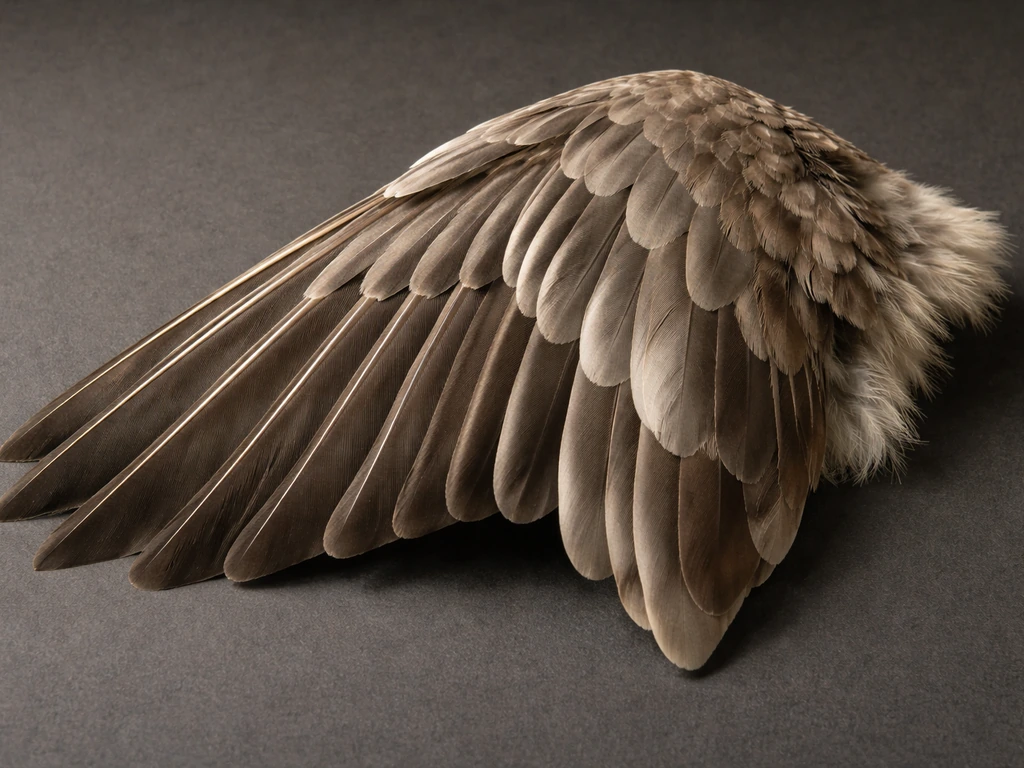
When people say a bird 'folds' its wings, they're describing the whole limb collapsing inward against the body, not just a surface flap closing like a book cover. The wing is a modified forelimb, and folding it means flexing at multiple joints simultaneously so the bones stack efficiently and the feathers layer on top of each other in a neat, overlapping arrangement. The wing doesn't retract into the body or disappear. It just tucks, rotating at the shoulder and bending at the elbow and wrist until the whole structure is compact enough to not catch the wind or get in the way while the bird is resting, perching, or moving through tight spaces.
One thing worth clearing up right away: the feathers themselves don't do the folding. They're passengers. The bones and joints do the mechanical work, and the feathers simply follow along because each flight feather is attached directly to a bone. That attachment and the nerves in skin and feather follicles help explain why bird wings can be quite sensitive to touch feathers simply follow along because each flight feather is attached directly to a bone.. Understanding that distinction is the key to visualizing the whole process correctly.
The bones and joints that make it happen
The wing has three main segments, and each one corresponds to a folding joint. Think of it like a human arm scaled and reshaped for flight, though some parts are dramatically different from what you'd expect.
The shoulder girdle: where folding begins
The shoulder isn't just one bone. It's a triangular arrangement of three structures: the scapula (shoulder blade), the coracoid (a strut-like bone that braces the shoulder against the sternum), and the furcula, which is the wishbone. These three bones together form a pocket for the head of the humerus, the upper arm bone, to rotate in. The furcula also runs through a structure called the triosseal canal, which is a pulley system for the supracoracoideus muscle that helps lift the wing. When a bird tucks its wing, the humerus rotates inward at this shoulder joint, starting the whole folding chain.
The elbow: the main folding hinge
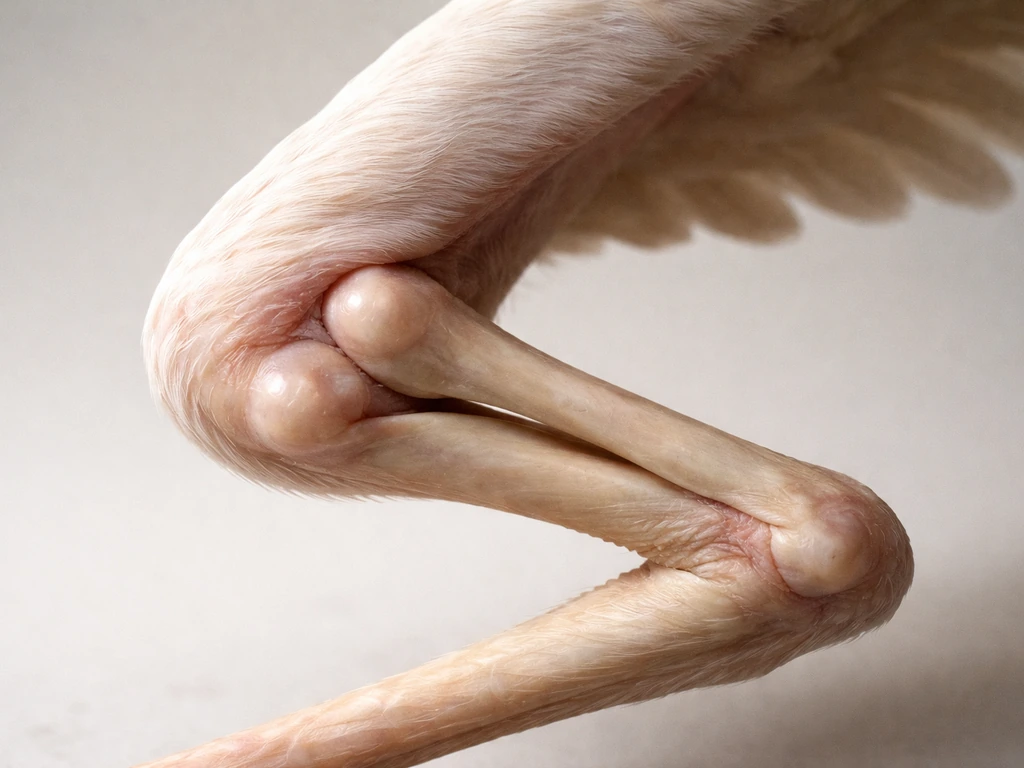
The elbow connects the humerus to the forearm, which is made up of two bones: the ulna (the thicker one, on the trailing edge of the wing) and the radius (thinner, on the leading edge). When the elbow flexes, the forearm swings back toward the body, and this is where the biggest visible change in wing shape happens. Most of the secondary flight feathers are attached along the ulna, so when the elbow folds, the secondaries come with it. The muscles that extend and flex the elbow are doing most of the heavy lifting here, and their coordination is precisely timed, not a passive collapse.
The wrist and hand: the final tuck
The 'hand' of a bird wing is a fused structure called the carpometacarpus, which is the carpus (wrist bones) and metacarpus (hand bones) fused together into one rigid unit. The wrist joint sits between the radius/ulna and the carpometacarpus, and when it flexes, the hand swings inward and forward, tucking the primary feathers (which attach to the carpometacarpus and the few remaining digits) tightly alongside the forearm.
There's also a passive mechanical coupling here worth knowing about: a membrane called the propatagium connects the shoulder to the wrist region, and when the elbow extends, it automatically pulls the wrist into extension too.
Extant-bird comparisons in Zoological Letters describe that at elbow extension, a propatagium-related mechanism synchronously causes wrist extension while keeping the elbow at an angle, along with an interlocking wing-folding mechanism where sliding of the ulna/radius contributes to wrist folding propatagium connects the shoulder to the wrist region.
This means elbow and wrist movement are mechanically linked, not fully independent.
| Wing Segment | Bones Involved | Joint That Folds | Feathers Attached |
|---|---|---|---|
| Upper arm | Humerus | Shoulder (glenohumeral joint) | Tertials (in some species) |
| Forearm | Ulna + Radius | Elbow | Secondary flight feathers |
| Hand | Carpometacarpus + digits | Wrist | Primary flight feathers |
How the feathers layer when the wing is closed
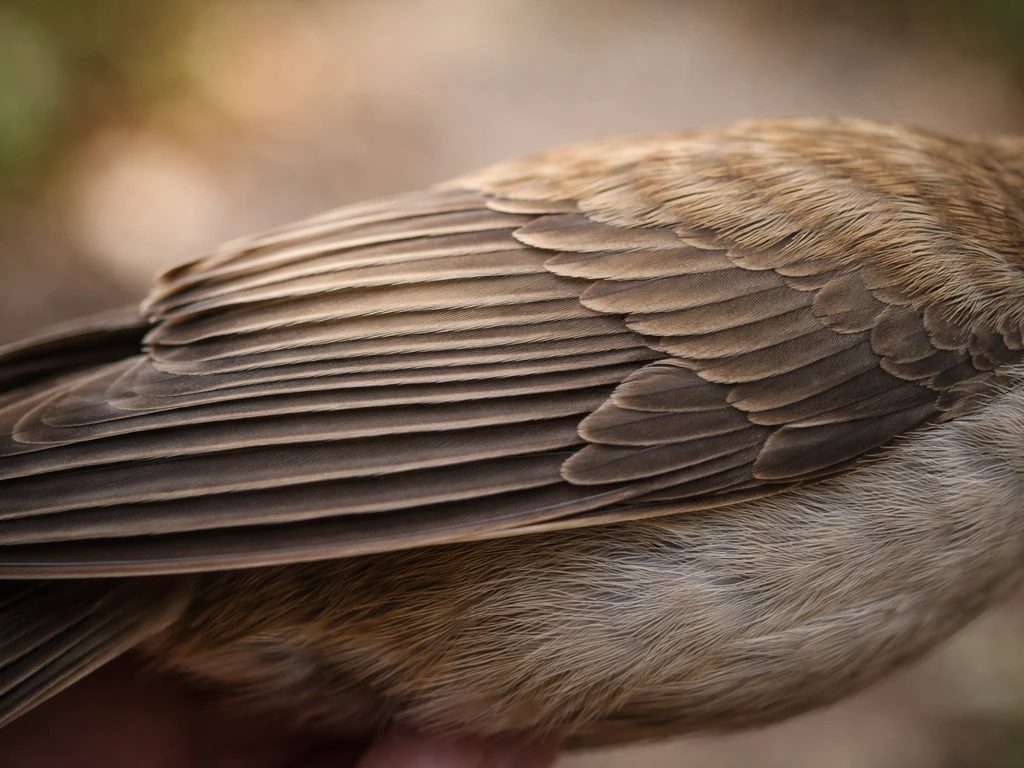
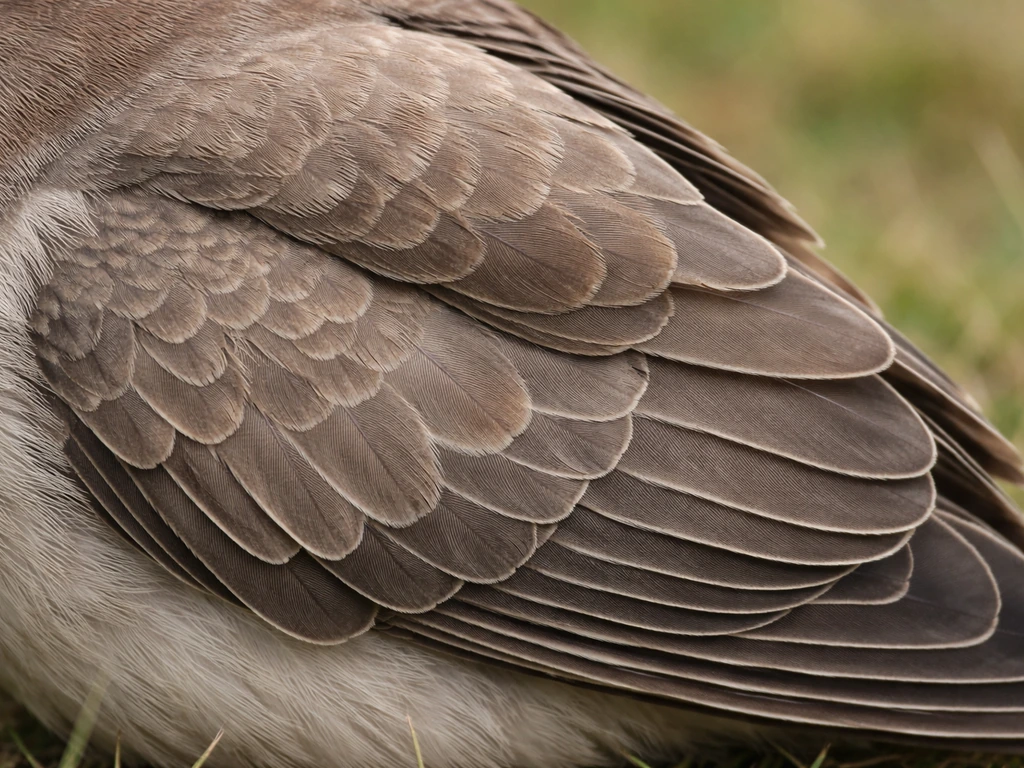
The large flight feathers are divided into two main groups: primaries and secondaries, collectively called remiges. The primaries are attached to the hand bones and form the outermost part of the wing tip. The secondaries are attached along the ulna and cover the inner portion of the wing. When the wing folds, both sets overlap each other and lie flat along the bird's side.
Covering the bases of those flight feathers are the coverts. Primary coverts overlay the base of each primary, while secondary coverts overlay the secondaries in several overlapping rows. These aren't just decorative; they smooth out the wing surface during flight and protect the feather attachment points on the folded wing. When you look at a perched bird and see neat rows of feathers on its closed wing, you're mostly seeing coverts, not the flight feathers themselves.
Many birds also have tertials, which are the innermost flight feathers attached near the humerus. In some species, especially shorebirds and songbirds, the tertials are long enough to cover most or all of the folded primaries and secondaries when the wing is closed, essentially hiding the wing tip entirely. This is why a folded wing can look almost featureless on some birds and quite complex on others.
One useful field concept that comes directly from wing folding is primary projection: how far the tips of the longest primaries extend beyond the tips of the tertials on a closed wing. Longer primary projection generally means longer wings relative to the body, which tends to correlate with more migratory or high-speed flight styles. It's a measurable consequence of exactly how the wing folds and how long the hand segment is.
Not all birds fold their wings the same way
Wing folding varies quite a bit across species, and most of that variation comes down to wing shape, flight style, and body proportions. A learning resource also notes that wing shape varies with the flight a species requires, which helps explain why folded-wing shapes and angles differ among bird types wing folding varies quite a bit across species. Research across multiple bird groups shows that range of motion at the elbow and wrist is strongly tied to how a bird actually flies, and that means resting posture differs too.
Songbirds and perching birds
Small perching birds (passerines) fold their wings very tightly and quickly. The wing is tucked high against the body, with the carpometacarpus pressed close to the forearm and the primaries largely hidden under the tertials. The whole folded wing sits snug against the flank. Because these birds have relatively short wings and frequent takeoffs, the fold-and-unfold motion has to be fast and reliable.
Soaring and gliding birds
Hawks, eagles, and vultures have much broader wings with a higher range of elbow and wrist extension for sustained gliding. At rest, their folded wings hang a bit more loosely and visibly than a songbird's. Interestingly, soaring birds like the steppe eagle have also been observed performing brief partial wing tucks mid-flight as a response to turbulence, essentially using a quick fold to reduce lift and stabilize during rough air. So folding isn't just a resting behavior for these birds.
Waterbirds and long-winged species
Ducks, geese, herons, and pelicans have long wings and often fold them in a way that leaves a visible 'elbow' bump at the back of the body. On a swimming duck, you can clearly see the folded elbow joint sticking out slightly above the tail. Herons fold their wings very close to the body and tuck the neck at the same time, giving them that distinctive hunched silhouette in flight. Wing shape requirements for their specific flight and foraging styles drive how tightly and at what angle the fold settles.
Flightless birds
Penguins, ostriches, and emus have wings that are modified for other purposes entirely. Penguin wings are stiff flipper-like limbs with fused joints that allow very limited folding compared to flying birds. The wrist and elbow have reduced range of motion, which makes sense since they don't need to fold wings to rest or fly. Ostriches have loose, reduced wings they fold back against the body but use mainly for display and balance. The folding mechanics are simplified relative to flying species.
How wing posture changes from rest to takeoff to landing
A resting, perched bird holds its wings in full fold: shoulder rotated in, elbow flexed, wrist tucked, primaries layered under or alongside the secondaries and coverts. This is the most compact state the wing can achieve.
During takeoff, the whole sequence reverses rapidly. The shoulder rotates out, the elbow extends, and the wrist extends simultaneously (helped by the propatagium linkage), snapping the wing open into its full span. Studies on pigeons show that during the downstroke of ascending flight, the wrist reaches near-full extension, and the entire shoulder, elbow, and wrist coordinate their timing together rather than acting in sequence. The stroke plane (the angle at which the wing beats through the air) tilts significantly during takeoff compared to level flight, with documented shifts of around 60 degrees or more in some measurements.
Landing is different again. As a bird approaches a perch, it pitches its wings upward at a steep angle, dramatically increasing drag while reducing lift to slow down. The wing posture during this braking phase involves partial flexion at the elbow and wrist to adjust the wing's profile. Research on perching birds shows rapid wing pitch changes happening in the final moments before touchdown. Aerodynamic force is generated mainly during downstrokes throughout these phases, so the amount of folding during the upstroke directly affects how much the bird can modulate its speed and direction.
During flapping flight itself, the wrist partially flexes on the upstroke to reduce the wing's surface area and drag, then extends again on the downstroke to maximize the surface pushing against the air. This means the wing is cycling through partial-fold and full-extension states with every single wingbeat, not just when the bird is resting.
Common misconceptions worth clearing up
The biggest misconception is that wings fold the same way human arms fold. They don't. When you bend your elbow, your forearm comes toward your upper arm in front of your body. When a bird folds its wing, the motion is inward and rearward, rotating the whole limb against the body wall. The geometry is completely different because the shoulder joint is oriented differently and the bones have different proportions.
A second common mistake is thinking the feathers 'clump together' on their own when a bird rests. A bird clutch refers to the eggs a bird is incubating or the brood it is caring for, so it can be helpful to understand how wing posture changes during resting too. The feathers have no folding mechanism of their own. They're attached to bones, and the only reason they layer neatly is because the bones moved into the right position first. If the joints didn't move, the feathers would stay splayed out. The neatness of a folded wing is entirely a product of precise joint coordination.
Third, many people assume the wrist is a minor joint that barely matters. In reality, the wrist is doing significant work, both during flight (cycling between extension and partial flexion with each wingbeat) and during the fold itself. Studies measuring joint angles in pigeons show the wrist has its own phase-specific timing that's distinct from the elbow, even though the two joints are mechanically coupled by the propatagium membrane.
Finally, folded-wing posture isn't just about rest. As noted with soaring eagles, birds can perform brief wing tucks mid-flight for aerodynamic reasons. The fold is a dynamic tool, not just a parking position.
A quick checklist for observing wing folding yourself
If you want to see these mechanics in action rather than just read about them, here's what to look for. If you are considering wing clipping, it's important to understand how often it should be done and when it is appropriate for the bird's situation how often to clip bird wings. You don't need any special equipment, just a local park with pigeons or sparrows, or even a good slow-motion video of a bird taking off or landing.
- Find the 'elbow bump' on a perched bird. On larger birds like pigeons or crows, you can often see the folded elbow joint as a slight bump at the back edge of the wing. That bump is the meeting point of the humerus and the ulna.
- Watch for the moment of full extension at takeoff. The split second after a bird launches, the wing snaps fully open. That snap is the shoulder, elbow, and wrist extending simultaneously.
- Look at the feather layering on a closed wing. The outermost visible feathers on a perched bird are usually the primary coverts or tertials, not the primaries themselves. See if you can spot the line where the primaries peek out beneath them.
- Check for primary projection. On a small songbird, look at how far the wing tips (primaries) extend past the end of the tertials. A long projection means a longer hand segment and usually a more migratory species.
- Watch the upstroke in slow motion. In a slow-motion video of a flapping bird, look for the partial wrist fold on the upstroke compared to the fully extended wing on the downstroke. It's subtle but visible on larger birds.
- Compare a soaring bird to a perching bird at rest. Hawks and eagles hold their folded wings differently, often with a looser, more visible fold, while sparrows and finches press their wings flat and tight against the body.
Where to go next if you want to dig deeper
If this sparked genuine curiosity about bird anatomy, there are some specific directions worth pursuing. The mechanics of wing folding connect directly to questions about what bird wings are actually made of at a structural level, how they generate lift and thrust during active flight, and why different wing shapes evolved for different flight styles. To answer the structural part of that question, bird wings are made of bones, joints, and keratin-based feathers what bird wings are actually made of. Each of those is its own rabbit hole.
- Look up 'avian wing kinematics' for peer-reviewed studies on how joints move during flight. The pigeon is the most-studied species, so start there.
- Search for 'carpometacarpus' to understand the fused hand bones that anchor the primaries. It's one of the most distinctive features of bird skeletons and directly relevant to how the wing tip folds.
- Find a labeled diagram of avian wing bones (any good ornithology textbook or museum website will have one) and try to identify the humerus, ulna, radius, and carpometacarpus on a folded wing photo side by side.
- Look at museum specimens if you have access to a natural history museum. Bird study skins often show the folded wing posture clearly, and skeletal mounts let you see the joint geometry directly.
- Watch slow-motion videos of pigeons or corvids taking off. YouTube has several from researchers, and you can clearly see the wing unfurl frame by frame.
- Explore how wing sensitivity plays into flight control, since the wing surface has sensory structures that inform the bird's adjustments during folding and extension.
- If you're interested in how all this relates to flight mechanics more broadly, looking into how bird wings actually generate force during the wingbeat will fill in the 'why does the fold matter mid-flight' question in full detail.
Wing folding is one of those topics that looks simple from the outside (the wing just closes, right?) until you start tracing the bones and realize there's a precisely coordinated three-joint mechanism happening every time a bird settles onto a branch. Once you see it that way, you'll never look at a perched pigeon the same way again.
FAQ
Do bird wings ever “disappear” inside the body when they fold?
No. The wing does not retract into the torso. Folding mainly rotates at the shoulder and flexes at the elbow and wrist, bringing the remiges and coverts into a compact layered position pressed along the side.
What part of the wing is actually moving when a bird folds it, the feathers or the bones?
The bones and joints do the work. Feathers follow because each flight feather is anchored to skeletal elements, so if the joints were held in the wrong orientation, the wing would not layer neatly.
Are the three joints (shoulder, elbow, wrist) always involved the same way in every bird?
They are always involved, but the amount and timing vary by species and wing design. Birds with broader, higher-range wings tend to show a less tightly “packed” resting fold than small perchers, which need a faster, tighter fold.
Why do some birds look like they have an “elbow bump” when folded?
In some swimming birds and certain wing shapes, the folded elbow region ends up more visible because the joint geometry and how tightly the wing tucks leave the proximal ulna/humerus area projecting slightly above the body line.
Do birds fold their wings the same way while perching versus resting on the ground?
The core fold pattern is the same, but ground resting can change how snug the wing sits because posture, balance, and space constraints differ. You may see a slightly looser tuck if the bird is shifting weight or facing different directions.
Can birds partially fold their wings during flight, and is it the same as resting?
Yes, many birds do quick partial wing tucks mid-flight, especially during turbulence or in transitions. These are dynamic adjustments to aerodynamics, not just the compact “parking position” used at rest.
Is the wing fold process the same on takeoff and landing, or do they use different mechanics?
They differ. Takeoff involves rapid opening driven by coordinated shoulder rotation with elbow and wrist extension, while landing braking uses wing pitch and partial flexion at the elbow and wrist to change aerodynamic drag and lift right before touchdown.
How can I tell, from a distance, whether a bird is fully folded or only partially tucked?
Look at whether the primaries and outer hand portion are hidden or still visible. In a full tuck, tertials and coverts usually cover much of the outer wing pattern; in partial folds, you often see more of the primary silhouette or a less layered look.
Does wing folding affect a bird’s lift, and could it be used to stabilize?
Yes. Reducing lift and altering pressure distribution can help manage speed and stability. That is part of why partial tucks are used during turbulence, where modulating wing posture changes aerodynamic forces.
Are birds with stiff or reduced-folding wings still able to “tuck” in a way that looks like other birds?
They can tuck to some extent, but the range is limited. Penguins have flipper-like wings with fused or reduced joint motion, and ostriches have simplified folding that relates more to display and balance than powered flight.
If I see a perched bird with messy or splayed feathers, does that mean the wing joints are not working correctly?
Not necessarily. Some feather arrangement can look uneven due to species differences, molt stage, wind, or how the bird is balancing. True joint problems are unusual, and posture alone is not enough to diagnose issues.
Is wing clipping something related to how wings fold, and what’s the common mistake people make?
Wing clipping changes how effectively a bird can open and control its wing, which can interfere with normal extension and flight behaviors even though folding mechanics still occur. A common mistake is clipping without considering the bird’s specific needs and how often it would require reassessment.
Next Articles
How Much Weight Can a Bird Carry Payload Limits Explained
Realistic payload ranges for different birds plus a method to estimate how much weight they can carry safely.
What Bird Has the Highest Heart Rate? Fastest Species Explained
Explains which bird has the highest heart rate, how it’s measured, key contenders, and how to compare readings fairly.
What Is the Highest Altitude a Bird Can Fly?
Find the highest documented bird flight altitude, how it’s measured, and the biology and flight mechanics behind extreme