
A typical bird has six standard external openings: two nostrils (nares), one mouth, two ear openings, and one cloacal vent. If the bird has a uropygial (preen) gland, that adds one more duct opening at the base of the tail, bringing the count to seven for most songbirds and raptors. Some seabirds also have functional salt-gland ducts that discharge near the nostrils, which can push the number higher depending on how strictly you define a 'hole.' So the honest answer is: six to eight, with six being the most universally applicable baseline.
How many holes does a bird have? Definitive count & guide

Marcus Chen
18 Jul 2026
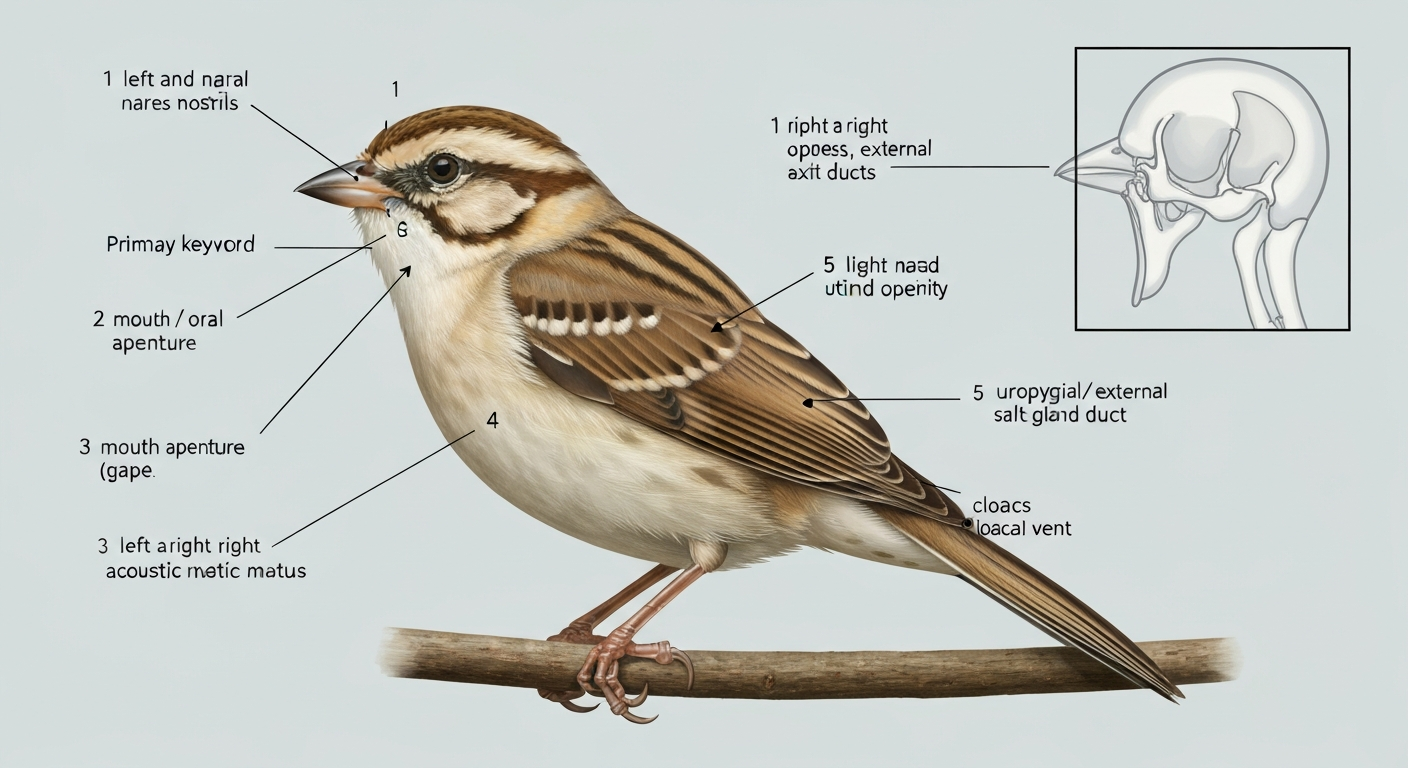
What counts as a 'hole' here?
Before listing anything, it helps to be clear about what we're counting, because the word 'hole' is doing a lot of work. For this article, a hole is any external aperture: an opening at the body surface that connects the outside world to an internal structure or cavity. It has to actually break the skin or integument. Internal passages do not count, no matter how much they look like holes from the outside.
The clearest example of something that does NOT count is the choana. That's the paired internal opening at the roof of a bird's mouth that connects the nasal cavity to the throat. If you look inside a bird's open beak you can sometimes see a visible slit there, and I completely understand why a first-timer would think 'hole.' But it's internal, it doesn't break the surface of the body, and anatomists consistently treat it as an internal structure. So it stays off the list.
Similarly, air sacs are internal and do not open to the exterior in a healthy adult bird. The article only counts openings you could, in principle, see or probe from the outside surface of the body.
The standard external openings every bird has
Here is the baseline set, walking from the front of the bird to the back. Each opening has a job, and once you know what it does, the anatomy starts making sense as a system rather than a random list.
The two nostrils (external nares)
Birds have two external nares, one on each side of the upper bill, usually near the base. See Journal of Morphology, discussion of the bony and fleshy nostril (apertura nasi ossea) and nasal anatomy in birds (Wiley Online Library) for detailed coverage of paired nares and their diverse forms. They open into the nasal cavity, which warms and filters incoming air and connects to the respiratory tract. Most species have visible slit- or oval-shaped openings; in some you can see daylight through both nostrils at once because the nasal septum is perforated. That always surprised me until I held a bird skull up to a window and saw the light come right through.
The mouth (oral aperture)
The gape, or oral opening, is a single external aperture. It's the most obvious opening on a bird, running the length of the bill at the commissure (the junction of the upper and lower mandibles). It serves feeding, drinking, vocalizing, thermoregulation (panting), and in some species, courtship display. Despite being one opening, it connects to both the digestive and respiratory tracts once you're past the beak.
The two ear openings (external acoustic meatus)
Birds do not have external ear flaps like mammals. Instead, each side of the head has a round-to-oval aperture leading to a short ear canal and then the eardrum (tympanic membrane). In most backyard species these openings are hidden under specialized auricular feathers called ear coverts, which are why you rarely notice them. A PubMed entry, Comparative anatomy of the external and middle ear of palaeognathous birds, Journal / PubMed entry (comparative ear anatomy; notes on exposed vs. covert ear openings), notes that birds have paired external ear openings leading to a short external ear canal and tympanic membrane, and that in most species the ear aperture is concealed by auricular (ear covert) feathers though in some (certain vultures, ratites and a few others) the opening is exposed and obvious Comparative anatomy of the external and middle ear of palaeognathous birds — Journal / PubMed entry (comparative ear anatomy; notes on exposed vs. covert ear openings).. Part them aside gently on a museum study skin and the hole is obvious. Owls, and certain vultures, have ear openings that are easier to spot, and in some owl species the two openings are asymmetrically positioned, which helps with three-dimensional sound localization.
The cloacal vent
At the other end of the bird is the cloaca, an internal chamber where the digestive, urinary, and reproductive tracts all converge. The single external opening of that chamber is called the vent. One opening, three systems. It's an elegantly compact arrangement that keeps the posterior body plan tidy, even if it sounds alarming when you first encounter it. The vent is the standard exit point for feces, uric acid, and (during breeding) eggs or sperm.
| Opening | Count | Location | Primary function |
|---|---|---|---|
| External nares (nostrils) | 2 (paired) | Base of upper bill | Airway entry, olfaction, air conditioning |
| Mouth (oral aperture) | 1 | Tip to base of bill commissure | Feeding, drinking, vocalization, panting |
| External ear openings | 2 (paired) | Side of head, behind and below eye | Sound reception, hearing |
| Cloacal vent | 1 | Posterior underside of body | Excretion (feces, uric acid), reproduction |
Optional and species-specific openings
Beyond the universal six, some birds have additional surface openings depending on their anatomy or ecology. These are real external apertures, but they're not present across all species, which is why they get their own section rather than being lumped into the baseline count.
The uropygial (preen) gland duct
The uropygial gland, often called the preen gland, sits at the dorsal base of the tail and secretes oils that birds spread over their feathers during preening. It is a bilobed gland but opens to the skin surface through a single duct orifice (sometimes described as having a small papilla or tuft of feathers at the tip). That single duct counts as an external opening. However, the gland is absent or highly reduced in ratites (ostriches, emus, rheas), many pigeons and doves, many woodpeckers, and some parrots. For those species you simply do not count this opening, because it isn't there.
Salt-gland ducts in seabirds
Marine birds face a chronic salt overload from drinking seawater and eating saltwater prey. The kidneys alone cannot keep up, so many seabirds have enlarged supraorbital (above the eye) nasal glands that extract excess sodium chloride from the bloodstream and excrete it as a concentrated salt solution. The ducts from these glands drain into the nasal passage and the secretion exits near or at the nostrils, sometimes running down the bill in visible droplets. Physiologist Knut Schmidt-Nielsen documented this in elegant detail in the 1950s and 1960s. Whether these duct openings count as extra holes depends on your definition: they open near the nares and are sometimes described as exiting at the nares rather than through separate independent apertures. Functionally, though, they do represent an additional excretory output point at the body surface.
How your counting rules change the total
This is where the question gets genuinely interesting, and also where I've seen a lot of online disagreement. The number you land on really does depend on what counting conventions you apply. Here are the main decision points:
- Paired vs. single: If you count each nostril separately and each ear separately (paired), the baseline is six. If you collapse pairs into single 'units,' the count drops to four.
- Include the uropygial gland duct: Adding the preen gland duct brings a typical songbird or raptor to seven openings. Exclude it and you stay at six.
- Include salt-gland ducts: For seabirds with active nasal glands, you could argue for eight, though this is contested because the secretion usually exits at or via the nares rather than through a clearly independent aperture.
- Exclude internal openings: The choana and internal air-sac connections do not count under any externally focused definition.
- Absent structures: Pigeons, some parrots, woodpeckers, and ratites lack a uropygial gland duct, so their count tops out at six.
| Counting convention | Typical total |
|---|---|
| Paired openings counted individually, no gland ducts | 6 |
| Paired openings counted individually, uropygial duct included | 7 |
| Paired openings, uropygial duct, and distinct salt-gland ducts | 8 |
| Pairs collapsed to single units, no gland ducts | 4 |
| Species lacking uropygial gland (e.g., pigeons, many parrots) | 6 |
How things vary across species
The six-opening baseline holds across a wide range of birds, but the form and function of those openings varies considerably. A few groups are worth highlighting because they show up repeatedly in questions about avian anatomy.
Seabirds: tubenoses and salt glands
Procellariiformes (albatrosses, petrels, shearwaters) are called 'tubenoses' for a reason: their external nares open through distinctive tubular structures on top of the bill rather than simple slit-shaped holes. These tubes are modifications of the same two nostrils, not extra openings, but they give the bird a very different profile. The tubes are thought to help with olfaction and possibly with airspeed sensing during dynamic soaring. These same birds are also among the most active users of salt-secreting nasal glands, so they're the clearest case where an argument for eight openings can be made.
Waterfowl: valvular nostrils
Ducks, geese, and other waterfowl often have valvular or closable nares. When diving or pressing through water, the nostrils can seal shut to prevent water intake. The openings themselves are still there, still paired, still count as two, but their functional anatomy is considerably different from a songbird's open-air nostrils. Waterfowl nares also tend to be positioned higher on the bill, which is useful to remember if you ever try to tube-feed a sick duck (which I have done, with mixed results).
Flightless birds: reduced or absent preen glands
Ratites (ostriches, emus, rheas, kiwis, cassowaries) generally lack a uropygial gland or have a highly reduced one. Their feather structure is also different from flying birds, with loose, hair-like barbules, and they don't need the same oil-distribution system. This means the baseline count for a ratite is six openings, not seven. Kiwis are an interesting additional case: they have nostrils positioned near the tip of their bill rather than the base, which is linked to their habit of probing soil for invertebrates by smell.
Owls: hidden and asymmetrical ears
All owls have two ear openings, just like any other bird, but in many species these are positioned asymmetrically: one ear aperture is higher on the skull than the other. This asymmetry, combined with the facial disc that funnels sound, allows owls to localize prey in three dimensions by sound alone. The openings are deeply concealed by the facial ruff, so they're easy to overlook, but they're definitely there and they definitely count.
Related bird anatomy: quick answers
Because questions about how many holes a bird has tend to arrive alongside questions about its other parts, here is a brief rundown of the answers to those related topics. For a direct answer to how many hearts a bird has, see our brief explanation how many hearts does a bird have. For example, see the quick answer 'How many stomachs does a bird have?' which explains the two-part stomach (proventriculus and gizzard). Each of these has deeper coverage elsewhere on this site, but if you need the number right now, here it is.
How many chambers does a bird heart have?
Four, exactly like the mammalian heart: two atria and two ventricles. The fully divided four-chambered heart evolved independently in birds and mammals and allows complete separation of oxygenated and deoxygenated blood, which is important for sustaining high metabolic rates during flight. For more detail, see does a bird have a 4 chambered heart.
How many lungs does a bird have?
Two lungs, but the respiratory system is far more elaborate than that number suggests. For a fuller explanation of bird respiratory anatomy, see how many lungs does a bird have. Birds also have a series of air sacs (typically nine) that act as bellows, creating a unidirectional airflow through the lung tissue. This means fresh air moves through the lungs on both inhalation and exhalation, making avian respiration considerably more efficient than the tidal breathing pattern in mammals.
How many stomachs does a bird have?
Birds have a two-part stomach. The first part, the proventriculus, is the glandular stomach that secretes digestive acids and enzymes. The second part, the gizzard (ventriculus), is the muscular stomach that grinds food mechanically. In seed-eaters the gizzard is thick-walled and powerful; in birds that eat soft prey it can be quite thin. So 'one stomach with two functional regions' or 'two stomach parts' are both defensible answers.
How many hearts does a bird have?
One. A single, four-chambered heart. There's no anatomical variant in any living bird species that involves two hearts. The bird heart is proportionally large relative to body mass compared to most other vertebrates, which supports high cardiac output for sustained flight.
How many ribs does a bird have?
Most birds have between seven and nine pairs of ribs, though the exact number varies by species and how you count the sternal (attached) versus asternal (floating) ribs. Many avian ribs have uncinate processes, bony projections that overlap the rib behind them and stiffen the thorax, which helps stabilize the trunk during the powerful muscle contractions of wingbeats. For more detail on avian rib counts and variation, see how many ribs does a bird have.
Where is a bird's heart located?
The bird heart sits in the thoracic cavity, roughly in the midline and slightly toward the lower chest, nestled between the paired air sacs and the liver. See where is a bird heart located for a fuller description of its exact position within the thoracic cavity. It is positioned more cranially (toward the head) than you might expect if you're used to mammalian anatomy, and it sits in close contact with the sternum (breastbone). This location puts it well-protected inside the keel-shaped sternal structure in flying birds.
How small a hole can a bird fit through?
The general rule is that a bird can fit through any opening its skull can pass through, because the skull is the widest rigid part of the body. See our detailed guide on how small of a hole can a bird fit through for practical measurements and nest-box recommendations. The feathers compress, the flexible shoulder girdle can angle inward, and the body is streamlined enough to follow the head. For small passerines, that can mean gaps of roughly 2.5 to 4 centimeters. Cavity-nesting species like nuthatches and chickadees regularly enter holes that look impossibly tight to human eyes. For larger birds, the limiting factor is still the skull width, which makes estimating entrance hole size for nest boxes a matter of measuring across the widest part of the bird's head.
Quick reference summary
If you came here just needing the number fast, here is the full picture in one place.
| Question | Answer |
|---|---|
| Standard external openings (paired counted separately) | 6 (2 nares + 1 mouth + 2 ear openings + 1 vent) |
| With uropygial gland duct (most songbirds, raptors) | 7 |
| With active salt-gland ducts (many seabirds) | Up to 8 |
| Species without uropygial gland (pigeons, many parrots, ratites) | 6 |
| Does the choana count? | No — it is an internal opening |
| Heart chambers | 4 |
| Number of lungs | 2 (plus 9 air sacs) |
| Stomach parts | 2 (proventriculus + gizzard) |
| Number of hearts | 1 |
| Rib pairs | Typically 7–9 pairs depending on species |
| Heart location | Mid-thorax, close to sternum, between air sacs and liver |
| Smallest hole a bird can fit through | Roughly equal to skull width; ~2.5–4 cm for small passerines |
The six-opening baseline is the answer that holds across virtually every living bird species. Everything beyond that, the preen gland duct, the salt-gland outlets, depends on the species in front of you and how strictly you define 'external opening.' For most purposes, and for most birds, six is the right number to carry in your head.
FAQ
Definitive short answer — how many external holes does a typical bird have?
A typical adult bird has six standard external openings: two external nares (nostrils), one mouth (oral gape), two external ear openings, and a single cloacal vent. Depending on how you count species‑specific ducts (preen/uropygial gland or salt‑gland outlets), the practical count can rise to seven or more in some species.
What do you mean by an "external hole"? How is it defined for this count?
An "external hole" (aperture/ostium) is an opening in the body surface that directly connects an internal organ or cavity to the outside world. Internal passages (for example, the choana) are not counted. Only surface openings that visibly or functionally vent to the exterior are included.
Labeled list of the standard external openings and their functions
1) Two external nares (paired nostrils) — entry for air, smell, and drainage of nasal secretions; may have valves or modified structures (e.g., tubenoses). 2) One mouth/gape (oral aperture) — ingestion, vocalization, initial airway entry, grooming/feeding. 3) Two external ear openings (one per side) — receive sound; usually hidden by auricular feathers (ear coverts). 4) One cloacal vent (single external cloacal opening) — common external exit/entry for digestive, urinary and reproductive tracts (defecation, urination in birds, egg laying, sperm transfer).
Which additional external openings might change the total count in some species?
Possible additional visible external apertures in some species include: a preen (uropygial) gland duct — usually a single duct opening at the dorsal tail base when the gland is present; and salt‑gland ducts in marine birds that secrete concentrated saline solutions to or near the nares. These are species‑dependent and not universal.
Examples of species variation that affect the count or appearance of openings
- Procellariiformes (albatrosses, petrels): tubular nasal structures modify the nares' external appearance but are not extra independent holes. - Marine birds (some gulls, albatrosses): active salt‑gland ducts may produce visible discharge at the bill/nares. - Parrots, some pigeons, ratites and woodpeckers: uropygial gland reduced or absent (so no preen‑gland duct to count). - Diving birds (ducks): valvular/closable nares reduce water entry but do not add openings. - Owls: ear openings are present but strongly concealed and sometimes asymmetrical.
If I include the uropygial gland and salt‑gland ducts, what is a possible maximum external count?
Including a present uropygial duct and active salt‑gland outlets, a bird could show at least seven externally visible openings (2 nares + 1 mouth + 2 ears + 1 cloaca + 1 preen or salt‑gland duct). Some species with paired or multiple salt‑gland duct patterns could appear to have additional discharge sites, but there is no single universal 'maximum' because gland morphology varies by species.