
If you mean the bird with the greatest total body mass, the common ostrich wins by a wide margin, tipping the scales at up to 156 kg (344 lbs). If you mean the bird that packs on the highest proportion of body fat relative to its size, the answer shifts toward migratory songbirds and seabirds that can nearly double their fat stores before a long journey, or the peculiar fat-hoarding chick of the oilbird, which at peak condition weighs more than its own parents. The word 'fattest' is doing a lot of heavy lifting here, and which bird earns the title really depends on which definition you care about.
What Is the Fattest Bird? Mass and Fat Explained

Marcus Chen
29 May 2026

"Fattest" means two very different things
Most people searching this question are probably picturing something like a big, round, waddling bird, which points toward total body mass. But biologically, "fatness" is its own separate measurement, distinct from overall size. A large, heavy bird is not automatically a fat one. Ostriches are massive, but much of that mass is muscle, bone, and organs. Measuring true fatness means looking at fat as a proportion of body weight, or at the size of fat reserves relative to lean body mass.
Scientists use a metric called the Lipid Index (roughly the ratio of fat mass to fat-free dry body weight) to quantify fat stores without being fooled by body size differences between species. That distinction matters a lot here, because the bird with the most total fat by weight is almost certainly a large species, while the bird with the highest fat-to-lean ratio could easily be a small migratory warbler topped up before crossing the Sahara. So let's handle both cases separately.
How scientists actually measure and compare bird fatness
The most common field method is visual fat scoring, where a researcher gently parts the feathers and examines the visible fat deposits under the skin, usually at the furculum (the wishbone area) and abdomen. Scores typically run from 0 (no visible fat) to 8 (bulging fat deposits). It is quick and non-destructive, which makes it practical for banding studies involving thousands of birds. The problem is that fat scoring is not perfectly reliable. Research from the USGS confirms that observers do not always score birds with objectively more body fat as having higher fat scores, and there is meaningful variability between individual scorers. So when someone tells you a bird "scored high on fat," treat that as an estimate, not a precise measurement.
The gold standard for measuring fat is destructive chemical analysis, where a bird (usually one that has already died) is dried and chemically extracted to separate fat from fat-free tissue. That gives you the true Lipid Index. For obvious reasons, this approach is used on carcasses and museum specimens rather than live birds in the field. It is also why precise fat percentage data exists for far fewer species than we would like.
One important trap: body mass alone is a terrible proxy for fatness. A bird's mass fluctuates dramatically with season, time of day, hydration, and reproductive state. Condition indices that rely only on mass versus structural size can mislead you, especially when comparing across species with very different ecologies. A small bird facing high predation risk may physiologically be capable of carrying far more fat than it actually does, simply because being heavier makes it slower and easier to catch. A related review highlights that ecological trade-offs, such as predation risk, can prevent small birds from carrying their physiological maximum fat levels, so “fattest” comparisons must account for ecology rather than raw mass A small bird facing high predation risk. That ecological trade-off means comparing species on raw mass alone misses a big part of the biology.
The heaviest birds: contenders by total body mass
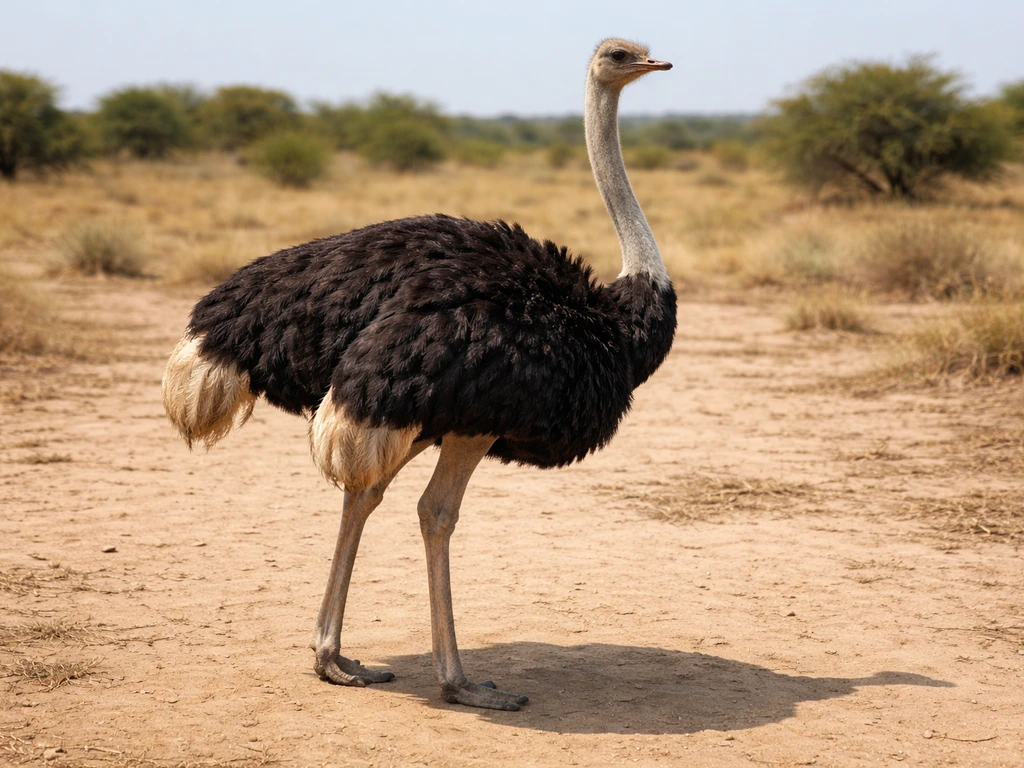
If you want the single heaviest bird alive today, the ostrich is the answer and it is not particularly close. Adult males average around 100 to 130 kg, with exceptional individuals reaching 156 kg. After the ostrich, the next tier of genuinely massive birds includes the following.
| Bird | Typical adult mass | Key note |
|---|---|---|
| Common ostrich (Struthio camelus) | 63–130 kg (up to 156 kg) | Heaviest living bird; flightless |
| Southern cassowary (Casuarius casuarius) | 58–76 kg | Second heaviest; flightless |
| Emu (Dromaius novaehollandiae) | 30–60 kg | Third heaviest; flightless |
| Emperor penguin (Aptenodytes forsteri) | 22–45 kg | Heaviest flying-capable lineage (though penguins don't fly); enormous fat reserves before fasting |
| Mute swan (Cygnus olor) | 7–15 kg | Heaviest flying bird in many regions |
| Kori bustard (Ardeotis kori) | up to 19 kg | Often cited as heaviest flying bird by max recorded weight |
| Great white pelican (Pelecanus onocrotalus) | up to 15 kg | Among heaviest regularly flying birds |
The kori bustard and the great bustard (Otis tarda) of Europe and Central Asia compete for the title of heaviest flying bird, with exceptional males of both species recorded above 18 kg. Swans and large pelicans are not far behind. Worth noting: if you are curious about how large birds get generally, the picture changes significantly when you look at extinct species, where giant teratorns and the elephant bird Aepyornis maximus would dwarf even the ostrich.
Birds with the highest fat reserves: the real "fattest" contenders
This is where things get genuinely fascinating. Bird spiders live in forests and other wooded habitats, where they can find suitable hiding spots among leaf litter and vegetation where do bird spiders live. Some birds load up on fat to a degree that seems almost cartoonish compared to their normal lean weight. Bird-eating spiders also vary dramatically by species, so a size comparison helps put their scale into context bird-eating spider size comparison. The three most striking examples involve migratory birds, penguins fasting through breeding, and a strange tropical bird called the oilbird.
Migratory songbirds and shorebirds
Small migratory birds like the blackpoll warbler (Setophaga striata) and the bar-tailed godwit (Limosa lapponica) are probably the champions of fat loading by proportion. A blackpoll warbler heading out over the Atlantic Ocean in autumn can nearly double its body mass through fat deposition before departure, going from roughly 11 g to over 20 g. That fat is essentially pure flight fuel. The godwit is even more dramatic in absolute terms: before its non-stop transoceanic migration from Alaska to New Zealand (roughly 12,000 km), it shrinks its digestive organs and packs on enough fat that fat can represent over 50 percent of its total body mass. For a bird the size of a large pigeon, that is a staggering physiological feat.
Emperor penguins fasting through winter

Emperor penguins arrive at their Antarctic breeding colonies in autumn in peak condition, having spent months feeding at sea. Males then fast for up to 115 days through the polar winter while incubating eggs, surviving entirely on fat reserves. At the start of that fast, a male emperor penguin can carry several kilograms of subcutaneous and visceral fat. By the end, it has lost around 40 percent of its body weight. In absolute terms, that represents one of the largest fat reserves of any bird species.
The oilbird chick: almost too fat to fly
The oilbird (Steatornis caripensis), a cave-nesting species from South America and Trinidad, has one of the most extraordinary fat-loading strategies in the bird world. Its chicks are fed a diet of oily palm fruits and can grow to 150 to 200 percent of adult body weight before fledging. Indigenous and colonial peoples historically harvested these chicks specifically for their fat, which was rendered into cooking oil and lamp fuel, hence the name. At peak mass, an oilbird chick's fat content by proportion rivals anything else in the avian world. This is not seasonal migration preparation; it is a developmental quirk of the species' unique ecology.
Waterfowl before long migrations
Ducks, geese, and swans that undertake long migrations also accumulate significant subcutaneous fat, and large-bodied species like the greater white-fronted goose or the Canada goose can carry hundreds of grams of fat prior to migration. In absolute terms this approaches the fat loads seen in larger penguin species, though as a proportion of body mass it typically does not match the extremes seen in shorebirds or oilbird chicks.
How to verify this yourself
If you want to fact-check any of these numbers, here are the most reliable places to look and a few traps to avoid along the way.
- The Handbook of the Birds of the World (HBW Alive / Birds of the World from Cornell Lab) contains verified mass ranges for most species, usually drawn from multiple studies. This is the single best starting point for comparing body mass across species.
- The Dunning Body Masses of Birds of the World database (often cited as Dunning 2008) is the standard reference for avian mass data and is widely cited in peer-reviewed literature.
- For fat reserves specifically, search Google Scholar or PubMed for terms like 'subcutaneous fat deposition [species name]' or 'pre-migratory fattening.' Studies by researchers like Theunis Piersma on godwit physiology are particularly detailed.
- The USGS fat scoring literature is useful for understanding how field fat estimates are made and where their limits lie. Knowing those limits helps you read banding study data critically.
- Avoid Wikipedia species pages as a primary source for mass data: they often cite single extreme records rather than typical adult ranges, which can make a species look far larger or heavier than it actually is on average.
The most common trap is conflating 'largest bird' with 'fattest bird.' Ostriches are the heaviest, but they are not particularly fat animals. The second trap is ignoring seasonality: a bird measured outside its peak fattening window will look lean even if it is a species known for extreme fat loading. Timing matters enormously. A blackpoll warbler weighed in July looks nothing like one weighed in October just before departure.
How to think about bird fatness going forward
Bird fat is not static, decorative weight. Web-building is mainly associated with spiders, not birds, and there is no solid evidence that any bird-eating group of animals builds webs to catch prey. It is a dynamic energy reserve tied directly to survival and reproduction. A bird's fat level at any given moment is shaped by its migratory schedule, breeding stage, food availability, predation pressure, and metabolic demands of thermoregulation. Understanding that makes the original question more interesting, not less. In the same way that fatness depends on definition, you can also ask how big can goliath bird eaters get if you mean total size rather than “fattest” in the bird sense. The answer is not a single species: it is a spectrum of biological strategies.
Think of it this way. Body mass is roughly equivalent to how big a bird is. Fat percentage is how much fuel it is currently carrying. And fat reserves are the absolute quantity of energy stored. A huge bird can have modest fat percentage. A tiny warbler can be more than half fat by weight for a few weeks each autumn. The oilbird chick is briefly the most absurdly fat bird alive by proportion. The emperor penguin carries more absolute fat by mass than almost anything else that flies (or at least, whose ancestors flew). And the ostrich is just genuinely enormous, mostly because of muscle and structural mass, not adipose tissue.
If you have been exploring questions about bird body size more broadly, the way fat interacts with overall body proportions also connects to how flight mechanics constrain bird size, and why the largest flying birds cluster around the 15 to 20 kg range. Beyond that threshold, the power requirements for lift generally exceed what even the most efficient avian flight muscles can sustain. That boundary explains why the truly massive birds (ostriches, emus, cassowaries, penguins) all abandoned flight at some point in their evolutionary history.
Bottom line: if someone asks you which bird is the fattest, ask them back which definition they mean. If you are also wondering how big is a finch bird, that is the related body-size angle, but it is a different question from which species is fattest by proportion or reserves. For total body mass, say ostrich. For highest fat proportion at peak season, say bar-tailed godwit or blackpoll warbler. As a separate, very different example, goliath bird-eating spider questions often come down to a specific count of eyes. For the most surprisingly over-fed individual, say oilbird chick. All three answers are defensible, and all three come from genuinely interesting biology. If you want to compare bird sizes beyond fatness, you can also look at how big can a bird get in terms of overall mass and wingspan.
FAQ
Does the fattest bird depend on the time of year I measure it?
If you mean fatness “right now,” the answer is season dependent. A species that looks lean outside its peak feeding or pre-migration window can be among the fattest shortly before departure, and some birds also change fat differently during breeding versus non-breeding periods.
Why can a heavier bird still be less “fat” than a smaller one?
Not reliably. Total mass is strongly influenced by hydration, gut fill, breeding condition, and daily energy balance. Two birds with identical fat stores can have different weights, so a “heavier” bird is not automatically “fatter” unless fat-free structural size and fat proportion are accounted for.
Do birds ever change their body composition, not just add fat?
Yes, for small birds in particular. For example, when warblers or other small migrants fatten up, their digestive organs can shrink and metabolic priorities shift, so the measured increase in mass can reflect a much larger fraction of stored fuel than it does in large birds.
How do I interpret fat-score rankings if different researchers measured them?
For field work, fat scoring is most comparable when the same observer uses the same method and scoring rubric. If multiple labs or scorers are involved, the rankings can shift because visual scoring can underestimate or overestimate fat in different individuals.
What measurement type should I look for when comparing “fattest” claims?
Watch for whether a source is reporting fat as a percentage of body mass, a proportion of fat-free mass, or an absolute fat mass in grams or kilograms. Those measures can point to different “fattest” winners, especially when comparing small shorebirds or warblers to huge flightless birds.
Is the fattest bird the same as the heaviest flying bird?
“Fattest” can also be confused with “heaviest living flying bird.” A small high-fat migrator can be fat-proportion champions, while the heaviest flying birds are defined by total body mass, so the top answers will often differ.
Can lab-based fat measurements from dead birds tell the full story?
Carcass or museum-based chemical analyses tend to give the most accurate fat estimates, but they cannot show how fat levels change day to day or during an entire migration. If you only have dead-specimen data, you may miss peak fattening moments or underestimate seasonal highs.
For fasting birds like penguins, which point in the fast should count for “fattest”?
Yes. Some birds fast for long periods and rely heavily on stored fat, so “fattest” by proportion can occur right before fasting, while “most absolute fat remaining” might occur earlier or later depending on the species’ timeline. The relevant comparison point is the start versus end of the fast.
Can I use photos or body “roundness” to guess which bird is fattest?
If you plan to estimate fatness from photographs, avoid ranking by body shape alone. Plumage can hide or exaggerate fat deposits, and posture, feather condition, and lighting can change how bulging appears compared with the more standardized scoring approach.
Next Article
Where Do Bird Spiders Live? Habitat and Range Guide
Learn where bird-eating tarantula-like spiders live, from forests to deserts, including habitat, shelter, and regions.