
Goliath bird-eater spiders (Theraphosa blondi) can reach a legspan of up to about 28–30 cm (roughly 11–12 inches) tip to tip, a body length of around 12–13 cm, and a live mass of up to approximately 170–175 grams. Those are the figures you'll see cited most often, and they come from real measured specimens. The heaviest reliably documented individual weighed around 170 g, and the longest legspan on record is 28 cm, documented by Guinness World Records from two separate sources. To put that in perspective: this is a spider roughly the diameter of a dinner plate, and it is, by mass, the heaviest spider on Earth. For a quick size comparison, see how big is a finch bird to compare the spider's mass and span with a small passerine.
How Big Can Goliath Bird-Eaters Get: Size, Records & Reasons

Marcus Chen
12 Jul 2026
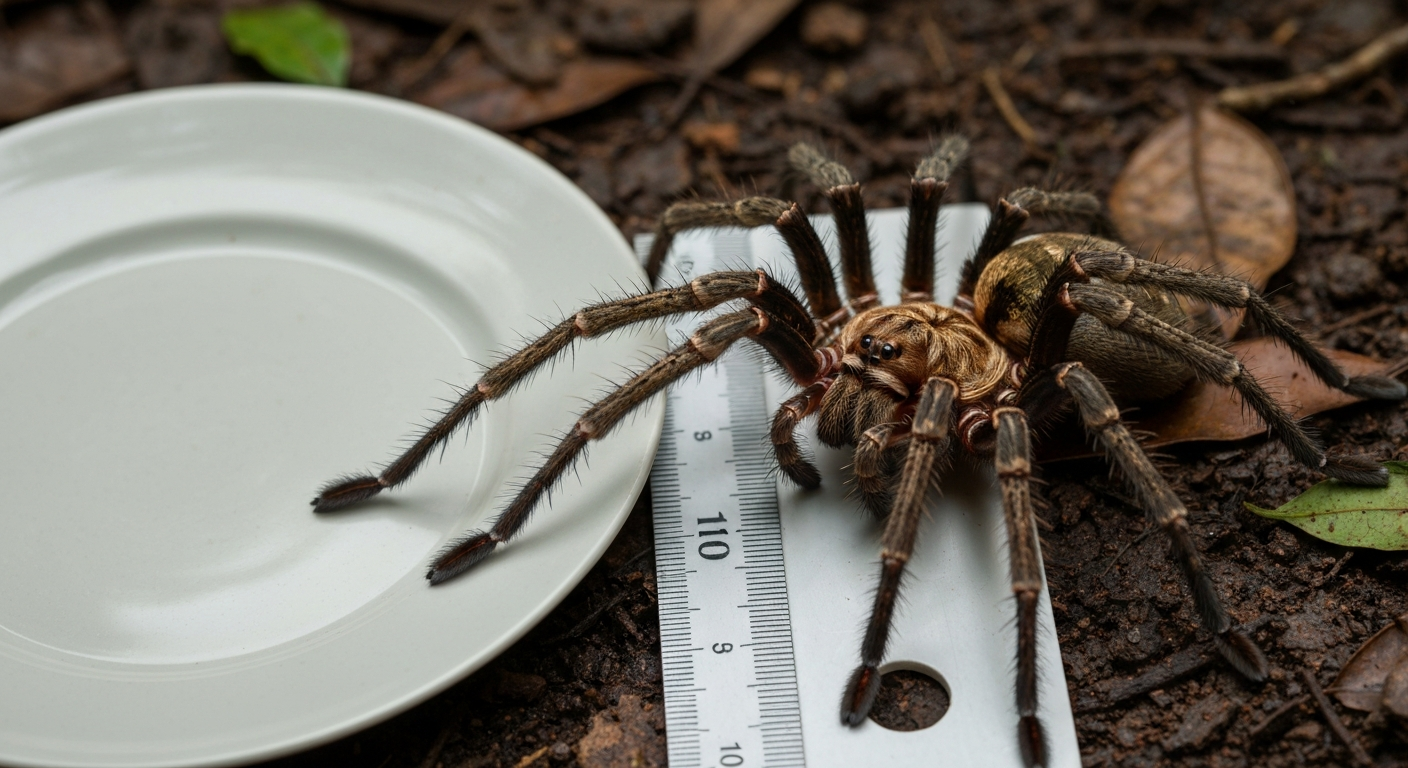
Typical size ranges at a glance
If you want the quick numbers without the caveats (though the caveats do matter, and I'll get to them), here is what the evidence supports for adult Theraphosa blondi.
| Measurement | Typical adult range | Maximum recorded |
|---|---|---|
| Body length (prosoma + opisthosoma) | 9–12 cm | ~13 cm |
| Legspan (diagonal, tip to tip) | 20–26 cm | 28 cm |
| Live mass | 70–150 g (female) | ~175 g |
The 28 cm legspan figure appears twice in Guinness World Records documentation: once from a wild specimen collected during the Pablo San Martín Expedition at Río Cavro, Venezuela, in April 1965, and once from a captive individual nicknamed 'Rosi,' bred by Robert Bustard and reared by Brian Burnett, measured in February 1998 at 28 cm and 170 g. Mass figures above 170 g are sometimes cited (up to ~175 g) in secondary natural history sources, but the original measurement context for those figures is less precisely documented, so treat them as approximate upper bounds rather than confirmed records.
How scientists actually measure spider size
This is genuinely one of the first things I had to look up, because 'size' for a spider is not a single number and the way you measure it changes the result significantly. Arachnologists use three main metrics, and they mean different things.
- Body length: the combined length of the prosoma (the fused head and thorax, called the cephalothorax) plus the opisthosoma (the abdomen). Measured in millimetres on a preserved or freshly dead specimen, usually with digital vernier calipers. This is the standard for formal taxonomic descriptions.
- Legspan: the distance from the tip of a front leg on one side to the tip of the opposite rear leg on the other side, measured diagonally. Commonly called 'diagonal leg span' (DLS). This is the number most people mean when they say how 'big' a tarantula is.
- Mass: live weight in grams, ideally measured before preservation. Preserved specimens stored in ethanol lose fluid over time, making later mass measurements unreliable. This is why formal taxonomic papers usually report only linear measurements, not mass.
There is an important wrinkle here: taxonomists working with museum specimens tend to measure body length on preserved material in millimetres, while hobbyists and breeders typically report legspan on live animals or a freshly shed molt (the exoskeleton shed during growth). Peer‑reviewed species description (method notes showing preserved specimens and mm measurements) notes that museum specimens are typically fixed/stored in ethanol and that taxonomic measurements report linear dimensions in millimetres because fixation and dehydration alter mass and can make later mass measurements unreliable. These conventions are not directly comparable. A breeder measuring a live spider diagonally can produce a larger-sounding number than a taxonomist measuring body length on a pinned specimen. When you read a record size claim, it is worth asking which method was used.
Growth from spiderling to adult: what to expect at each stage
Theraphosa blondi grows slowly by most invertebrate standards. Spiderlings hatch at a few millimetres in body length and spend the first weeks of life in the egg sac before their first molt. From that point, each molt (called ecdysis, the shedding of the exoskeleton) produces a measurable size increase. Published life-history data on wild T. blondi are genuinely scarce in the peer-reviewed literature, so much of what we know about captive growth comes from breeders and husbandry accounts rather than controlled studies. With that caveat stated, the general trajectory looks something like this.
| Approximate age | Approximate legspan | Notes |
|---|---|---|
| 0–3 months (spiderling) | 1–2 cm | Just post-egg sac; fragile, rarely eats immediately |
| 3–12 months (juvenile) | 3–6 cm | Molting every 1–2 months in good conditions |
| 1–2 years (subadult) | 8–15 cm | Growth slowing; sex often determinable by examining molts |
| 3–4 years (young adult female) | 18–22 cm | Approaching reproductive size; continues growing |
| 5+ years (mature female) | 22–28 cm | Maximum size range; females continue molting indefinitely |
| 3–4 years (mature male) | 16–20 cm | Reaches sexual maturity; stops growing after ultimate molt |
The timelines above are approximations and vary considerably with temperature, humidity, and feeding frequency. In well-maintained captive conditions with regular feeding, growth tends to be faster than in wild animals that experience prey scarcity and seasonal temperature variation. The broader pattern, multi-year development with incremental size gains at each molt, is consistent across the Theraphosidae family (the family all tarantulas belong to).
Maximum recorded sizes and how to read record claims
The 28 cm legspan figure is as solid as it gets for this species, backed by two independent documented measurements. The ~175 g mass figure circulates widely in popular science summaries, but the precise original source for that specific number is harder to trace than the Guinness records, so I treat it as a reasonable upper-bound estimate rather than a confirmed single-specimen measurement. Record claims in general deserve a bit of skepticism for a few reasons.
- Measurement method matters: a live spider measured at maximum leg extension diagonally will produce a larger number than the same spider measured as a preserved specimen with legs folded naturally.
- Preserved specimens lose mass over time in ethanol, so a museum jar weight is not a reliable live mass.
- Hobbyist records often lack the verification infrastructure of scientific records, meaning the largest 'home-kept' specimens may be anecdotally reported rather than independently confirmed.
- Body condition affects mass significantly: a freshly fed spider with a full opisthosoma can weigh noticeably more than the same individual after a prolonged fast.
The broader popular figure of '30 cm legspan' that appears in some sources is likely a rounded-up version of the 28 cm record, or possibly reflects uncalibrated measurements from live specimens. Until a new verified record emerges, 28 cm remains the best-documented maximum legspan for T. blondi.
Males vs. females: a meaningful size difference
Theraphosa blondi shows clear sexual size dimorphism, meaning males and females differ noticeably in size. Females are substantially larger and heavier, and this pattern is common across tarantula species. The biological driver is partly life history: female tarantulas continue to molt (and therefore grow) throughout their adult lives, while males stop molting permanently after their 'ultimate molt,' the final shed that marks sexual maturity. After that point a male's body is fixed at whatever size it reached. Males also have a much shorter post-maturity lifespan, typically months rather than years, so they simply have less time to accumulate mass.
| Trait | Female | Male |
|---|---|---|
| Adult legspan | 22–28 cm (up to record 28 cm) | 16–20 cm typical |
| Adult body mass | 100–175 g | 30–60 g typical |
| Post-maturity molting | Yes, continues throughout life | No, growth stops after ultimate molt |
| Lifespan (captive) | 15–25+ years reported | 3–6 years post-maturity |
| Tibial hooks (mating spurs) | Absent | Present on front legs |
When you encounter size claims for T. blondi without a sex specified, assume the figure refers to a female. Records and maximum size statements almost always reflect females, because males simply do not reach equivalent dimensions.
Molting: the engine of growth
Spiders, like all arthropods, grow by periodically shedding their exoskeleton in a process called ecdysis (from the Greek for 'stripping off'). The rigid exoskeleton cannot expand incrementally the way vertebrate bone does, so the spider must break out of its old shell, expand its soft new body before it hardens, and then wait for the new exoskeleton to sclerotize (harden and darken). During and immediately after a molt, a tarantula is extremely vulnerable because it has no structural protection. The new exoskeleton is initially pale and soft.
Each molt cycle produces a size increment that depends on age and nutritional state: young, well-fed spiderlings may molt every few weeks, while large adult females may go a year or more between molts. A spider that is underfed or in poor health may produce a smaller size increase at molting, or in severe cases may fail to molt successfully (called a 'bad molt' or dysecdysis). Conversely, a well-nourished adult female in optimal conditions will continue adding small amounts of legspan and mass at each molt, which is why the largest recorded individuals are almost always older captive females with consistent care.
One practical note: the shed exoskeleton (called a 'molt' or 'exuvia') is often used by hobbyists and breeders to measure legspan without stressing the live animal. A freshly shed molt can be gently spread out and measured. This is an accepted if informal measurement method, and it is likely the source of many of the legspan figures cited in the hobby literature.
Diet, feeding, and how nutrition shapes size
Despite the dramatic common name, Goliath bird-eaters do not regularly eat birds. For related details on anatomy and vision, see how many eyes does a Goliath bird eating spider have. If you're curious about large birds and which species ranks as the fattest, see what is the fattest bird. The name traces back to a historical naturalist engraving showing a tarantula consuming a hummingbird, which made for compelling illustration but does not reflect everyday feeding behavior. In the wild, T. blondi is a nocturnal ambush predator whose typical prey consists of large invertebrates, toads, small lizards, and occasionally small rodents. Avian predation appears to be an opportunistic rarity rather than a dietary staple.
Diet quality and feeding frequency are among the most controllable variables affecting maximum size in captivity. A spider with consistent access to nutritionally adequate prey will reach larger adult dimensions than one experiencing irregular or nutritionally poor feeding. In the wild, prey availability fluctuates seasonally in the Amazonian and Guianan rainforest habitats where T. blondi lives, and this almost certainly produces more variable individual sizes than what is seen in well-managed captive populations. The heaviest reliably documented individual (the captive 'Rosi' at 170 g) reflects the upper end of what consistent captive nutrition can produce.
There is also a physiological ceiling on size that diet alone cannot overcome. Spiders breathe through structures called book lungs (paired, leaf-like respiratory organs in the opisthosoma) and in some species supplementary tracheal tubes. As body mass increases, the respiratory surface area available to supply oxygen becomes a limiting factor. Comparative reviews document that respiratory surface area (book lungs and tracheal branching) scales with body mass in spiders, creating diffusion-based constraints on maximum attainable spider size (Frontiers in Physiology, Adaptation of the spiders to the environment: the case of some Chilean species) respiratory surface area (book lungs/tracheal branching) scales with body mass in spiders. This is one reason why spiders do not reach the dimensions of, say, a large mammal or even a large bird: the diffusion-based respiratory system has scaling constraints that body size cannot escape indefinitely. This is a genuine biological size limit, not just a practical one.
Where Goliath bird-eaters live and why habitat caps size
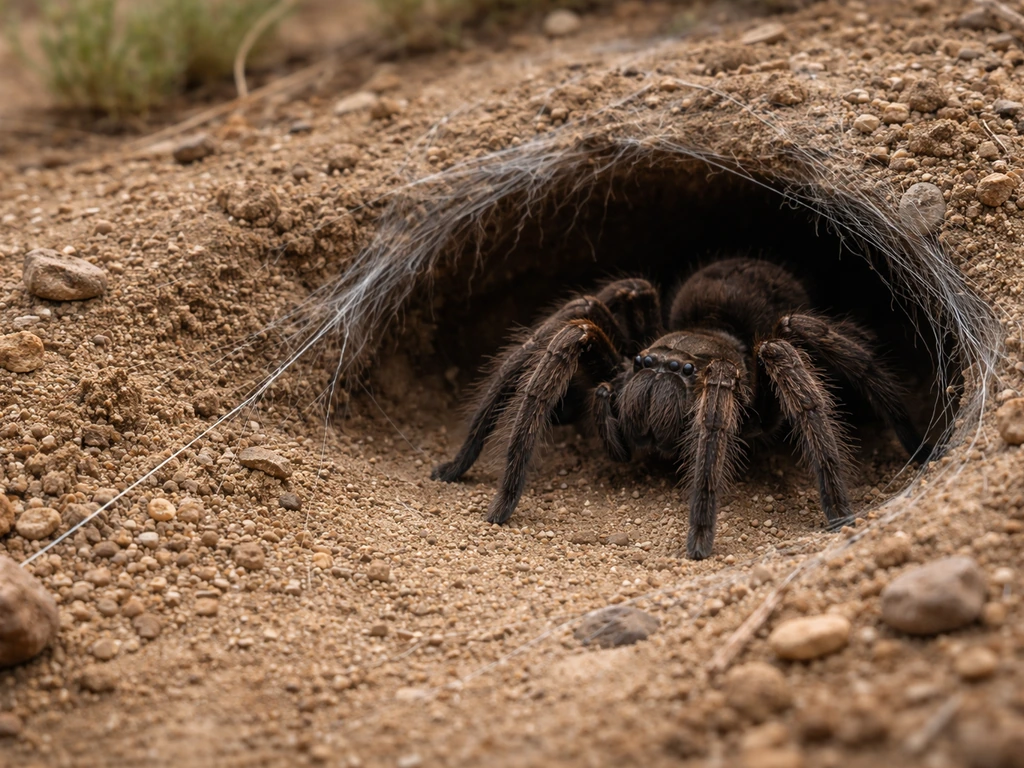
Theraphosa blondi has a confirmed distribution across northern South America: Suriname, Guyana, French Guiana, Venezuela, and the northern Amazon basin of Brazil. If you want a quick answer to where do bird spiders live, see the section on Goliath bird-eaters' Amazonian and Guianan rainforest distribution. Occurrence records in museum collections and biodiversity databases support this range, concentrated in lowland tropical rainforest. The species is terrestrial and nocturnal, spending daylight hours inside silk-lined burrows in moist forest floor substrate. It does not build aerial prey-catching webs; the silk lines the burrow and retreat rather than forming a web structure designed to intercept flying prey. Do Goliath bird-eaters make webs? No, they use silk to line and reinforce burrows and retreats rather than constructing aerial prey‑catching webs.
The warm, humid, stable climate of tropical rainforest is important for maximum size attainment. Consistent temperatures (roughly 24–28°C) and high humidity support year-round activity and feeding, which in turn supports consistent molting cycles. Individuals at the edges of the range or in areas with more pronounced dry seasons likely experience growth interruptions that limit maximum adult size. In regions where prey biomass is lower, individuals may be smaller on average even if the genetic potential for large size is present.
Burrow depth and substrate availability also play a role in individual ecology: T. blondi excavates or modifies existing burrows in soft, moist earth, and the size of an available burrow may influence how large an individual grows before being forced to relocate. These are the kinds of microhabitat constraints that are difficult to quantify without long-term field data, and honest natural history writing has to acknowledge that specific wild growth data for this species are thin. Most of what we know about maximum sizes comes from captive animals and a handful of expedition-collected specimens.
How T. blondi compares to other large spiders
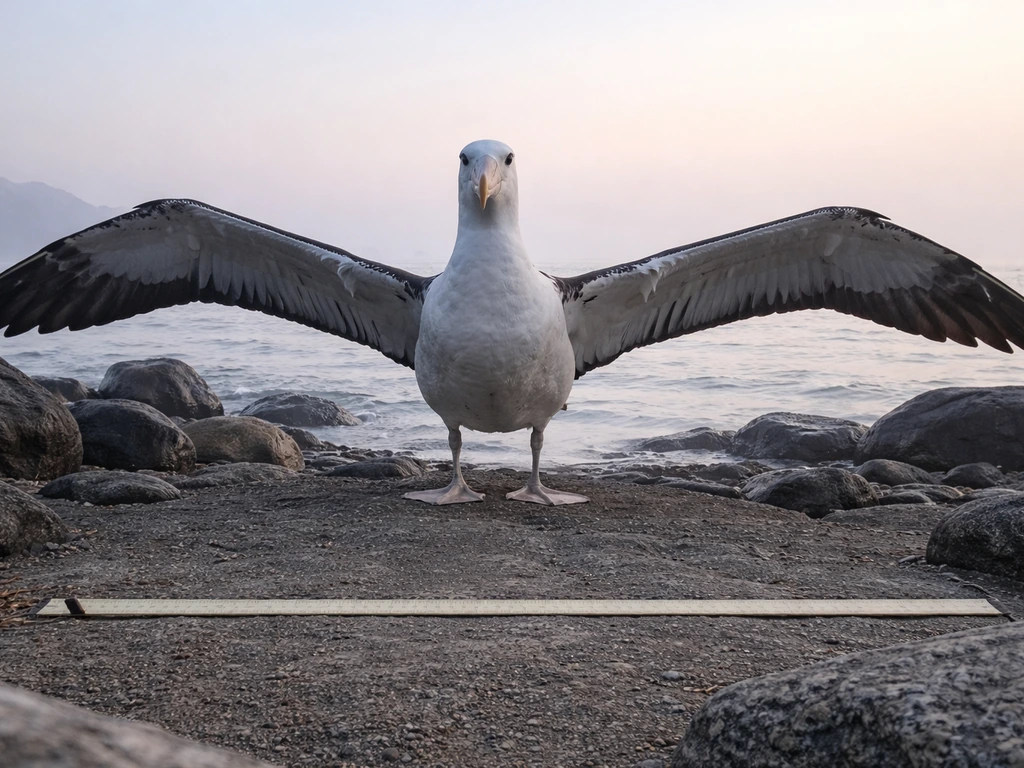
Theraphosa blondi holds the title of heaviest spider by mass, but the legspan record is contested. The giant huntsman spider (Heteropoda maxima) from Laos holds the legspan record at around 30 cm, though it is a much lighter, flatter spider with long slender legs rather than the stocky build of T. blondi. The comparison matters because 'largest spider' depends entirely on which measurement you use: mass, body length, or legspan give you different winners. For a sense of how size comparisons differ across animal groups, see how big can a bird get for analogous measurements and context in birds.
| Species | Max legspan | Max mass | Primary claim to 'largest' |
|---|---|---|---|
| Theraphosa blondi (Goliath birdeater) | ~28 cm | ~175 g | Heaviest spider by mass |
| Heteropoda maxima (giant huntsman) | ~30 cm | ~10–15 g | Longest legspan |
| Theraphosa stirmi (Burgundy birdeater) | ~26 cm | ~100–150 g | Close rival to T. blondi by mass |
| Lasiodora parahybana (salmon pink birdeater) | ~25–27 cm | ~100 g | Frequently cited rival in size comparisons |
Within the Theraphosa genus itself, T. stirmi and T. apophysis are closely related species sometimes called 'birdeaters' as well, and they approach but do not clearly exceed T. blondi in mass under documented conditions. When you see discussions about bird-eating spider size comparisons, the metric being used is usually the deciding factor in which species 'wins.'
A few things scientists still aren't sure about
I want to be honest about the gaps here, because this species is surprisingly under-studied in the wild given how famous it is. Quantified wild growth curves for T. blondi do not exist in published peer-reviewed literature in the way they do for, say, a well-studied bird or mammal species. The life-history data that do exist come largely from captive husbandry records and a small number of field natural history observations. The largest reliably documented legspan is 28 cm, but whether wild individuals exceed this routinely or rarely is unknown. The upper mass limit of the species under ideal wild conditions is also not precisely established, and different secondary sources report slightly different figures (170 g vs. 175 g) without always tracing back to a single original measurement.
What is well established is the general size class: T. blondi is genuinely extraordinary in the context of spiders, reaching masses and dimensions that are biologically unusual for an arthropod relying on book lungs for respiration. The constraints that prevent it from getting even larger are real physiological limits, not arbitrary ones, and understanding those limits is part of what makes the biology of large invertebrates genuinely interesting.
FAQ
How big can Goliath bird‑eater spiders (Theraphosa blondi) get?
Theraphosa blondi is among the largest spiders. Typical adult body length (combined prosoma + opisthosoma) is roughly 50–120 mm (5–12 cm), diagonal leg‑span commonly reported for large adults is about 200–300 mm (20–30 cm), and live mass values cited for very large individuals range up to ~150–175 g. These values are ranges from field reports, breeder records and published summaries; precise numbers depend on how size is measured and the specimen’s condition.
What are the maximum recorded measurements for T. blondi?
Published and widely cited maxima include a leg‑span of about 28 cm (recorded in historical/collector accounts and noted by Guinness World Records) and reported live masses approaching 170–175 g for exceptionally large captive specimens. Body‑length maxima reported in secondary sources are around 120–130 mm. Museum specimens and taxonomic papers usually report linear body measurements in millimetres rather than live mass.
How do scientists measure spider size (body length, leg‑span, mass)?
Taxonomists typically measure body length (prosoma + opisthosoma) in millimetres with calipers on preserved specimens and report leg segment totals (femur+patella+tibia+metatarsus+tarsus) or individual segment lengths. Hobbyists and many breeders commonly report diagonal leg‑span (tip of a front leg to tip of the opposite hind leg) on a live specimen or a shed molt. Live mass is measured with a scale but is rarely reported in taxonomic descriptions because preservation changes mass; methods should always be stated to make measurements comparable.
Why do measurements vary between sources?
Variation arises from (1) different metrics (body length vs. diagonal leg‑span vs. summed segment lengths), (2) whether measurements are taken on live animals, preserved specimens, or molted exuviae, (3) sexual dimorphism and individual condition (fed vs. starved, gravid females), and (4) inconsistent measurement technique among hobbyists versus scientists. Preservation and dehydration affect mass more than linear measures, so mass values from preserved specimens are unreliable unless recorded alive.
What biological factors determine how large a Goliath bird‑eater can grow?
Key biological determinants are age (they grow by molting; size increases with successive molts), sex (females of many theraphosids reach larger adult body masses and greater longevity), nutrition (quality and quantity of food during juvenile stages), molting frequency and success, genetic potential, and health (parasites/disease). Environmental factors such as temperature, humidity and habitat resource availability also influence growth rate and final size.
How do environmental factors (diet, habitat, captivity) affect growth?
Diet: abundant, protein‑rich prey accelerates growth and increases adult size. Habitat: stable, resource‑rich tropical forest habitats support larger individuals. Captivity: controlled temperatures, regular feeding and low predation can produce faster growth and larger captive specimens than many wild conspecifics; however, husbandry stress or poor care can stunt growth. Molting success and microclimate during development strongly influence outcomes.
Next Articles
Do Goliath Bird-Eaters Make Webs? How to Spot Silk
Yes. Goliath bird-eaters use silk for burrows and traplines, not orb webs. Spot lining, retreats, and silk cues.
How Big Can a Bird Get? Largest Birds by Weight and Wingspan
Largest living birds by weight and wingspan with sizes in meters and facts on anatomy limits and flightless giants.
What Is the Fattest Bird? Mass and Fat Explained
Definitive answer to what is the fattest bird by mass vs fat percentage, with top candidates and how to verify.