
Title: Bird-Eating Spider Size Comparison: How Big Are They Next to Real Birds? Meta description: How does a Goliath birdeater's 30 cm legspan compare to actual birds? We break down the numbers from bee hummingbirds to ostriches.
Bird-Eating Spider Size Comparison: Goliath vs Birds Guide

Marcus Chen
13 Jul 2026
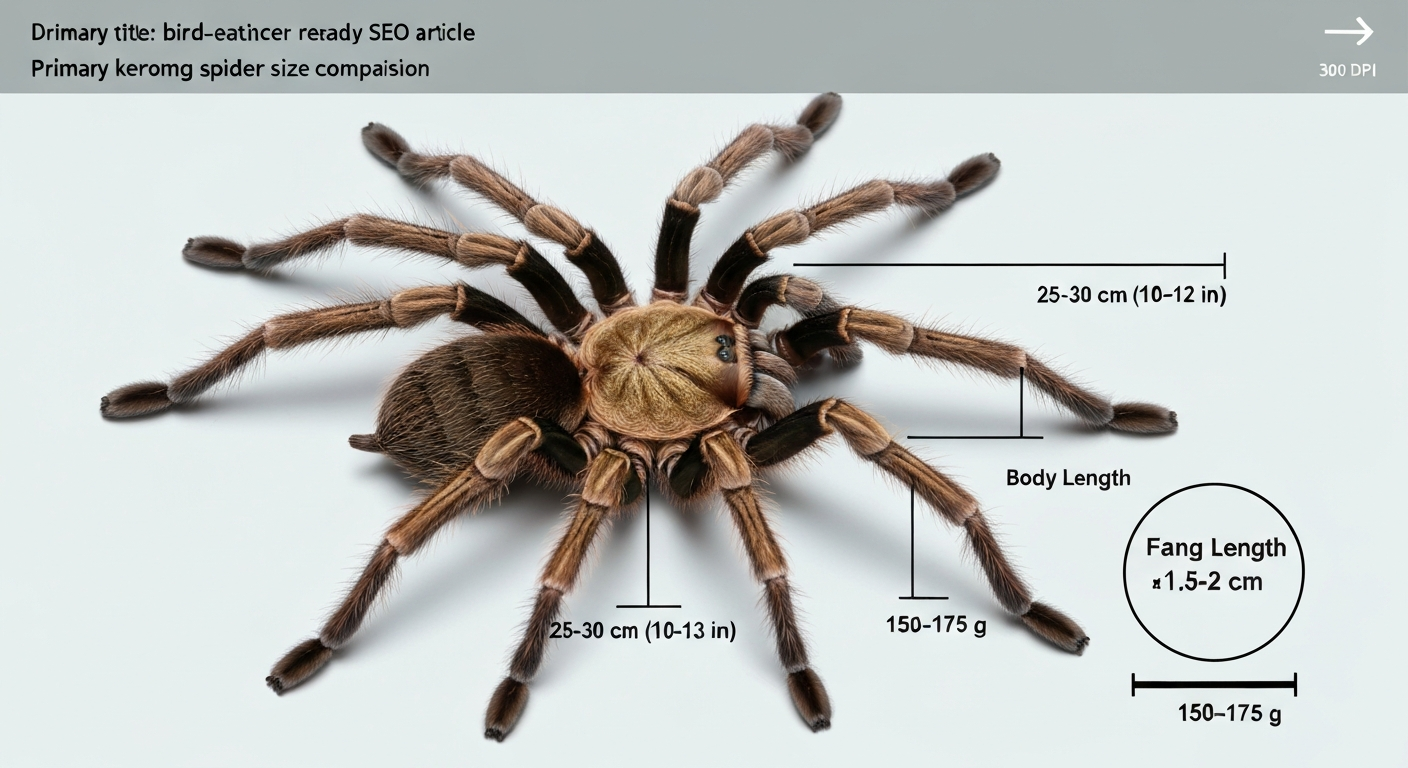
The Goliath birdeater (Theraphosa blondi) can reach a legspan of around 25 to 30 cm (roughly 10 to 12 inches) and weigh up to about 170 to 175 grams. That puts it larger than a sparrow and roughly in the same weight class as a small songbird. But here is the part that surprised me when I first looked into it: the spider's body length (head to rear, not counting legs) tops out around 13 cm, which means most of its intimidating size is legs. Actual bird-eating happens far less often than the name suggests, and the biology behind why is genuinely interesting.
Why I started comparing spider and bird sizes
I got curious about this after someone asked me whether a Goliath birdeater could actually carry off a hummingbird. The short version is: maybe a nestling, very rarely, under the right conditions. The longer version requires understanding what the measurements actually mean and where birds fit on the size spectrum. So let me walk through the numbers properly, because there is a lot of imprecise information floating around on this topic.
How spider and bird sizes are actually measured
Before comparing numbers, it helps to know what the numbers mean, because spiders and birds are measured in completely different ways and the conventions are not always spelled out clearly.
Spider measurement conventions
Arachnologists use three main metrics. Carapace length (CL) is the most reproducible: it runs from the front edge of the hard carapace to its rear margin, measured in millimeters with calipers or under a stereomicroscope. Total body length (BL) adds the abdomen (opisthosoma) to the carapace (prosoma), but because the abdomen is soft tissue, it can expand or contract depending on hydration, feeding state, and whether the specimen is preserved. That is why taxonomic papers often emphasize carapace length and individual leg-segment lengths rather than total body length alone.
Legspan is the metric most people recognize, but it is not formally standardized. It is measured tip-to-tip across fully extended legs, usually from the front leg on one side to the front or rear leg on the other, and the method varies by author. Scientific papers tend to publish individual leg-segment lengths (femur, patella, tibia, metatarsus, tarsus) so other researchers can reproduce the figures. The legspan number you see in popular sources is a calculated or estimated total, and it can vary depending on exactly how the measurement was made.
Bird measurement conventions
Birds are measured by total length (bill tip to tail tip, or sometimes top of head to tail tip depending on the family), wingspan (the natural spread of fully extended wings, measured chord to chord), and live mass in grams or kilograms. The Handbook of Bird Biology and Cornell Lab's Birds of the World use these conventions, and values can shift seasonally, especially for mass, because birds gain and lose weight dramatically around breeding and migration. When you see a bird's mass listed as a range, both ends of that range can be real for the same species.
Unit conversions at a glance
- 1 cm = 10 mm = 0.39 inches
- 1 inch = 2.54 cm = 25.4 mm
- 30 cm = 300 mm = about 11.8 inches
- 100 g = 0.1 kg = about 3.5 oz
- 175 g = 0.175 kg = about 6.2 oz
The Goliath birdeater's actual measurements
Theraphosa blondi is widely recognized as the world's heaviest spider by mass, and it genuinely earns that title. Here are the numbers as they appear in curated morphometric datasets, museum specimen records, and the major species summaries:
- Typical adult legspan: 25 to 28 cm (approximately 10 to 11 inches)
- Reported maximum legspan: around 30 cm (close to 12 inches), though extreme values come from a small number of specimens and should be treated with some caution
- Body length (carapace + abdomen): commonly 10 to 13 cm; figures above 13 cm in popular sources are often from captive individuals whose abdomens are distended by feeding
- Body mass: commonly 150 to 175 g in large adults; some captive records approach 170 to 175 g, but captivity, diet, and hydration all inflate body mass relative to typical wild adults
- Fang length: approximately 1.5 to 2 cm, which matters for understanding how deeply a spider could bite into prey
Theraphosa also includes two related species: T. stirmi and T. apophysis. T. stirmi is sometimes cited as comparable in legspan to T. blondi, and both are found in the Amazonian regions of Venezuela, Brazil, Guyana, and neighboring countries. Museum collections at institutions like the Natural History Museum in London hold specimen-level records that can corroborate extreme measurements, which is worth knowing because some online claims are not traceable to verified specimens. The Natural History Museum (NHMUK) specimen record, Theraphosa blondi (collection accession metadata) provides catalog numbers, collection locality, date, and measured morphometrics for a verified Theraphosa blondi specimen to corroborate extreme values Natural History Museum (NHMUK) specimen record — Theraphosa blondi (collection accession metadata).
Bird sizes from smallest to largest
To make the comparison meaningful, here is a quick run through representative bird sizes across the full spectrum, using figures from Cornell Lab and HBW/BirdLife species accounts. These are typical adult ranges unless otherwise noted.
Bee hummingbird (Mellisuga helenae)
The bee hummingbird is the world's smallest bird. Total length is about 5 to 6 cm (roughly 2 inches). Mass is approximately 1.6 to 2 g. Wingspan runs around 6 cm. This is the one bird that genuinely is smaller than a large tarantula by every linear measure.
Common finches and small passerines
House Finch (Haemorhous mexicanus) and similar small passerines measure roughly 13 to 15 cm in length (5 to 6 inches) and weigh about 16 to 27 g. That makes them lighter than a Goliath birdeater by mass but longer in body length than the spider's body alone. House Sparrows run slightly lighter, around 24 to 32 g. Comparing finch sizes to the spider's dimensions is a useful reality check: the bird's body is actually comparable in length to the spider's torso, though the spider's total legspan still dwarfs the bird's profile. For more detail on typical finch dimensions, see how big is a finch bird.
Mid-sized passerines and corvids
American Robin (Turdus migratorius): about 23 to 28 cm long, 77 to 85 g. American Crow (Corvus brachyrhynchos): 40 to 53 cm long, 316 to 620 g, wingspan 85 to 100 cm. At this size range, a Goliath birdeater is dramatically outsized by mass and wingspan.
Raptors
Red-tailed Hawk (Buteo jamaicensis): 45 to 65 cm long, 690 to 1,460 g, wingspan 110 to 145 cm. Cooper's Hawk: 35 to 50 cm, 220 to 680 g. Even the lighter end of hawk masses puts them well above the spider's ~175 g maximum.
Large flighted birds
Wild Turkey (Meleagris gallopavo): 76 to 125 cm long, 2.5 to 11 kg. Mute Swan (Cygnus olor): wingspan up to about 238 cm, mass 6 to 14 kg. These birds are in a completely different league from any arthropod.
Ostrich (Struthio camelus)
The ostrich is the world's largest living bird. Standing height up to about 2.7 m (9 feet), mass 63 to 145 kg. For more on the world's heaviest bird and why the ostrich holds that title, see what is the fattest bird. A Goliath birdeater weighs roughly 0.1 to 0.2 percent of a large ostrich's body mass. The comparison is almost absurd, but it anchors just how wide the bird size spectrum really is. See our related guide on how big can a bird get for full details on bird size records and limits.
Size comparison table: Goliath birdeater vs birds
| Species | Body/Total Length | Mass | Wingspan or Legspan |
|---|---|---|---|
| Goliath birdeater (T. blondi) | 10–13 cm body | 150–175 g | 25–30 cm legspan |
| T. stirmi (close relative) | ~10–12 cm body | ~150–170 g | ~26–28 cm legspan |
| Bee Hummingbird | 5–6 cm | 1.6–2 g | ~6 cm wingspan |
| House Finch | 13–15 cm | 16–27 g | ~22–25 cm wingspan |
| House Sparrow | 14–16 cm | 24–32 g | ~19–25 cm wingspan |
| American Robin | 23–28 cm | 77–85 g | ~31–40 cm wingspan |
| American Crow | 40–53 cm | 316–620 g | 85–100 cm wingspan |
| Red-tailed Hawk | 45–65 cm | 690–1,460 g | 110–145 cm wingspan |
| Wild Turkey | 76–125 cm | 2,500–11,000 g | 130–180 cm wingspan |
| Ostrich | ~200–270 cm tall | 63,000–145,000 g | No flight wings |
Looking at this table, the Goliath birdeater's legspan (25 to 30 cm) is comparable to the wingspan of a small finch or sparrow, which is a striking coincidence. In terms of mass, the spider sits between a House Sparrow and an American Robin, heavier than most small passerines but lighter than any raptor.
What the name 'birdeater' actually means (and doesn't mean)
This one took me down a rabbit hole. The 'birdeater' name traces back to an 18th-century engraving by the naturalist Maria Sibylla Merian, which depicted a large spider eating a hummingbird. The image was influential, the name stuck, and it has been generating misconceptions ever since. Major reviews and species accounts consistently note that documented records of these spiders eating birds in the wild are exceptional and largely anecdotal. Their typical diet is invertebrates, with occasional small frogs, lizards, and rodents. Birds, when they appear as prey at all, are usually nestlings, not adult birds.
Why the size gap matters for predation
The comparison table above makes something clear: even a small passerine like a House Sparrow outweighs a Goliath birdeater by mass, despite the spider having a longer legspan. Adult birds are simply too large and too mobile for even the biggest tarantulas to reliably subdue. The spider's strategy is ambush from a burrow, and an adult bird's flight response makes that approach almost impossible to execute successfully.
Nestlings and eggs are a different story. Ground-nesting birds and open-cup nesters whose eggs or hatchlings are accessible at ground level face genuine, if rare, risk from large burrowing tarantulas. Nestlings lack feathers or have only sparse down, they cannot fly, and they are confined to a small space. A spider encountering a nest cup at the right stage of development has a realistic window. That is the ecological scenario that likely produced the original name, even if it happens far less often than the dramatic label implies.
Feeding mechanics: external digestion vs avian feeding
Spiders and birds feed in fundamentally different ways, and understanding that difference explains a lot about prey size limits. Spiders are external digesters: they immobilize prey with chelicerae (fangs) and inject venom, then pump digestive enzymes into the prey's body and drink the liquefied tissue. The Goliath birdeater's venom includes peptides with neuromuscular blocking activity, demonstrated in laboratory preparations using mouse tissue (Fontana et al. A recent review (Brazilian Theraphosidae: a toxicological point of view) summarizes theraphosid venom composition and cites Fontana et al. 2002 for neuromuscular‑blocking activity Brazilian Theraphosidae: a toxicological point of view (review citing Fontana et al. 2002 and venom composition) — PMC review. , 2002). That means the venom can genuinely affect vertebrate nervous systems, which is part of how a tarantula could subdue a small vertebrate. But the digestion process takes time, requires the prey to be held in place, and the spider physically cannot ingest solid bone or large masses of feathers.
Feathers compound this problem for the spider considerably. An adult bird's contour feathers interlock through a system of barbs and barbules (the tiny hook-and-groove structures you can feel when you press feather vanes together), creating a dense, layered surface that is genuinely difficult to bite through. A fang that is 1.5 to 2 cm long could theoretically penetrate feather layers, but reaching soft tissue in a bird with a full plumage coat requires navigating substantial mechanical resistance. Nestlings, which lack this protection, are far more accessible. This is not a hypothetical consideration: avian anatomy texts routinely note feather structure as a physical barrier against predators, and it applies to arthropod predators as much as to any others.
Birds, by contrast, use internal digestion. A raptor's digestive tract processes whole prey items including bone, fur, and feathers, regurgitating the indigestible parts as pellets. The avian gizzard (muscular stomach) grinds food mechanically, while the proventriculus (glandular stomach) handles enzymatic breakdown. The two systems, external-digestive spider versus internal-digestive bird, reflect completely different evolutionary solutions to breaking down prey, and they set very different upper limits on what each animal can eat.
Prey size selection in large tarantulas
Large theraphosids are ambush predators, typically terrestrial burrowers that wait at or near burrow entrances for prey to walk past. Their prey selection is primarily governed by what is reliably catchable and digestible, not by maximum possible prey size. Invertebrates (beetles, crickets, roaches, large insects) make up the bulk of their diet in the wild. Frogs and small lizards appear in documented records. Mammals (small mice or similar rodents) are occasionally taken. Birds remain the rarest category, and when they are recorded, it is almost always nestlings rather than adult birds. The image of a spider hauling a hummingbird is more mythology than ecology.
Other large tarantulas in context
The Goliath birdeater is the record holder by mass, but several other theraphosids approach it in legspan. The Giant Huntsman Spider (Heteropoda maxima, not a tarantula but a sparassid) holds claims to legspan records around 30 cm, though its body and mass are much smaller. Among true theraphosids, the Chaco golden knee (Grammostola pulchripes) and Colombian giant tarantula (Megaphobema robustum) both have adult legspans in the 20 to 25 cm range. None of these approach the mass of even a small songbird, which reinforces the point that legspan is a misleading measure of ecological impact when comparing to birds.
Quick reference: size rankings side by side
- Bee Hummingbird: smallest bird alive (5–6 cm, ~2 g) — smaller than a large tarantula by every metric
- House Finch / House Sparrow: lighter than a Goliath birdeater in mass, comparable in body length to the spider's torso
- Goliath birdeater: approximately 10–13 cm body, 25–30 cm legspan, 150–175 g — sits between a finch and a robin by mass
- American Robin: heavier than the spider, similar legspan to spider's legspan
- American Crow: 4 to 10 times heavier than the spider, wingspan triple the spider's legspan
- Red-tailed Hawk: 4 to 8 times heavier than the spider, wingspan up to 145 cm
- Ostrich: up to 145 kg — roughly 800 times the spider's body mass
What this means if you're a birdwatcher or study nesting birds
If you are watching birds in North America or Europe, the Goliath birdeater is not a risk you will ever encounter: it lives in the humid lowland rainforests of the Amazon basin (Venezuela, Brazil, Guyana, Suriname), spending most of its time in burrows in the forest floor. The broader category of 'bird spiders' in the hobby sense includes various large tarantulas sold in the pet trade, and these present no realistic threat to wild birds in temperate regions.
For those studying or monitoring ground-nesting birds in tropical South America, the relevant consideration is not adult bird predation but nest and egg vulnerability during the incubation and early nestling period, particularly for low-sited nests. Signs of large spider activity include silk trip-lines across burrow entrances (theraphosids do produce silk for burrow lining and trip-wire detection, though they do not build capture webs), disturbed soil around burrow openings, and occasionally the spider itself at dusk when it is most active. The silk lining aspect is worth noting: unlike orb-weavers, Goliath birdeaters do not construct prey-capture webs, but they do use silk extensively for burrow stabilization and sensory purposes.
A note on what we still don't know
Scientists are genuinely candid that documented records of Goliath birdeaters eating birds are thin. For related basic facts, such as how many eyes does a Goliath bird eating spider have, see the species overview. Most cited cases come from secondary sources, early natural history accounts with unclear provenance, or captivity observations. Wild diet studies on large theraphosids are difficult to conduct because the spiders are nocturnal, cryptic, and live in dense forest. It is entirely possible that bird predation occurs more often than the record suggests, but it is equally possible that the name has amplified a rare event into a defining characteristic. The honest answer is that the ecology here is not fully resolved, which I find refreshing to admit rather than pretend certainty exists where it does not.
Putting the numbers together
The Goliath birdeater is a genuinely enormous spider: at 30 cm legspan and up to 175 g, it overlaps in mass with small songbirds and in legspan with small bird wingspans. But 'enormous for a spider' and 'large enough to reliably catch birds' are very different claims. Adult birds, with flight capability, mobile defenses, and feather armor, sit well beyond what a burrowing ambush predator can routinely take. Nestlings and eggs are the realistic prey category, and even that is rare and situational. The numbers make the name more of an exaggeration than a description, which is a useful thing to know when you are trying to explain avian biology accurately.
FAQ
What is the single core aim of the requested article and which primary data categories must it include?
Aim: produce a clear, science‑based comparison of large "bird‑eating" tarantulas (chiefly Theraphosa blondi and close relatives) with birds across the size spectrum to inform readers of Bird Anatomy And Physiology how spider and bird dimensions relate to anatomy and ecological interactions. Required data categories: measurement definitions and unit conversions; authoritative spider morphometrics (typical and maximum legspan, body length, mass) with provenance; standardized bird metrics across a size gradient (bee hummingbird through ostrich: length, wingspan, mass; typical range and maxima); measurement caveats and methods; behavioral and anatomical context (feeding mechanics, feathers, predation potential, nestling vulnerability); specimen and collection records to corroborate extremes; captive vs wild measurement bias; practical takeaways for birdwatchers/nesters; suggested images and measurement diagrams; primary references for each factual claim.
Which measurement definitions and units should the article use and which sources justify those definitions?
Measurements to define and publish: carapace length (CL) — anterior tip to posterior carapace margin; total body length (BL) — prosoma + opisthosoma excluding movable chelicerae/spinnerets where specified; leg‑segment lengths (femur, patella, tibia, metatarsus, tarsus) and summed leg span (explain informal nature); tip‑to‑tip legspan (explain variability in methods); bird metrics: body length (bill tip to tail tip), wingspan (maximum natural spread), and mass (live mass, seasonal variation noted). Units: present metric primary (mm, cm, g, kg) and imperial equivalents in parentheses. Supporting sources: peer‑reviewed taxonomic methods (e.g., PMC taxonomic papers: measurement protocols), HBW / BirdLife treatment and presentation guidance for birds, and museum measurement conventions (NHM specimen metadata).
What authoritative spider species measurements are needed for accuracy, and which sources provide them?
For Theraphosa blondi and close large theraphosines collect: typical adult leg‑span (mean/range), maximum reported leg‑span (with specimen context), body length (typical & maximum), and measured body mass (typical & maximum) plus method notes (live vs preserved, captive vs wild). Also collect per‑segment leg data where available and specimen voucher/catalog numbers for extreme records. Primary sources: a global morphometric dataset and species notes (Nature dataset reference), peer‑reviewed taxonomic papers with measurement protocols (PMC taxonomic literature), World Spider Catalog (taxonomy/distribution links), Natural History Museum specimen records, and reputable syntheses/new‑world tarantula monographs. Use captive/veterinary studies to contextualize mass but explicitly flag captivity bias.
What bird species and metrics should be included to span the size spectrum, and which bird resources are authoritative?
Include representative species from smallest to largest: Bee Hummingbird (Mellisuga helenae), small passerine (e.g., House Finch/Fringillidae example), small songbird/warbler, finch size example (typical finch like House Finch or Goldfinch), pigeon/dove (Columba livia), corvid (American Crow/Corvus), medium raptor (Cooper’s or Red‑tailed Hawk), turkey (Meleagris gallopavo) and ostrich (Struthio camelus). For each: report body length (bill tip to tail tip), wingspan (where appropriate), and live mass (typical ranges and maxima), including seasonal/sex dimorphism notes. Authoritative sources: HBW/BirdLife Treatment & Presentation, Cornell Lab (All About Birds / Birds of the World), HBW species accounts, and standard checklists/datasets (Cornell Clements/HBW exports).
Which behavioral and anatomical topics must be covered to explain ecological relevance of size differences, and what references support them?
Topics: spider feeding mechanics (external/extra‑oral digestion, fang/chelicera function, venom effects), documented ability to subdue vertebrate prey (rare/anecdotal records), why feathers and avian morphology reduce predator success (feather structure, insulation, mechanical barrier), nestling vulnerability (mobility, feather stage), and limits on ingestion (fang penetration, external digestion limits). Primary references: venom/toxicology reviews and primary venom experiments (Fontana et al. 2002; venom review PMC), avian anatomy and nestling vulnerability from Handbook of Bird Biology and avian anatomy texts, and natural‑history syntheses noting rarity of bird predation (National Geographic/species accounts and tarantula behavior chapters). Emphasize documented mechanics and avoid overstating rare events.
What specimen‑level and collection data strengthen claims about maximum sizes and distribution?
Needed specimen metadata: museum/catalog numbers, collection locality, date, measurement method and who measured, specimen condition (preserved vs fresh, captive vs wild), and photographic voucher if available. Use Natural History Museum collection records, other major museum portals, and World Spider Catalog primary literature links to original species descriptions or recorded measurements. For birds, cite specimen or banding datasets when citing extreme mass/length values and note seasonal or migratory condition effects.
Next Articles
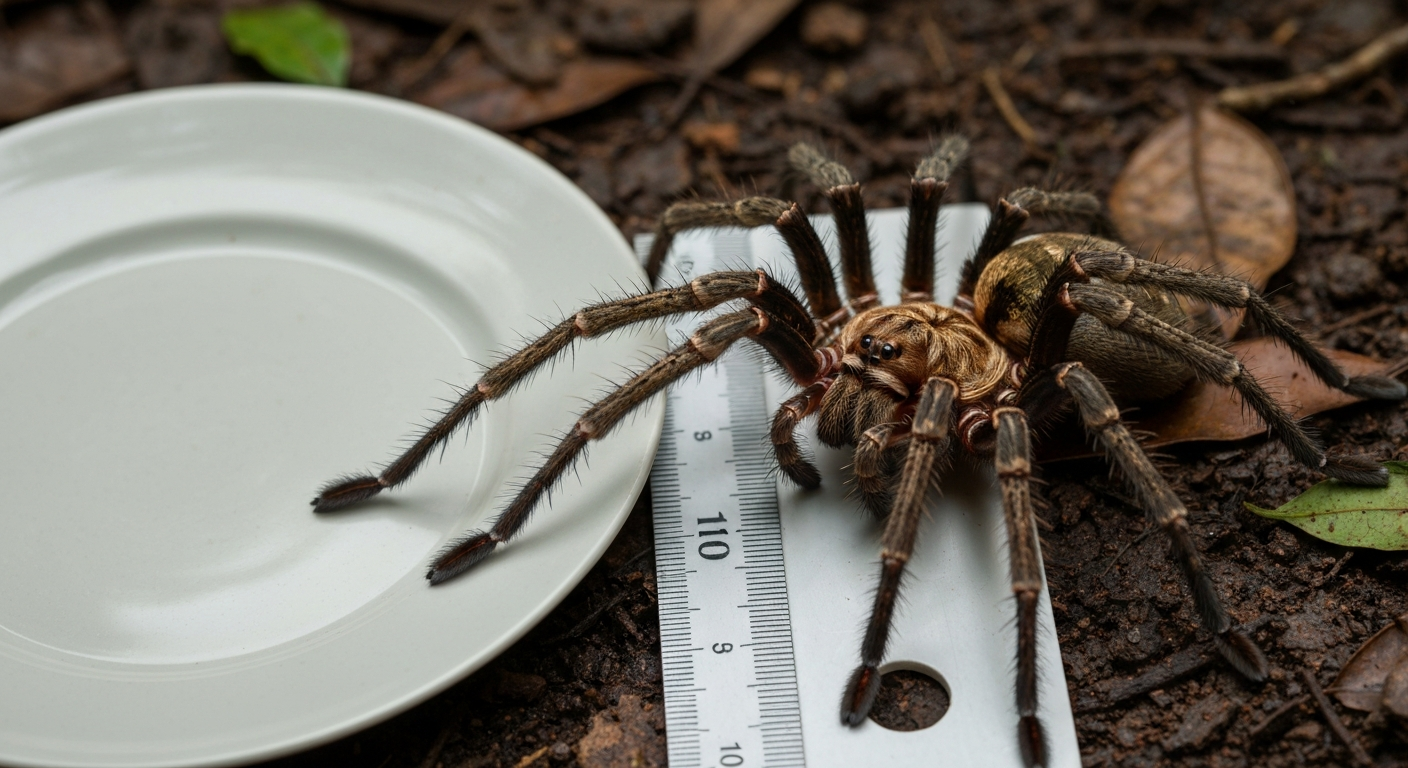
How Big Can Goliath Bird-Eaters Get: Size, Records & Reasons
How big can Goliath bird-eaters get: evidence-based body length, legspan, mass, records, measurement methods & growth
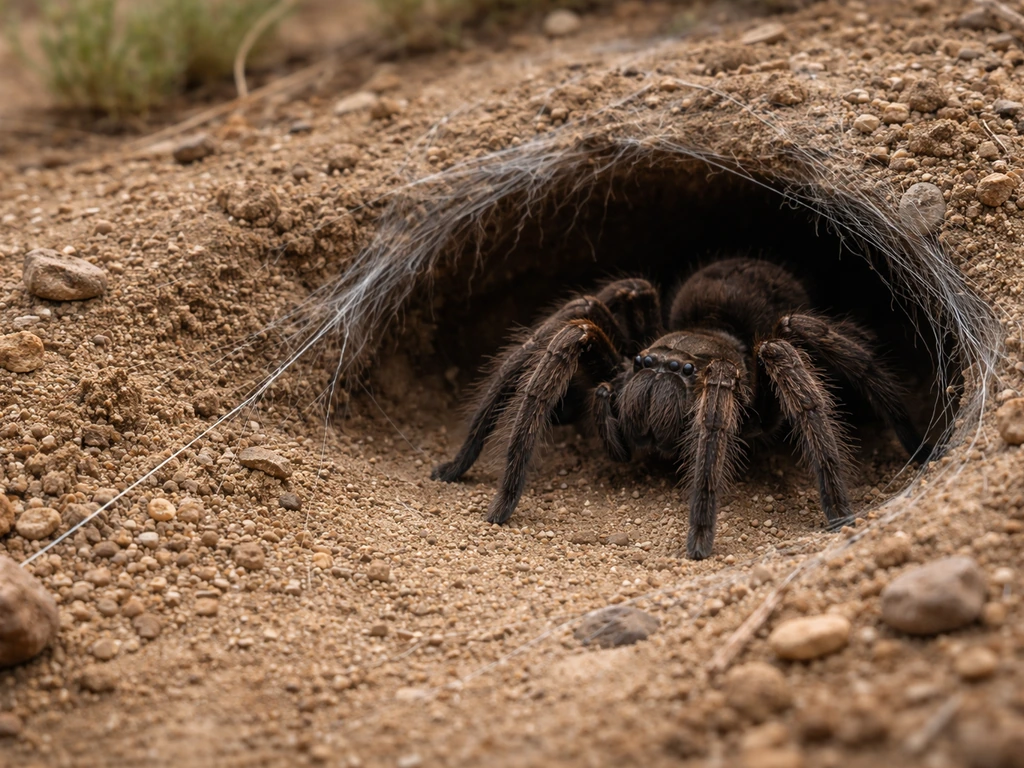
Do Goliath Bird-Eaters Make Webs? How to Spot Silk
Yes. Goliath bird-eaters use silk for burrows and traplines, not orb webs. Spot lining, retreats, and silk cues.
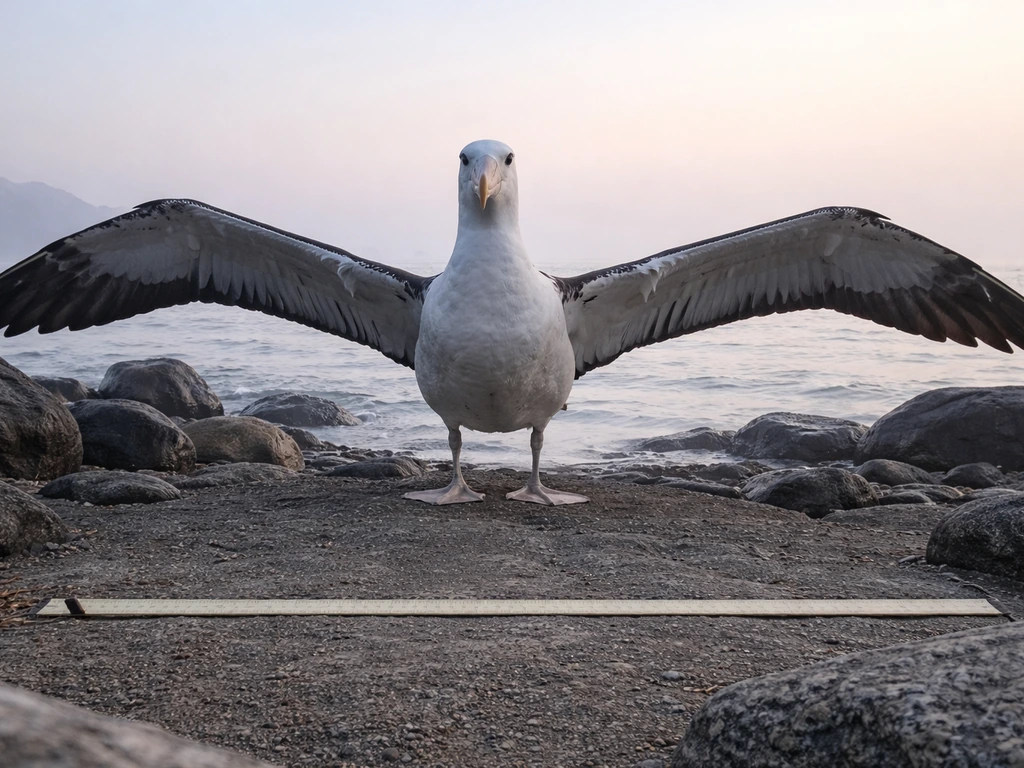
How Big Can a Bird Get? Largest Birds by Weight and Wingspan
Largest living birds by weight and wingspan with sizes in meters and facts on anatomy limits and flightless giants.