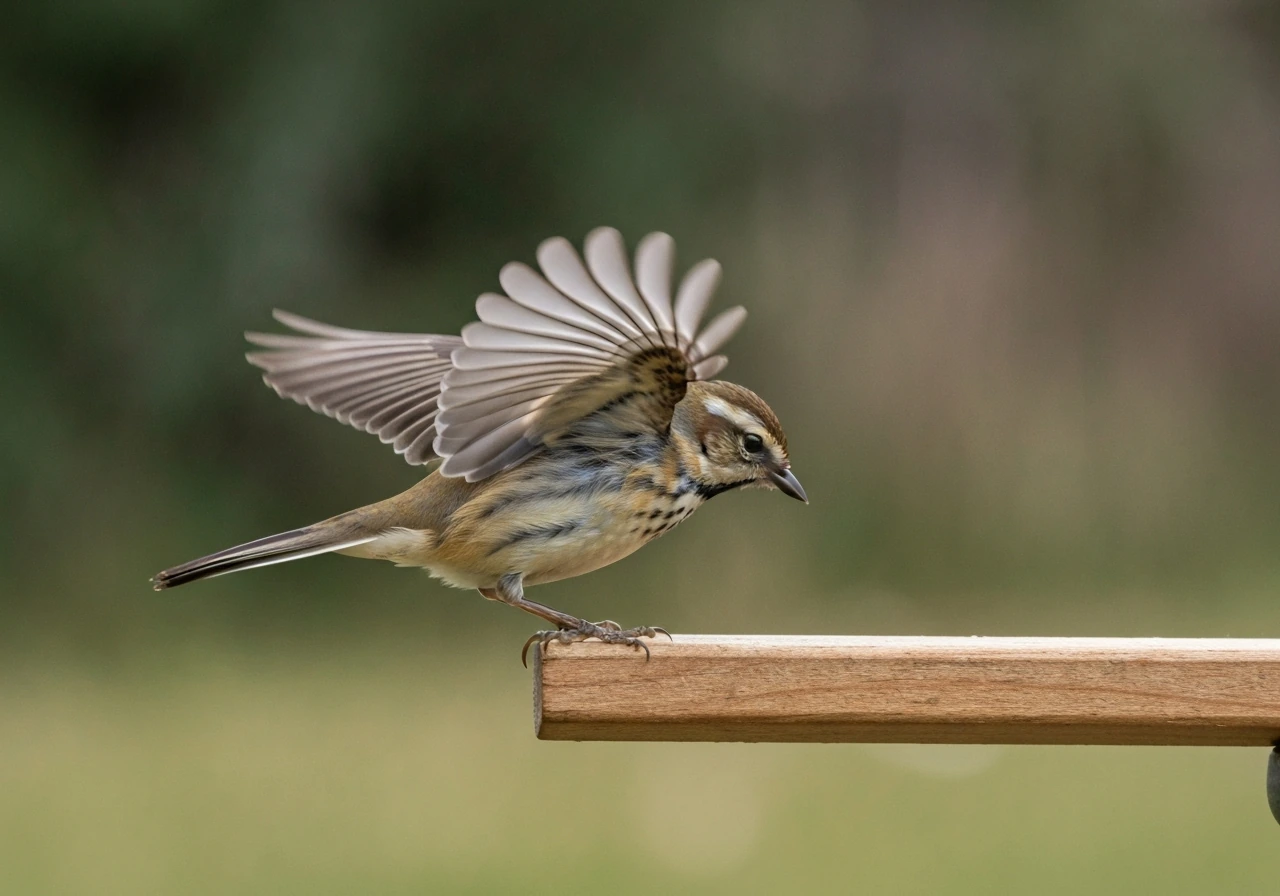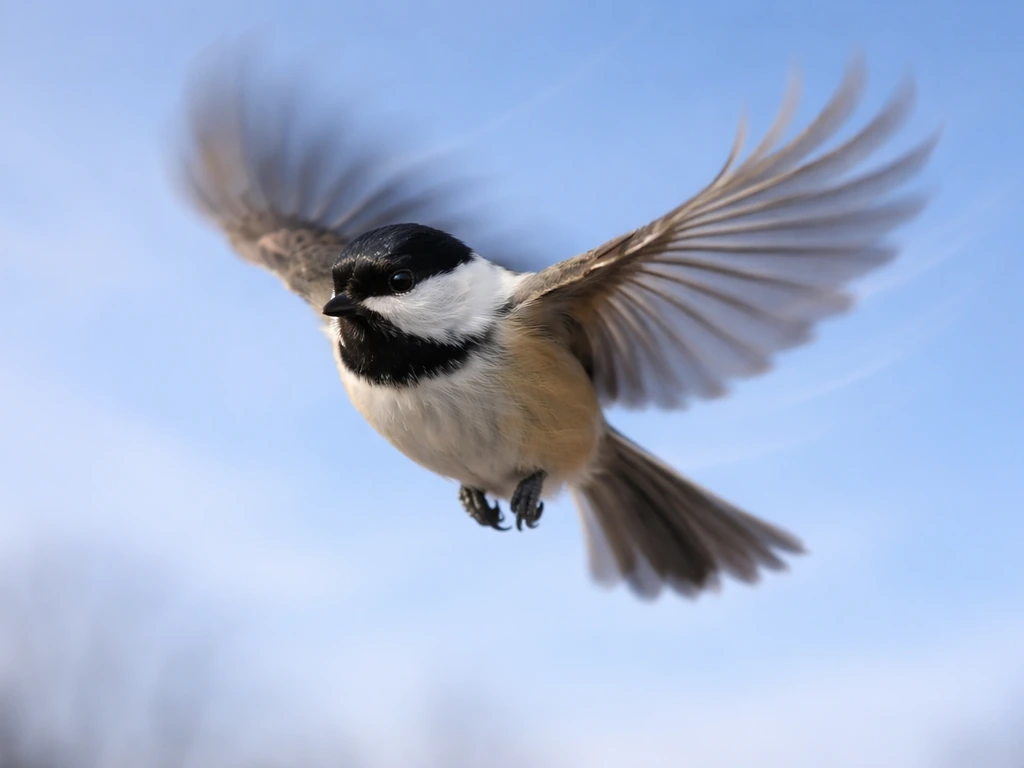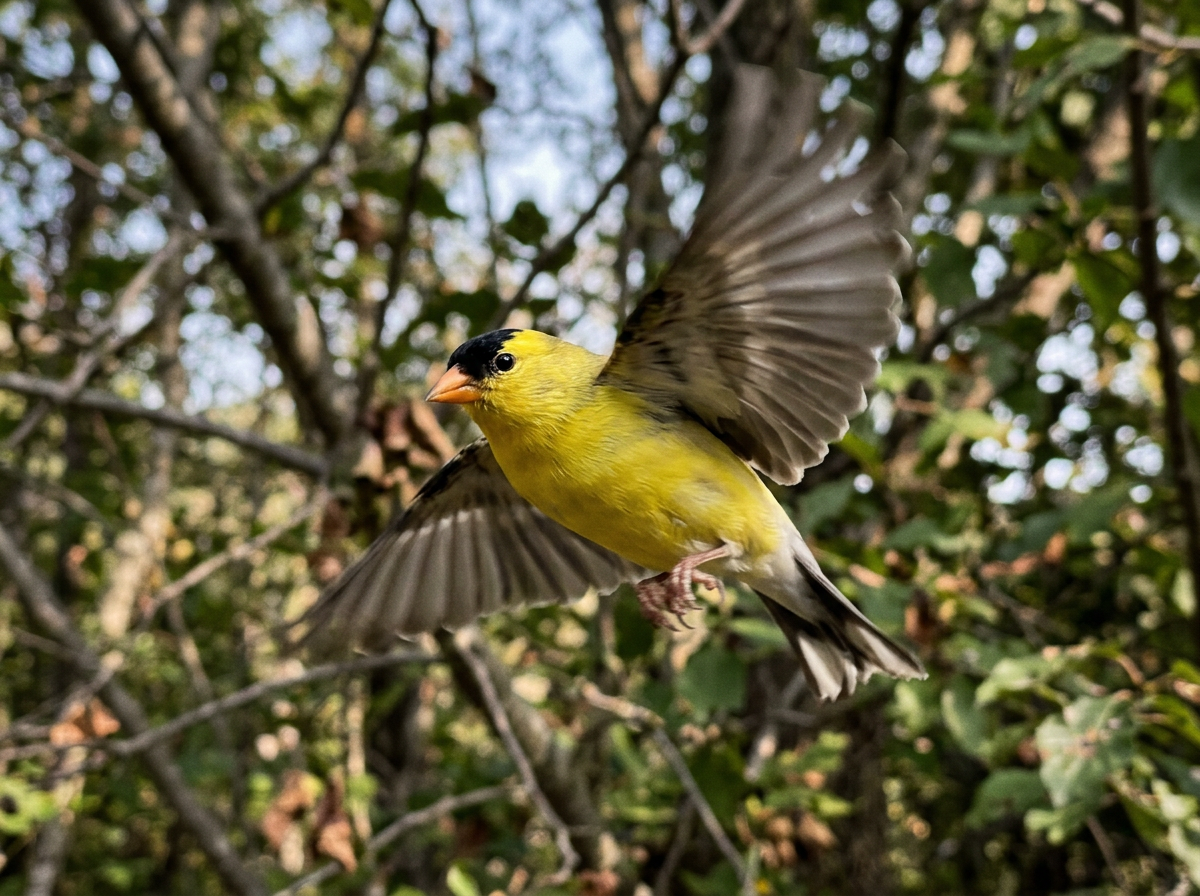
When someone asks 'what is the order of a bird,' they almost always mean the taxonomic rank: Order is the classification level that sits above Family and below Class in the Linnaean system, grouping related bird families into a broader evolutionary unit. For a plain-language definition of taxonomic ranks including 'Order' as the rank above Family and below Class, see blank" rel="noopener noreferrer">What is taxonomy? | Natural History Museum (UK). A Robin, for example, belongs to Order Passeriformes, while a Mallard belongs to Order Anseriformes. It is a formal scientific category that tells you which large branch of the bird family tree a species belongs to, and it shows up in field guides, online databases, and conservation lists every day. Quick note: if you were searching for the sequence of a bird's body parts, the order of movements during flight, or why birds move in that distinctive jerky way, those are genuinely different topics, and I have linked to the right pages throughout this article so you can jump there without having to dig.
What Is the Order of a Bird: Clear Guide to Avian Orders

What people mean when they ask this question
I have to admit this was one of those searches I almost got wrong myself. The phrase 'order of a bird' pulls in at least three different intents. First, and most common, is the biology student or curious birdwatcher who wants to understand the taxonomic rank. Second is someone who is thinking about the structural layout of a bird, wondering which parts come first or how anatomy is organized, which is more of an avian anatomy question. Third is someone interested in the sequence and mechanics of bird movement, like what happens during a wingbeat cycle, how birds slow down and stop, or why bird movements look so jerky compared to mammals. If you are in that third group, those topics each have their own detailed pages on this site worth visiting directly. This article is focused on taxonomy: the formal, scientifically governed rank called Order.
The taxonomic rank 'Order' defined for birds
In Linnaean classification, living things are sorted into a nested hierarchy of ranks. For birds (Class Aves), the full sequence from broadest to most specific runs: Class, Order, Family, Genus, Species. An Order groups together multiple related families that share a common ancestor more recent than the broader Class but older than any individual Family. For instance, Order Accipitriformes contains several families of diurnal raptors, including Accipitridae (hawks and eagles) and Pandionidae (ospreys), because these families share deep evolutionary history and a constellation of diagnostic traits.
One thing worth knowing: the International Code of Zoological Nomenclature (ICZN) formally governs names at the family level and below, but it does not regulate names and rank assignments above the family group. That means Order-level names and boundaries are set by taxonomic convention and scientific consensus rather than a rigid legal code. In practice this is why different authoritative checklists sometimes disagree on how many orders birds should be split into, and why those boundaries shift over time as new evidence comes in.
Why the Order rank actually matters
You might wonder whether knowing an Order is really useful or just academic trivia. It is surprisingly practical. At the scientific level, Orders serve as shorthand units for comparative biology: researchers studying flight mechanics, immune systems, or metabolism across birds need a consistent framework for grouping species, and Order provides a manageable level between 'all birds' and 'this one species.' At the field identification level, knowing an Order gives you a powerful shortcut. If you can recognize that the large soaring bird overhead belongs to Accipitriformes rather than Falconiformes, you have already narrowed your identification dramatically before you even look at the tail pattern.
For conservation, the stakes are even higher. Major policy bodies, including BirdLife International and CITES, rely on standardized checklists that include Order-level placements to track which species are covered under international agreements. When a checklist assigns or reassigns a species to a different Order, it can affect its legal protection status and how it is counted in biodiversity assessments. Getting the taxonomy right, including the Order rank, is not just bookkeeping.
How ornithologists decide which Order a bird belongs to
This is where the science gets genuinely interesting, and honestly a little messier than most textbooks let on. For most of the history of ornithology, Order assignments were based on morphology: the shape and structure of bones, feathers, bills, feet, and internal organs. A landmark example is Livezey and Zusi's 2006 and 2007 work, which compiled thousands of skeletal and soft-tissue characters from museum specimens to produce a large-scale hypothesis of bird relationships. Museum osteology, the study of bird skeletons, remains essential today, especially for interpreting fossil birds that cannot be genetically sequenced.
Behavior and ecology have also historically informed ordinal groupings, though these are treated with more caution since similar behaviors can evolve independently in unrelated lineages (a phenomenon called convergent evolution). A swimming, filter-feeding waterbird looks superficially similar to other waterbirds, but that similarity might be ecological rather than ancestral.
The biggest shift in the past two decades has come from molecular genetics. Two landmark studies, Jarvis et al. (2014) using whole-genome sequencing and Prum et al. (2015) using targeted nuclear loci, fundamentally reshaped our understanding of how the major bird lineages (collectively called Neoaves) relate to each other. These studies overturned some long-held groupings and justified splitting or redefining several Orders. Modern methods used to resolve these deep relationships include ultraconserved elements (UCEs), which are segments of the genome that barely change across evolutionary time and provide reliable alignment across very distantly related species, and anchored hybrid enrichment (AHE), which targets another set of conserved genomic regions. These tools let researchers compare hundreds or thousands of genetic markers at once, giving far more statistical power than single-gene studies from earlier decades.
Major avian Orders and what makes each one recognizable
There are approximately 40 to 46 recognized avian Orders depending on which checklist you consult (more on that variation below). The seven Orders below cover a wide range of bird types you are likely to encounter, and each one has a distinctive combination of anatomy and ecology that makes it identifiable even before you open a field guide.
Passeriformes (perching birds and songbirds)
This is the largest Order by a wide margin, containing more than half of all living bird species. The American Robin (Turdus migratorius) is a familiar example. The defining anatomical feature is the anisodactyl foot: three toes pointing forward and one pointing backward, with a locking tendon that allows the bird to grip a perch automatically when it lands without actively gripping. Oscine passerines, the true songbirds within this order, also have a highly developed syrinx (the avian vocal organ, roughly equivalent to a larynx) that enables the complex learned songs you hear in your backyard. Field cues: small-to-medium body, perching and hopping posture, rich vocal repertoire.
Anseriformes (waterfowl)
Ducks, geese, swans, and screamers belong here, with the Mallard (Anas platyrhynchos) as a textbook example. Diagnostic traits include palmate (fully webbed) feet for swimming, broad flat bills edged with lamellae (comb-like plates that filter food from water), and waterproof plumage maintained by preen-gland oils. Field cues: swimming or upending posture on water, long outstretched neck in swans and geese during flight, rapid direct wingbeats.
Accipitriformes (hawks, eagles, and relatives)
The Red-tailed Hawk (Buteo jamaicensis) is a classic North American representative. The ordinal hallmarks are a strongly hooked beak for tearing flesh, a fleshy cere at the base of the bill, powerful feet with curved talons for capturing prey, and large forward-facing eyes that provide the depth perception a predator needs. See Hawks, eagles, and relatives, Encyclopedia of Life (morphology and ecology summary) for the ordinal diagnostic traits and an exemplar (Red‑tailed Hawk, Buteo jamaicensis) Hawks, eagles, and relatives — Encyclopedia of Life (morphology and ecology summary). Flight style is a key field cue: broad rounded wings and a wide tail are adapted for thermal soaring, and you will often see these birds circling high on updrafts. Understanding how birds like these use air currents to stay aloft ties directly into the mechanics of flight and how birds respond to changes in airflow, topics covered in more depth on related pages.
Strigiformes (owls)
The Great Horned Owl (Bubo virginianus) is probably the most recognized member. Owls have a remarkable suite of adaptations for nocturnal hunting: enormous forward-facing eyes that gather low-light information, a broad flat facial disc that functions like a parabolic dish to focus sound toward the ears, and highly specialized flight feathers with fringed trailing edges that break up turbulence and allow nearly silent flight. Their feet are often described as zygodactyl (two toes forward, two back, like parrots), though owls can rearrange toe position. Field cues: round or heart-shaped head, silent wingbeat, often active at dawn and dusk.
Psittaciformes (parrots)
The Blue-and-yellow Macaw (Ara ararauna) illustrates the Order well. Parrots are characterized by a strongly curved, hooked bill with powerful jaw musculature, a thick muscular tongue used for manipulating food, and true zygodactyl feet (two toes forward, two back) that function almost like hands for gripping branches and handling food. The combination of that stout bill profile and climbing behavior is distinctive in the field. Parrots are also known for vocal mimicry, though their syrinx anatomy differs from songbirds.
Columbiformes (pigeons and doves)
The Rock Pigeon (Columba livia) is possibly the world's most studied bird. Columbiformes have a compact, plump body, a small rounded head relative to body size, and a short bill with a distinctive fleshy cere. One genuinely unusual biological trait unique to this Order is crop milk: both parents produce a protein- and fat-rich secretion from the crop lining to feed nestlings, something no other bird Order does in quite the same way. Field cues: plump silhouette, rapid shallow wingbeats, strong direct flight.
Falconiformes (falcons and caracaras)
Falcons were historically grouped with hawks and eagles, but genomic studies showed they are not closely related to Accipitriformes at all. They now occupy their own Order, Falconiformes. The Peregrine Falcon (Falco peregrinus) is the most famous member. Falcons share the hooked bill and taloned feet of other raptors, but they differ in skull anatomy, in how they kill prey (often a cervical bite rather than grip-and-crush), and in nest behavior. Flight silhouette is a reliable field cue: long, pointed wings built for speed and aerial pursuit, very different from the broad, rounded wings of buteos. How birds like falcons achieve and manage extreme flight speeds, and how they decelerate and land precisely, is a topic worth exploring separately in the context of bird flight mechanics.
A quick comparison of the seven Orders
| Order | Example Species | Key Foot Type | Bill Shape | Distinctive Field Cue |
|---|---|---|---|---|
| Passeriformes | American Robin | Anisodactyl (3 forward, 1 back) | Varies widely | Perching/hopping; complex song |
| Anseriformes | Mallard | Palmate (webbed) | Broad, flat with lamellae | Swims; neck outstretched in flight |
| Accipitriformes | Red-tailed Hawk | Raptorial curved talons | Strongly hooked with cere | Broad wings; soaring on thermals |
| Strigiformes | Great Horned Owl | Zygodactyl-like; reversible outer toe | Short, hooked; hidden in facial disc | Silent flight; round/heart-shaped face |
| Psittaciformes | Blue-and-yellow Macaw | Zygodactyl (2 forward, 2 back) | Strongly curved/hooked | Climbing behavior; stout bill profile |
| Columbiformes | Rock Pigeon | Anisodactyl | Short, slender with fleshy cere | Plump body; rapid direct wingbeats |
| Falconiformes | Peregrine Falcon | Raptorial curved talons | Hooked; notched upper mandible | Long pointed wings; high-speed pursuit |
Field-friendly cues for identifying an Order on sight
You do not need a specimen or a genetics lab to get to Order level in the field. A few reliable cues will narrow things down quickly.
- Silhouette: Body proportions, wing shape (broad and rounded versus long and pointed), tail length, and overall size are visible at a distance and are often the first separator between Orders.
- Flight style: Thermal soaring with minimal wingbeats (Accipitriformes), rapid shallow wingbeats in a straight line (Columbiformes, Anseriformes), undulating up-and-down flight (many Passeriformes), and high-speed aerial pursuit with stiff wingbeats (Falconiformes) are all diagnostic patterns.
- Bill form: The hooked bill of raptors and parrots, the flat lamellate bill of ducks, the stout conical bill of many seed-eating passerines, and the small soft-cered bill of pigeons all reflect ordinal-level traits.
- Foot and perching behavior: Watch what the bird does when it lands. Does it grip a perch (Passeriformes), swim (Anseriformes), climb vertically using bill and feet (Psittaciformes), or stand on flat ground with partially webbed feet?
- Habitat and activity time: Nocturnal activity immediately narrows the field enormously toward Strigiformes. Open water almost always means Anseriformes or related waterbird orders. Dense forest canopy with loud squawking frequently points to parrots.
- Calls and vocalizations: While complex learned song is characteristic of oscine Passeriformes, many other Orders have highly diagnostic call types (the haunting hoot of owls, the harsh screech of raptors, the coo of Columbiformes).
It is worth noting that some identification cues that seem obvious can mislead you. Convergent evolution means that unrelated birds sometimes look or behave similarly because they occupy similar ecological niches. This is one reason why molecular phylogenetics was such a revelation: falcons looked so much like hawks that ornithologists grouped them together for a century before genome data showed they were not closely related at all. When in doubt, confirm with a checklist or database.
Suggested visuals: what to show and why
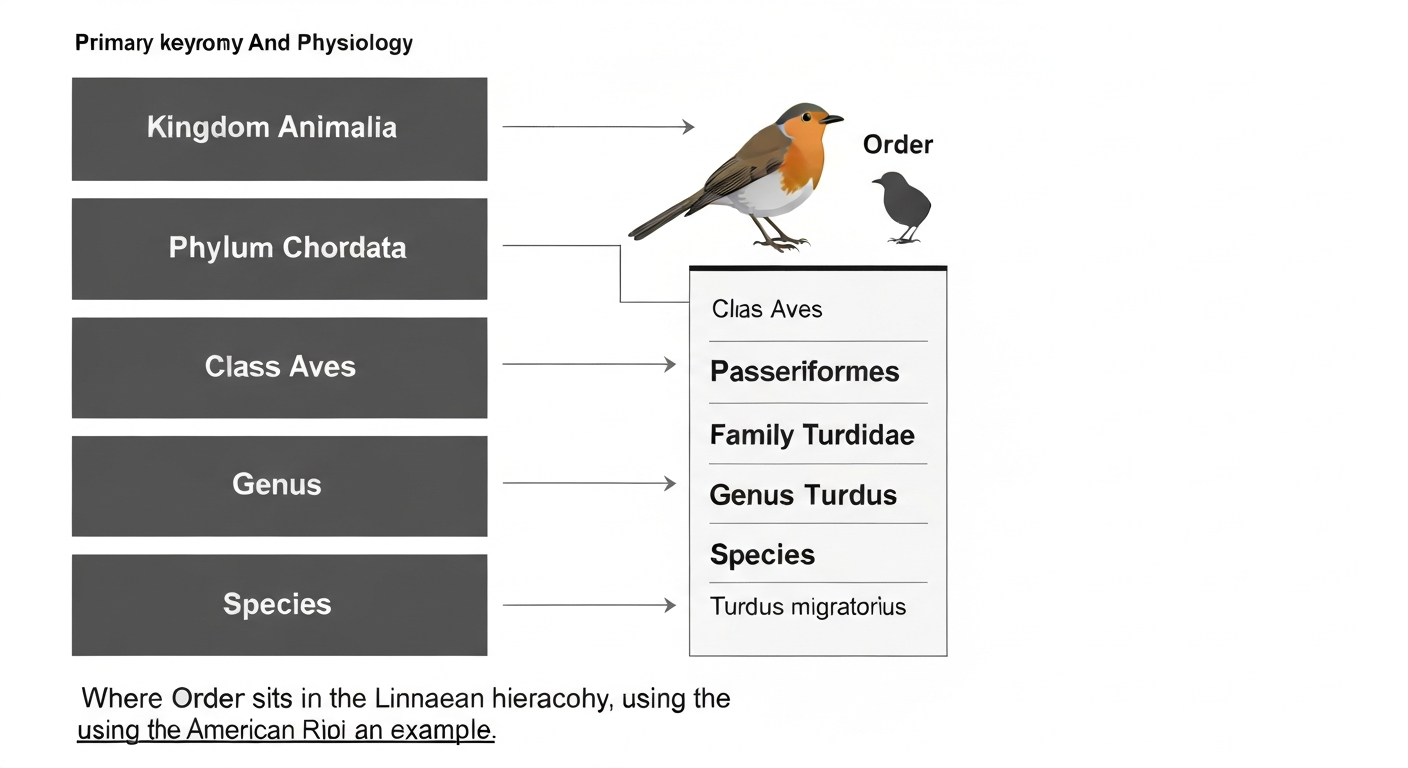
Two types of visuals work best for this topic. First, a taxonomic hierarchy diagram showing the levels Kingdom down to Species with 'Order' highlighted and annotated with a real example (e.g., Passeriformes containing Family Turdidae containing Genus Turdus containing Species T. migratorius) makes the abstract ranking immediately concrete. A caption like 'Where Order sits in the Linnaean hierarchy, using the American Robin as an example' anchors the concept.
Second, a silhouette comparison image showing seven bird outlines side-by-side (one per Order covered above) at roughly comparable scale, each labeled with its Order name and a one-line identifier such as 'broad soaring wings' or 'plump body, small head,' gives readers a visual shortcut for field identification. Captions should note the representative species for each silhouette and the most diagnostic visual feature at ordinal level.
How to look up a bird's Order quickly
The most reliable approach is to consult one of the major global checklists or databases. Each has slightly different strengths depending on whether you are in the field, at a desk, or doing formal research.
- eBird (Cornell Lab of Ornithology): Search any species name in the eBird species search box and the full taxonomic breakdown including Order appears immediately on the species page. It uses the Clements Checklist taxonomy, which is updated annually.
- IOC World Bird List (ioc-worldbirdlist.org): Free downloadable spreadsheet and searchable online interface. Type a species name and you get Order, Family, and authority. The IOC list is one of the most widely used in academic ornithology.
- Avibase (avibase.bsc-eoc.org): Maintained by Bird Studies Canada, Avibase cross-references multiple checklists at once, so you can see how the same species is classified under IOC versus HBW/BirdLife taxonomy in a single view. Very useful when checklists disagree.
- AviList: The newest unified global checklist, developed by a working group including BirdLife International, Cornell Lab, the American Ornithological Society (AOS), and Avibase, recognizes 46 Orders and is designed to harmonize nomenclature across organizations. Check BirdLife International's website for access.
- Regional field guides: For everyday birdwatching, a well-produced regional field guide (such as the Sibley Guides for North America or Collins Bird Guides for Europe) lists the Order for every species in its index or species accounts. These are the fastest reference in the field.
- Museum collection keys and the Handbook of the Birds of the World (HBW): For specimen-based research or deeper study, HBW (now also available via Birds of the World on Cornell Lab's platform) provides morphological descriptions and taxonomic discussion at ordinal level, with references to original literature.
One practical tip: if you find different Orders listed for the same species in two different sources, you are almost certainly seeing a checklist disagreement rather than an error. As noted earlier, the IOC has historically recognized around 40 Orders while the unified AviList recognizes 46, reflecting genuine differences in how taxonomists choose to split or lump higher groups. For most purposes, picking one authoritative checklist and using it consistently is the right move.
Clearing up the most common confusions
Order vs. Family vs. Genus vs. Species
These four ranks are the ones most people encounter, and mixing them up is genuinely easy at first. An Order contains multiple Families. A Family contains multiple Genera (plural of Genus). A Genus contains one or more Species. So Passeriformes (Order) contains Turdidae (Family), which contains Turdus (Genus), which contains Turdus migratorius (the American Robin, a Species). Each level narrows the group. If someone says 'it's in the Turdidae family,' that is more specific than saying 'it's a passerine,' but less specific than giving the species name.
Why different books list different Orders for the same bird
Because Order-level taxonomy above the family group is not regulated by the ICZN, it is a matter of scientific consensus that is still actively evolving. Checklist committees at IOC, BirdLife/HBW, and AOS each review new molecular and morphological evidence and make independent decisions. This means a species might be placed in Order X by one checklist and Order Y by another, or two groups treated as a single Order in one checklist might be split into two in another. This is not a flaw in the system; it is the system working as it should, with taxonomy reflecting the current best understanding of evolution.
If you were searching for the sequence or arrangement of a bird's parts
If your original question was actually about the physical layout of a bird's anatomy, how its body parts are arranged and adapted, or the sequential mechanics of how it moves through the air, those are rich topics in their own right. For a focused look at those traits, see our guide on how birds adapt to their environment. The flight stroke involves a precise sequence of wing and body movements. Birds have very specific adaptations in their skeleton, feathers, and musculature that make flight possible, and the way a bird transitions from powered flight to a controlled stop involves distinct biomechanical phases. For a focused overview of what adaptations help a bird to fly, see our article on adaptations that enable avian flight. If any of that is what you were after, the related pages on flight adaptations, what happens to a bird in flow, how birds slow down and stop, and why bird movements appear so jerky will give you much more useful detail than a taxonomy article can.
FAQ
What is an “order” in bird classification?
In Linnaean taxonomy an Order is a ranked grouping above Family and below Class that gathers related families of birds. It is a conventional taxonomic rank whose boundaries are set by taxonomists using morphology and, increasingly, phylogenetic (genetic) evidence. (See Natural History Museum overview of taxonomy and ICZN scope clarifications.)
Why does the rank Order matter for birders, students, and scientists?
Orders organize broad evolutionary and ecological units — they provide a shorthand for large groups (songbirds, waterfowl, raptors, etc.) used in field identification, comparative biology, conservation planning, legal/policy lists, and museum curation. Different checklists use Orders to communicate higher‑level relationships and priorities.
What are clear, example avian orders and the easy traits to recognize them by?
Examples with quick traits: Passeriformes (perching birds): anisodactyl foot, perching habit, often complex song. Anseriformes (ducks, geese, swans): palmate (webbed) feet, broad flattened bills with lamellae, aquatic habit. Accipitriformes (hawks, eagles): hooked bill with cere, strong raptorial feet and talons, soaring silhouettes. Strigiformes (owls): forward‑facing eyes, facial disc, silent flight feathers, often nocturnal. Psittaciformes (parrots): strong hooked bill, zygodactyl feet (2+2), climbing behavior. Columbiformes (pigeons/doves): compact body, small head with fleshy cere, crop milk production. Falconiformes (falcons) differ from Accipitriformes by built‑for‑speed body, a tomial tooth on bill for killing prey. These diagnostic cues are useful in the field but note exceptions and variation.
How do ornithologists determine which families belong to an order?
Historically by comparative morphology (skeletal, soft‑tissue, feather characters, behavior) and museum osteology. Modern practice integrates large‑scale molecular phylogenetics (AHE, ultraconserved elements, whole genomes) to infer evolutionary relationships. Landmark phylogenomic studies (e.g., Jarvis et al. 2014; Prum et al. 2015) reshaped many higher‑level groupings and inform recent checklists.
What field‑friendly cues help tell a bird’s order from sight or a specimen?
Look first at posture and habitat: perching + anisodactyl foot often = Passeriformes; swimming with webbed feet = Anseriformes; hooked bill + talons + soaring = Accipitriformes; stocky, rounded silhouette + facial disc + nocturnal = Strigiformes; stout, hooked bill + climbing behavior = Psittaciformes; plump body, rapid wingbeats and direct flight = Columbiformes. Combine silhouette, bill/feet type, flight style, and behavior for best guesses.
Where can I reliably look up a bird’s order?
Use authoritative global checklists or regional field guides. Major sources: IOC World Bird List (worldbirdnames.org), Clements Checklist / Cornell Lab (birds.cornell.edu/clementschecklist), HBW/BirdLife, Avibase (avibase.bsc-eoc.org), and the AviList unified checklist (BirdLife news). Field guides (e.g., Peterson, Collins, regional guides) typically list higher taxonomy. Cross‑check if needed because different checklists sometimes disagree.