
If you searched "what happens to the bird in flow," you might be coming from a few different directions, and it's worth sorting those out before diving in. This site is about bird biology, so the most relevant meaning here is what happens to a bird's body when it is moving through airflow: actively flapping, gliding, soaring, or hovering. That's the main focus. But there's also a reasonable interpretation where "flow" means a performance state, the way athletes talk about being "in the zone." The good news is that both interpretations map back to the same underlying biology, because what's happening physiologically during peak flight effort is measurable, fascinating, and genuinely underappreciated.
What Happens to the Bird in Flow During Flight

Marcus Chen
9 Apr 2026
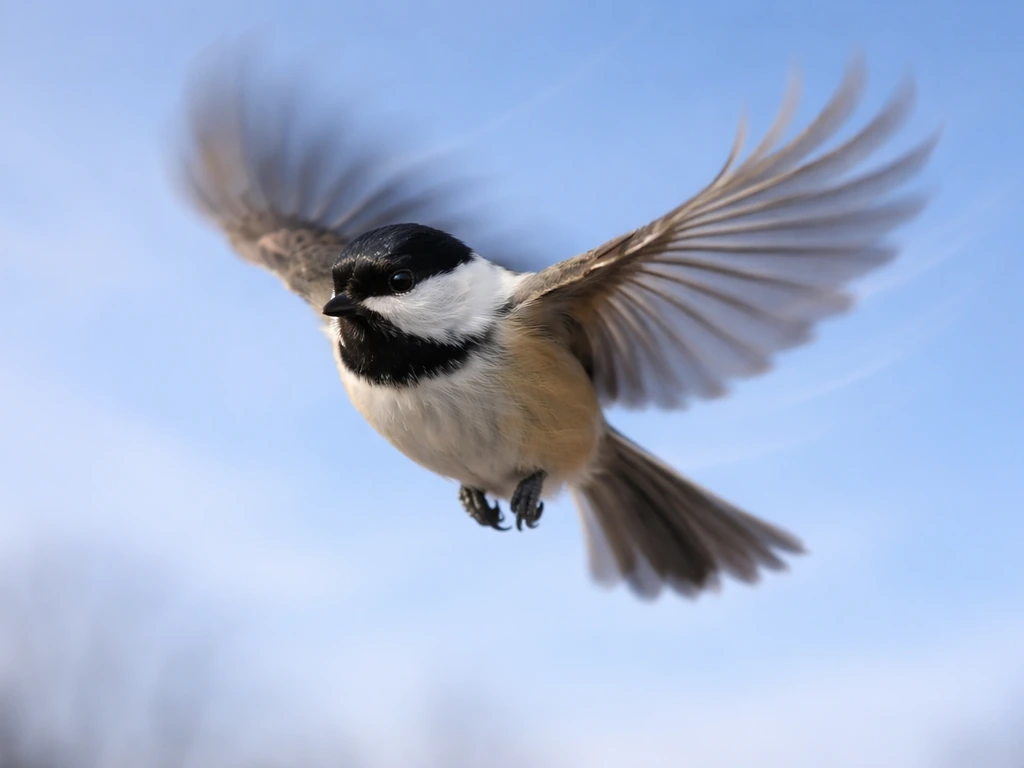
What "Flow" Actually Means Here (and Why It Matters)
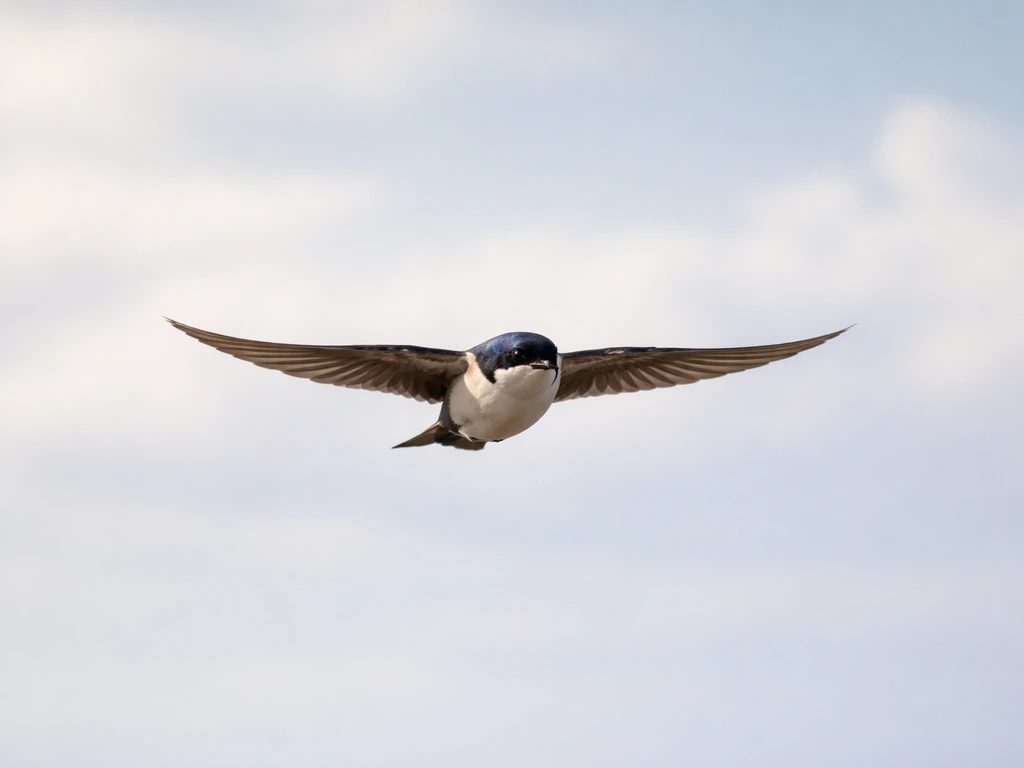
"Flow" in popular usage often refers to a psychological state of full engagement and peak performance. For a bird, there's no clean way to measure that subjectively, but we can measure everything that would produce it: heart rate, oxygen consumption, muscle activity, wing kinematics, and sensory processing. In that sense, "a bird in flow" is really just a bird actively flying, and the physiology is extraordinary.
The other common source of confusion is whether "flow" refers to airflow specifically, as in how moving air interacts with the bird's wings and body. That's also deeply relevant, because the bird's entire anatomy is shaped around managing that interaction. This article covers both: the mechanical relationship between the bird and moving air, and all the biological systems that fire up to sustain flight.
How Airflow Actually Works Around a Flying Bird
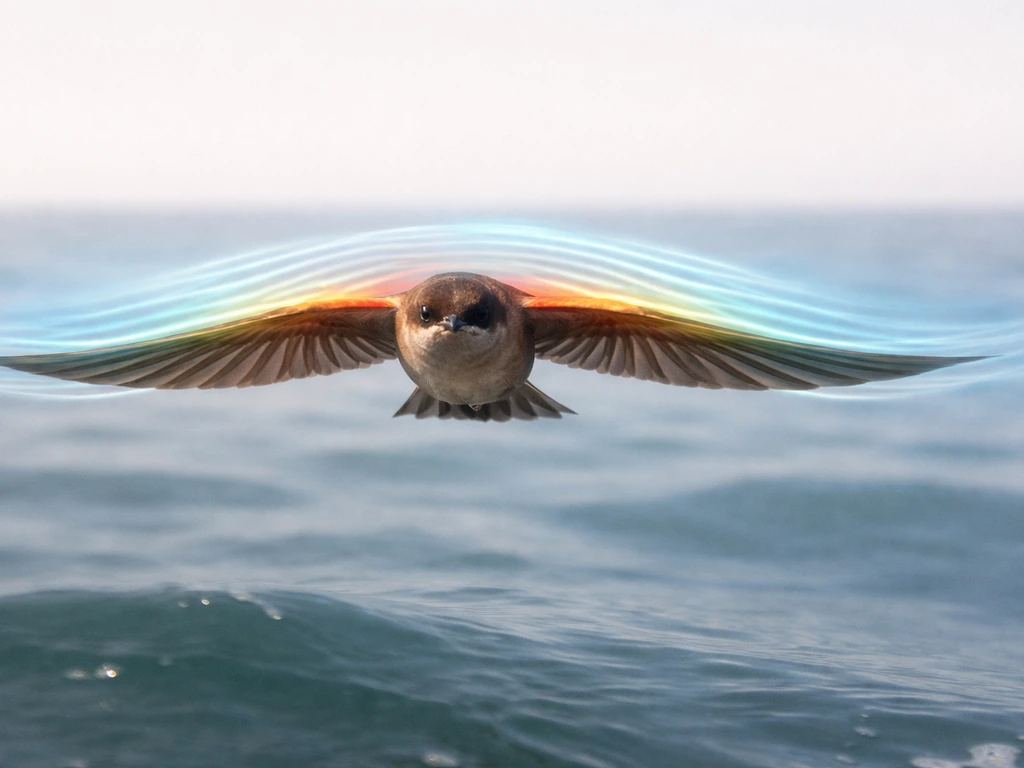
When a bird moves through air, its wings generate lift by creating a pressure difference: lower pressure above the wing, higher pressure below. This is aerodynamic lift, and it depends on the wing's shape (the camber), its angle relative to oncoming airflow (angle of attack), and the bird's speed. Drag works against forward motion, and thrust comes from the downstroke of flapping. The bird's body is constantly negotiating all three of these forces simultaneously, which is why the adaptations that help a bird fly are so structurally specific: hollow bones reduce weight, asymmetric flight feathers create airfoil geometry, and the furcula (wishbone) acts as a spring storing and releasing energy with each wingbeat.
Gliding and soaring simplify the equation because the wings are held relatively fixed and the bird harvests energy from rising air columns (thermals) or wind gradients. Flapping flight is far more energetically costly and mechanically complex, requiring the wings to generate both lift and thrust in a coordinated stroke cycle. How a bird slows down or stops is actually a mirror of this same system: the bird spreads its tail, rotates its wings to increase drag, and adjusts its angle of attack to reduce lift in a controlled way.
The Muscles Doing All the Work
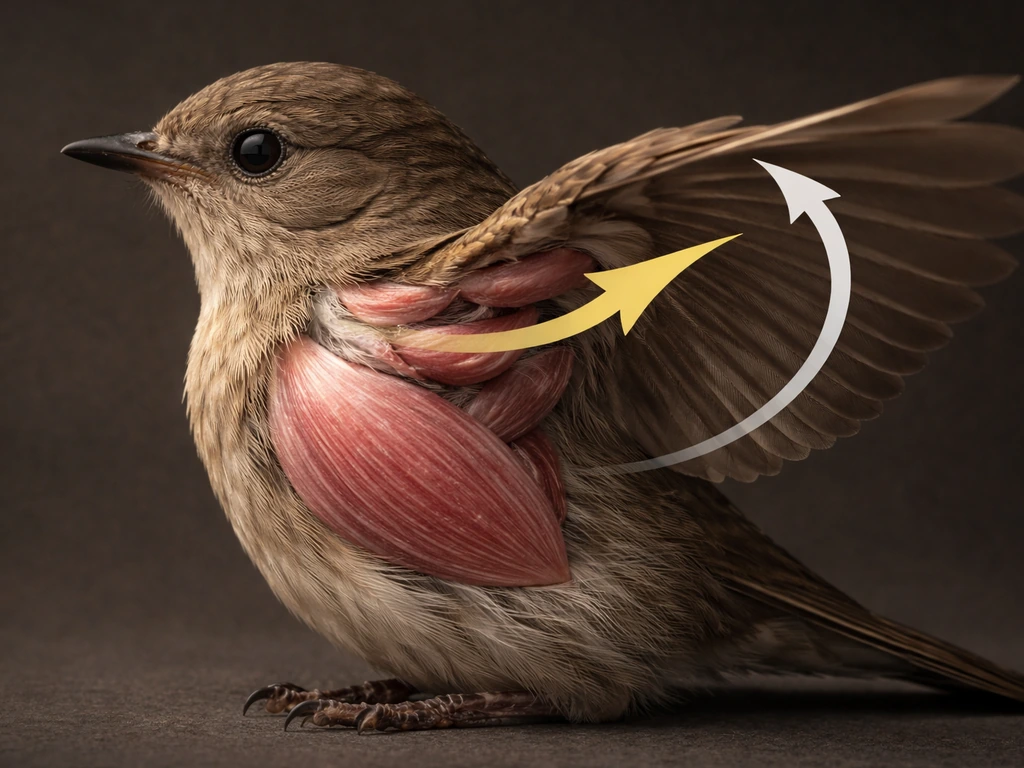
The two muscles responsible for powered flight are the pectoralis (the big downstroke muscle, the one you'd recognize as the breast meat on a chicken) and the supracoracoideus, a deeper muscle that pulls the wing back up. Together they account for roughly 25–35% of a bird's body mass in strong fliers. Research into muscle function during avian flight has found that the supracoracoideus can actually show higher normalized operating stresses than the pectoralis in some flight conditions, particularly during ascending versus descending flight, which challenges the simple "pectoralis does everything" assumption most people start with.
What makes sustained flapping possible is not just muscle strength but how the tendons and connective tissue work with those muscles. Wings store and release elastic energy through tendons during each stroke cycle, the way a spring would, which reduces the metabolic cost of each beat. A biomechanics perspective on avian flight emphasizes that this elastic energy storage is what allows birds to maintain high wingbeat rates without burning through their energy reserves immediately. One interesting measurement note: wingbeat frequency doesn't necessarily increase with flight speed in a simple linear way. A classic study found wingbeat frequency to be largely independent of flight speed, so faster doesn't always mean more beats per second.
Breathing and Circulation in Moving Air
This is where birds genuinely outperform mammals, and it's worth understanding why. Birds use a two-cycle, unidirectional breathing system built around a set of air sacs (typically nine) that act as bellows. Unlike mammalian lungs, which fill and empty in a tidal pattern, bird lungs have air flowing through them continuously in one direction. This lung, air sac organization separates gas exchange from mechanical ventilation and produces continuous unidirectional airflow through the avian respiratory system bird lungs have air flowing through them continuously in one direction. This means fresh, oxygen-rich air is always in contact with the gas-exchange surface. During flight, this system is pushed to its absolute limit.
Oxygen consumption during flight increases roughly 10 to 15 times above resting metabolic rate. To support that, heart rate more than doubles from resting values. Telemetry studies on soaring birds have recorded heart rates in the range of 230 to 260 beats per minute during active flight, compared to much lower resting rates. Research on migrating European bee-eaters has shown that heart rate telemetry can reliably distinguish between energetically cheap flight modes (soaring and gliding) and expensive ones (powered flapping), because the cardiovascular system scales so tightly with metabolic demand.
Altitude changes this picture significantly. As arterial oxygen partial pressure drops in hypoxic conditions (like high altitude), the bird's blood oxygen content falls, and the cardiovascular and respiratory systems are pushed even harder. Some species, like bar-headed geese flying over the Himalayas, have evolved specific hemoglobin adaptations to cope. Most birds, though, are operating within a relatively safe oxygen envelope close to sea level.
Staying Cool While Working That Hard
Flight generates a lot of heat. A bird working at 10 to 15 times resting metabolic rate is producing enormous amounts of waste heat, and it can't sweat. Instead, birds use a behavior called gular flutter: rapid vibration of the moist membranes in the throat combined with open-mouth panting, which dramatically increases evaporative water loss and cools the bird. Studies on small owls have found that gular flutter can produce increases in evaporative heat loss of 44 to 100 percent while only raising resting metabolic rate by less than 5 percent. That's a very efficient cooling mechanism.
Airflow during flight actually helps with cooling too, since moving air increases convective heat loss from the skin and feathers. This creates an interesting tradeoff: fast flight generates more heat from muscle activity but also dissipates more heat through convection. Slow hovering or soaring in still air can be thermally harder on the bird in some conditions. Not all birds are equally capable at gular flutter.
Research comparing eagle-owls, thick-knees, and sandgrouse found pronounced differences in evaporative cooling capacity, and passerines (songbirds) generally have more limited gular-flutter ability than larger species. This is one reason how a bird adapts to its environment varies so dramatically between desert species and temperate ones: thermoregulatory capacity is a survival constraint, not just a comfort issue.
One important caveat: behavioral signs of heat stress (panting, wing drooping, shade-seeking) are useful proxies but can over- or underestimate actual evaporative heat loss depending on the species. If you're observing a bird and trying to assess whether it's overheating, visible gular flutter combined with reduced activity is a more reliable signal than panting alone.
Energy, Fuel, and What the Gut Is Doing Mid-Flight
Birds in sustained flight are burning through fuel at a rate that would be unsustainable for most animals. The primary fuel source during flight is fat, which provides more than twice the energy per gram compared to carbohydrates. Migrating birds can deposit enormous fat reserves before long flights and deplete them continuously during the journey. Muscle glycogen is also used, particularly for burst efforts, but fat is the aerobic workhorse.
Digestion essentially slows or pauses during intense flight because blood is redirected to the muscles, heart, and lungs. Gut motility drops, and the bird's digestive organs actually shrink in mass during long migrations (and regrow after landing), which is a well-documented phenomenon in migratory species. This is why you'll often see birds gorging before a long migration and eating heavily immediately after: the gut is rebuilding itself. Understanding the order of a bird taxonomically also matters here because metabolic strategies vary enormously: shorebirds, passerines, raptors, and waterfowl have very different fueling and digestion profiles during flight.
How the Bird Keeps Its Head During All of This
I'll be honest: I didn't fully appreciate how sophisticated avian sensory control is until I looked into this. Flying through changing airflow requires constant real-time correction. The bird is processing visual input, balance signals from its inner ear (vestibular system), and proprioceptive feedback from its wings and feathers simultaneously, and it's doing this at the speed of a reflexive motor system, not a conscious decision.
Research on simulated flight conditions found that the flight state itself changes how birds process sensory input: vestibular gaze-stabilizing responses become stronger (higher gain) during simulated flight compared to rest. The bird's brain literally upregulates its sensitivity to rotational motion when it expects to be flying. This is state-dependent sensorimotor processing, and it's a big part of why birds can maintain such stable visual fields despite their bodies pitching and rolling constantly.
Vision plays a specific role in turns. Studies of pigeons during turning flight show that birds stabilize their head in space during a turn (holding it still relative to the horizon) and then snap it to a new position in a rapid saccade, similar to how human eyes make rapid fixation jumps. This alternating stabilize-and-snap pattern gives the visual system clean, blur-free frames to work with during maneuvers. It also explains why bird movements look so jerky to us: what appears erratic from the outside is actually a precisely timed visual control strategy.
Wingbeat frequency itself can be read as a proxy for flight effort. Studies of nocturnal migrants have extracted wingbeat frequency from acoustic recordings, allowing researchers to assess flight behavior without direct observation. In flocking birds, wingbeat frequency has been shown to change with flock density, rising by measurable increments as social context changes the aerodynamic environment each bird is flying in.
What to Watch For and How to Go Deeper
If you're trying to understand what's happening to a bird "in flow" in a practical, observational sense, here's where to start:
- Watch wingbeat rhythm during different flight modes. Soaring birds with spread, locked wings are in a low-cost metabolic state. Rapid flapping, especially on ascent, represents peak muscle and cardiovascular load.
- Look for gular flutter during warm days: an open-mouthed bird rapidly vibrating its throat is actively managing heat, not just panting from exertion.
- Notice head movements during flight. A bird that holds its head still and then snaps it to a new position is using saccadic visual control, a normal and healthy behavior, not a sign of distress.
- Watch for post-flight feeding behavior. A bird that lands and immediately begins eating heavily has likely depleted significant fat reserves and may be rebuilding gut mass.
- Compare soaring versus flapping modes across species. Larger birds tend to soar more, in part because their metabolic cost of flapping per unit body weight is higher.
- If you're looking at a bird that seems stressed in hot, still air (drooping wings, panting, lethargy), the thermoregulatory system may be overloaded, particularly in species with limited gular-flutter capacity.
If you want to go deeper into the structural reasons flight is possible in the first place, the skeletal and feather adaptations are the best starting point. From there, the respiratory system's air-sac architecture is probably the most surprising and counter-intuitive system to understand, because it works so differently from mammalian breathing that most people have to rethink their mental model entirely. For the movement and control side, studying how sensory systems (especially vision and the vestibular system) integrate during flight is an active research area with genuinely new findings coming out regularly.
The bottom line: a bird in flight is running nearly every major biological system at close to maximum capacity simultaneously. Muscles are generating mechanical power through elastic tendons, the respiratory system is pushing oxygen through in a continuous unidirectional stream, the heart is running at more than double its resting rate, the gut is effectively paused, evaporative cooling is managing heat load, and the sensory system is making real-time corrections faster than conscious thought. That's what "flow" looks like in bird biology, and honestly, it's more impressive than the psychological version.
FAQ
Does “bird in flow” always mean powered flapping, or can a bird be “in flow” while gliding or soaring?
A bird can be in a high-performance, flow-like physiological state during gliding or soaring too, but the pattern shifts. In gliding, metabolic demand and muscle activation are typically lower because thrust is reduced, while sensory and aerodynamic control still run at high priority. So it is still “flight biology in action,” just with different balance among lift, drag, and energy use.
How can I tell whether a bird’s rapid wingbeats are due to speed or due to something else (like wind or maneuvering)?
Wingbeat frequency is not guaranteed to rise linearly with flight speed, so you need context. Faster wingbeats can reflect climb demand, maneuver stiffness, or changing angles of attack rather than just velocity. A practical check is to watch for concurrent behaviors, like tighter turning, ascending posture, or tail and wing adjustments, which often indicate effort changes beyond speed.
Is high heart rate always a sign the bird is working hard, or can it be elevated in other situations?
Heart rate strongly tracks metabolic demand during flight, but “high” depends on species, baseline fitness, and flight mode. If you see elevated rates, try to pair it with behavioral indicators (powered flapping versus extended glides, sustained climb, or repeated takeoff cycles). That combination gives a more reliable interpretation than heart rate alone.
What happens to breathing in low oxygen conditions, like high altitude, and are all birds equally affected?
In hypoxia, arterial oxygen content drops, so the bird compensates by pushing the respiratory and cardiovascular systems harder. Some species have specialized adaptations, such as hemoglobin variants, which change oxygen loading efficiency. Most birds still operate within an oxygen envelope near sea level, so altitude can become a real limiting factor for those without such adaptations.
Does gular flutter mean a bird is in danger of overheating, or is it a normal part of cooling during flight?
Gular flutter is a normal, efficient cooling strategy that can occur during intense flight, especially when heat production is high. It becomes more concerning when it is accompanied by broader heat-stress signs (reduced activity, unusual panting intensity, or persistent shade-seeking). In other words, flutter alone is not an emergency indicator, but the combination of signs matters.
Can birds overestimate or underestimate their cooling needs, and are visual signs always reliable?
Visual proxies like panting or wing drooping are useful but not perfect. Evaporative cooling effectiveness varies by species, membrane capacity, and how moist the tissues are at that moment. That means a bird can look moderately stressed while losing heat more slowly, or look active while cooling efficiently. If you are observing, prioritize consistent patterns over single moments.
When do birds stop digesting during flight, and do they literally “shut down” the gut?
Digestion is strongly reduced during intense flight because blood flow is redirected to support muscles, heart, and respiration. In many migratory species, gut mass can shrink and gut motility drops, but it is not an immediate off switch. The slow-down is time- and intensity-dependent, which is why birds tend to eat heavily before departure and then feed again right after landing to rebuild function.
Do different bird groups use different fuels in “flow,” or is fat always the main fuel?
Fat is the dominant long-duration fuel for sustained flight because it yields more energy per gram, but the contribution of muscle glycogen rises during burst efforts or rapid changes in demand. So a bird’s fuel mix depends on whether the bout is steady travel, repeated acceleration, takeoffs, or steep climbs. That is why energetic behavior (mode switching) can change the “feel” of flow even if the bird stays airborne.
How do birds keep balance and stabilize vision during turbulence or rapid turns while in flow?
They rely on state-dependent sensory processing, meaning the brain dynamically increases gain for motion signals when flight is expected or simulated conditions demand it. During turning, birds can alternate between stabilizing head orientation relative to the horizon and then making rapid saccadic shifts to update the visual frame. This control strategy reduces blur during maneuvers and helps maintain accurate steering.
Can flocking change an individual bird’s flight effort and how that might look to an observer?
Yes. Flock density changes the aerodynamic environment each bird experiences, which can shift wingbeat frequency and overall effort. To an observer, that may look like uneven wing rhythms among neighbors, even if everyone is moving in the same direction. Interpreting effort then requires attention to the bird’s position in the flock and whether it is in more turbulent wake regions.
What are common observer mistakes when people try to interpret “flow” from outside appearance?
A common mistake is assuming wingbeat rate equals speed, or assuming panting always means immediate danger. Another is treating gliding and flapping as physiologically identical, when muscle recruitment, oxygen consumption, and cooling priorities can differ by mode. If you want a better read, pair movement cues (mode, climb/turn, tail and wing posture) with environmental cues (wind, temperature, altitude).
If I wanted to study “what happens in flow” in the field, what practical measurements or observations would be most useful?
Without lab equipment, the most informative approach is structured observation: log flight mode (flap, glide, climb, turn), behavior tied to cooling (mouth opening or visible gular flutter), and the bird’s posture changes. For more quantitative work, acoustic wingbeat extraction (nocturnal migrants) or indirect proxies like wingbeat patterns across contexts can help. The key is recording context so you can separate effort changes from simply changing airspeed.