Bird legs are built from the inside out using bone, cartilage, connective tissue, muscle, tendon, skin, and keratin. The inner framework is a set of lightweight but strong bones, some of which are fused together in ways you won't find in mammals. Surrounding those bones are compact muscle groups and long tendons that run down into the feet. On the outside, the lower leg and foot are covered in tough, scaly skin called the podotheca, and the tips of the toes end in curved claws made almost entirely of keratin, the same protein that makes up your fingernails.
What Are Bird Legs Made Of Inside Out Materials Explained

Marcus Chen
30 May 2026
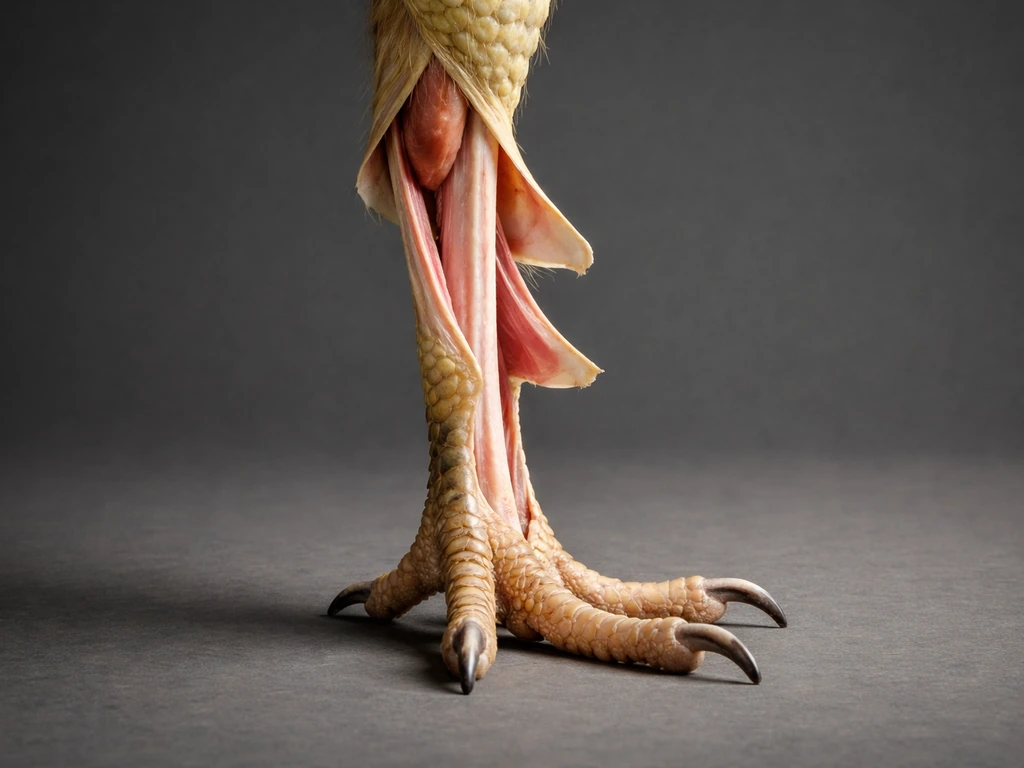
Bird leg anatomy overview
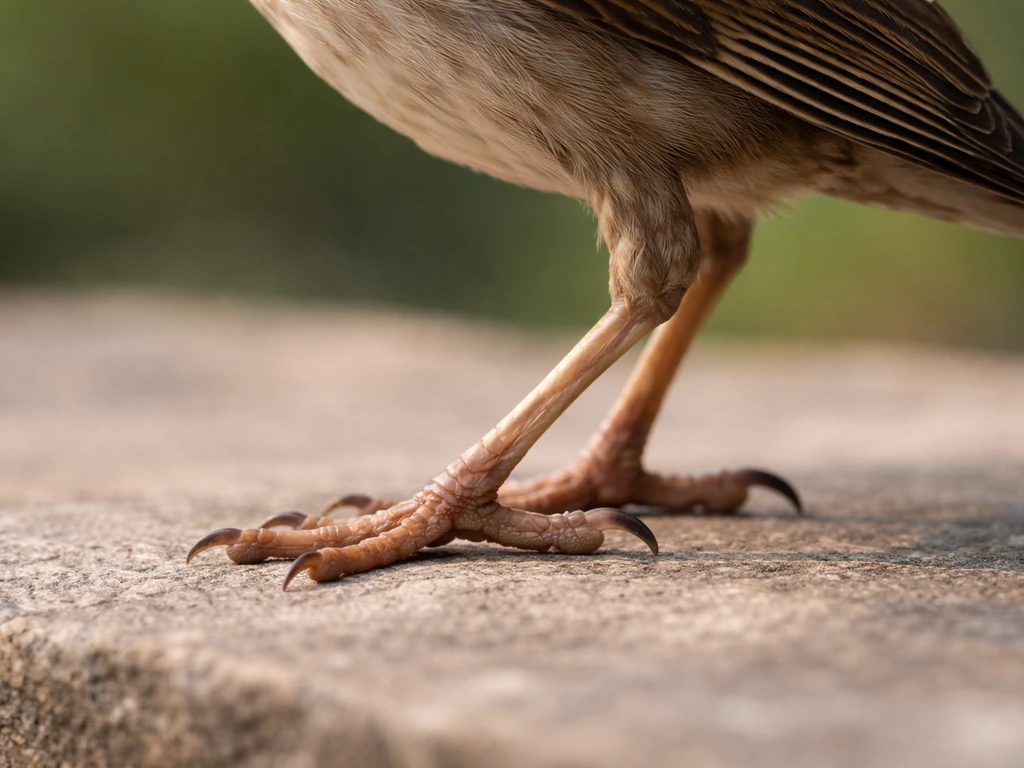
If you look at a bird standing still, what you see as the "leg" is actually a mix of true leg bones, fused ankle bones, and elongated foot bones. Most of the actual leg (the part containing the femur, or thigh bone) is hidden up inside the body, tucked under feathers. What looks like the knee bending backward on a heron or a pigeon is actually the ankle. The real knee is higher up and almost never visible. I spent a long time thinking birds had backward knees before I figured this out, and I'm guessing I'm not alone.
Birds are digitigrade animals, which means they walk and stand on their toes rather than on the full foot the way humans do. Think of a bird's "foot" as being closer to the front half of a human foot, always raised up on the ball. This posture shapes everything about how the leg bones, muscles, and tendons are arranged, and it's why bird legs look so different from ours even though the underlying components are structurally similar.
Bones and joints in bird legs
The bird leg skeleton has four main segments moving from the body downward: the femur (thigh), the tibiotarsus (the long shin bone, itself a fusion of the tibia and part of the ankle), the tarsometatarsus (the lower visible "leg"), and finally the toe bones, called phalanges.
The tarsometatarsus is the standout structure here. It's a bone found only in birds and some non-avian dinosaurs, formed by the fusion of several ankle bones (tarsals) and foot bones (metatarsals) into a single rigid unit. The tarsometatarsus is homologous to the mammalian ankle (tarsus) plus metatarsals homologous to mammalian ankle and metatarsals. In mammals, those same bones stay separate and make up a flexible ankle and midfoot. In birds, they're locked together into one long lever, which helps with efficient push-off during walking and takeoff. When people say bird legs are mostly fused bones, this is what they mean.
The joints between these bones work much like other vertebrate joints, with cartilage cushioning the contact surfaces and ligaments holding bones in alignment. The knee joint, between the femur and tibiotarsus, points forward (just like a human knee) but sits so high on the body and is so well-feathered that it's nearly impossible to spot on most living birds.
Muscles, tendons, and how legs move
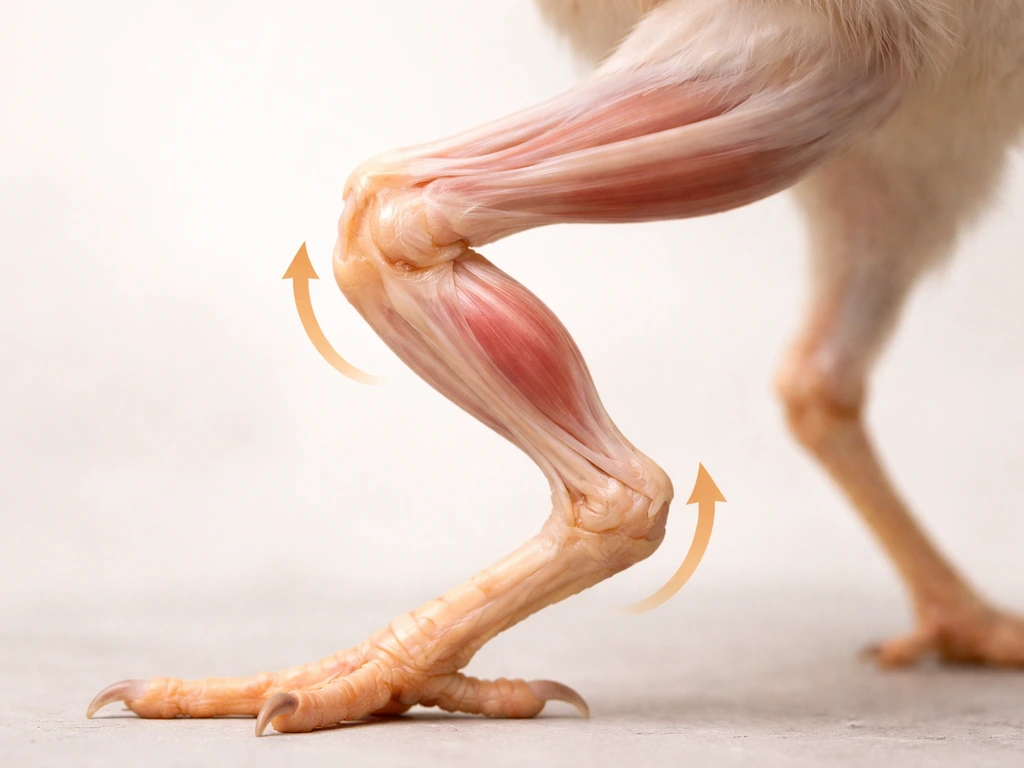
Here's something that surprised me when I first read about it: most of the muscle mass in a bird's leg is concentrated high up on the femur and tibiotarsus, close to the body. The lower leg and foot contain relatively little muscle tissue. Instead, long tendons run all the way down from those upper muscles through the tarsometatarsus and into the toes, acting like cables pulling on pulleys. The next step is to see how these bones, muscles, and tendons coordinate to power walking, perching, and takeoff tendons run all the way down.
This arrangement keeps the lower leg and foot light, which matters enormously for flight. Moving mass closer to the body's center reduces the energy needed to swing the legs and helps with aerodynamic balance. Studies counting the toe actuators (the muscles and tendons that control toe movement) across different bird species find anywhere from 11 to 18 distinct units, split between extrinsic muscles (arising from the tibiotarsus and controlling toe movement from a distance) and intrinsic muscles (smaller ones arising from the tarsometatarsus itself).
Perching birds have an especially clever setup. When a bird lands on a branch and bends its legs, the flexor tendons in the foot are pulled taut automatically, causing the toes to curl and grip without the bird having to consciously squeeze. A limbless prey for a bird, like a snake, can still be grasped effectively because the bird's toes and tendon-locking grip respond instantly when the tendons pull taut. This is sometimes called the tendon-locking mechanism (TLM).
The tendons have ridges and bumps that engage with matching structures in the tendon sheath, essentially locking the grip in place. A sleeping bird on a branch doesn't fall off because this passive mechanical lock holds the toes closed with no muscular effort required.
Skin, scales, and outer covering
The outer surface of a bird's lower leg and foot is called the podotheca. It's not bare skin the way human forearms are. Instead, it's a tough, keratinized (hardened) layer that forms overlapping scales or plates. These are called scutes or scutella depending on their size and location, and different parts of the foot can have different scale arrangements. The front of a chicken's lower leg, for example, has large overlapping scutes, while the back has smaller, differently shaped ones.
Research into the composition of these scales shows they contain primarily beta-keratin, the type of keratin associated with birds and reptiles rather than the alpha-keratin more common in mammalian skin. Some regions also have alpha-keratin in the underlying or transitional layers. The result is a hard, durable, somewhat flexible outer surface that protects the foot from abrasion, moisture loss, and the general wear of walking on rough ground or gripping bark.
This scaly covering is one of the clearest visible reminders that birds are, evolutionarily speaking, a lineage of reptiles. If you look at a bird's foot next to a lizard's foot, the surface texture is recognizably similar.
Feet and claws: toes, keratin, and beak-like keratin structures
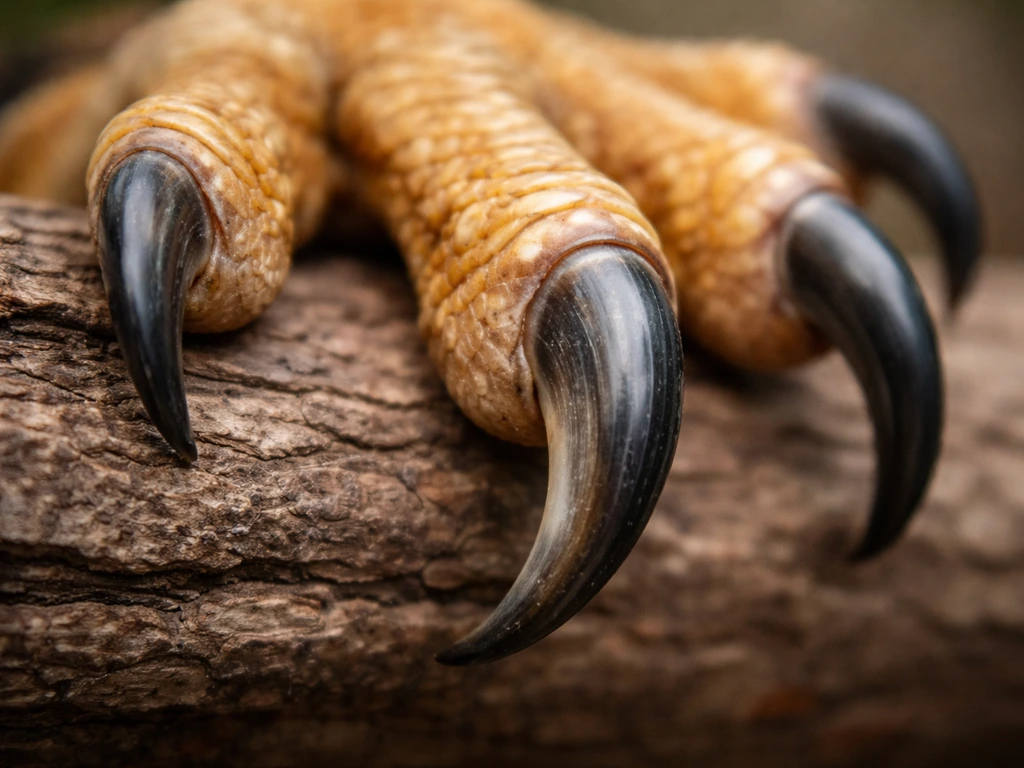
At the ends of the toes sit the claws, and this is where keratin really takes center stage. A bird's claw is essentially a hardened, curved sheath of keratin wrapped around the terminal phalanx, the last bone in each toe. The bone inside provides the structural core and gives the claw its basic shape; the keratin sheath is the hard outer layer you can see and feel. Claws are generally curved and pointed, though the degree of curve varies widely depending on how the bird uses its feet.
In raptors, the claws are called talons, and they tend to be longer, more curved, and more strongly built than those of seed-eating or wading birds. The keratin in a talon is layered and maintained naturally by wear during hunting and gripping. In the wild, a healthy raptor rarely needs its talons trimmed because normal use keeps them shaped correctly. The structural analogy to a beak is real: both are keratinized epidermal structures built over a bony core, hardened by beta-keratin, and continuously growing from the base.
Most birds have four toes (though ostriches have two and emus have three), and the typical arrangement has three toes pointing forward and one pointing backward, called the hallux. The hallux is the toe that hooks under a branch during perching and plays a major role in the grip-locking mechanism described earlier.
How bird leg composition supports walking, perching, and balance
All of these materials, bone, tendon, muscle, keratin, work together in a system tuned over millions of years for specific behaviors. The fused tarsometatarsus acts as a rigid lever that transfers force efficiently during each step. The high placement of heavy muscle mass keeps the bird's center of gravity close to its wings, making flight easier. The tendon-locking mechanism means perching requires almost no sustained muscular energy, which is why birds can sleep on branches for hours without falling.
Walking on the ground, which is worth thinking about as a separate challenge, involves a different coordination of those same muscles and tendons. Birds that spend a lot of time walking (think robins hunting worms or herons stalking in shallows) tend to have proportionally larger leg muscles and slightly different tendon geometry than birds that rarely come down from the trees. How a bird walks on the ground is shaped directly by the proportions and stiffness of these same internal components.
Balance is partly a skeletal story too. Because birds are digitigrade and carry their weight on their toes, the tarsometatarsus functions almost like a built-in shock absorber and balance rod. The scaly podotheca gives grip on uneven surfaces, and the arrangement of toe angles (spread wide apart when landing, curled tight when perching) gives the foot a wide effective base when needed and a vice-like grip when not.
A quick material map from inside to outside
| Layer / Component | Main Material | Function |
|---|---|---|
| Femur, tibiotarsus, tarsometatarsus | Bone (some hollow/pneumatized) | Structural support and lever action |
| Joints | Cartilage and ligament | Cushioning and alignment between bones |
| Upper leg muscles | Skeletal muscle tissue | Power generation for movement |
| Tendons | Dense collagen connective tissue | Force transmission from muscles to toes |
| Lower leg / foot outer surface (podotheca) | Keratinized skin with beta-keratin scales | Protection, grip, moisture retention |
| Claws / talons | Beta-keratin sheath over terminal phalanx bone | Gripping, perching, defense, prey capture |
Where to go if you want to dig deeper
If this has sparked more questions (it did for me), a few search terms will take you further fast. Look up "avian tarsometatarsus" to find clear skeletal diagrams showing exactly which bones fused into what. Search "tendon locking mechanism birds" for papers and diagrams explaining the perching grip in detail.
If you're curious about why bird legs look so thin despite supporting a full body weight, the short answer is that the muscle bulk is hidden higher up, but there's a lot more to it than that. If you are trying to identify individual birds rather than just their leg anatomy, see how to identify bird leg bands for practical ways to read bands in the field.
Bird legs can look especially skinny because much of the supporting muscle bulk is tucked higher up, with long tendons running down to the feet why are bird legs so skinny. And if you want to understand how the claw and beak are structurally related, searching "beta-keratin birds" will connect the dots between scales, claws, and feathers in a way that's genuinely satisfying.
For visual learners, finding a labeled bird skeleton diagram at a natural history museum website or in an ornithology textbook and matching each labeled bone to what you see on a live bird is one of the best practical exercises. Once you spot the real "knee" hiding under feathers and realize what the visible joint actually is, bird legs never look quite the same again.
FAQ
Are bird legs mostly bone, or is it mostly soft tissue?
It depends on what you count. The visible lower leg and foot have relatively little muscle bulk, but they contain tendon cords, joint cartilage, and the outer podotheca. Most of the leg muscle mass sits higher up on the femur and tibiotarsus, with tendons doing much of the work down at the toes.
What part of a bird’s leg is actually the “knee,” and why does it look backward?
The true knee joint is higher on the body, between the femur and tibiotarsus, and it is usually hidden by feathers. The bend that looks like a backward knee on many birds is the ankle region, where the fused segments are arranged to point the visible joint differently.
What is the podotheca made of, and does it contain keratin like claws?
The podotheca is a hardened, keratinized covering with overlapping scales or plates. Its dominant keratin type is usually beta-keratin (with some alpha-keratin in certain layers), while claws are also keratinized but use the claw sheath around the terminal toe bone for the visible hard tip.
Do all birds have the same number of toes and similar claw structures?
Most birds have four toes total, with three typically facing forward and one (the hallux) pointing backward. However, exceptions exist, like ostriches having two toes and emus having three. Claw shape and thickness also vary by lifestyle, such as raptors versus wading or perching birds.
Why do perching birds not fall asleep, even though they’re not constantly gripping?
Many use a tendon-locking mechanism. When the legs bend on a branch, flexor tendons become taut and the toes curl into place through an interaction between tendon ridges and the tendon sheath, producing a passive grip. This reduces the need for sustained muscular effort while resting.
Is keratin the same material as human fingernails?
Claws are made of keratin and are structurally similar in concept to nails, but the specific keratin chemistry can differ. Bird scales and claws are often dominated by beta-keratin, whereas mammalian skin commonly relies more on alpha-keratin.
Why do bird legs look thin if they must support body weight?
A big reason is location. Muscle bulk is concentrated higher up near the body, so the lower leg and foot carry less mass and are instead dominated by tendons and joint structures. This keeps the distal parts lighter, which also helps flight efficiency.
Do bird leg bones fuse like they do in mammals, or is it different?
Fusing patterns are distinct. The standout difference is the tarsometatarsus, formed by multiple ankle and midfoot elements fused into a rigid lever. In mammals, those corresponding elements remain separate and create a more flexible ankle and midfoot.
Can a bird’s claw regenerate if it breaks, or do they need trimming?
In many wild raptors, talons are maintained naturally through wear from gripping and hunting, so trimming is usually unnecessary in healthy conditions. If a claw is severely damaged in captivity, professional assessment is important, because regrowth depends on how much of the keratin and underlying living tissue were affected.
What makes bird feet good at gripping different surfaces like bark and wet ground?
Grip comes from multiple material and mechanical features working together. The podotheca provides traction through tough scaly surfaces, while toe angle and the tendon-locking system change when perching or landing. Claw curvature also varies by how a bird stabilizes on different substrates.
Next Article
How Much Weight Can an Osprey Bird Carry: Numbers & Limits
How much weight can an osprey carry: typical prey 0.5–2 kg (≈30–100% body mass); anatomy, flight limits and evidence.