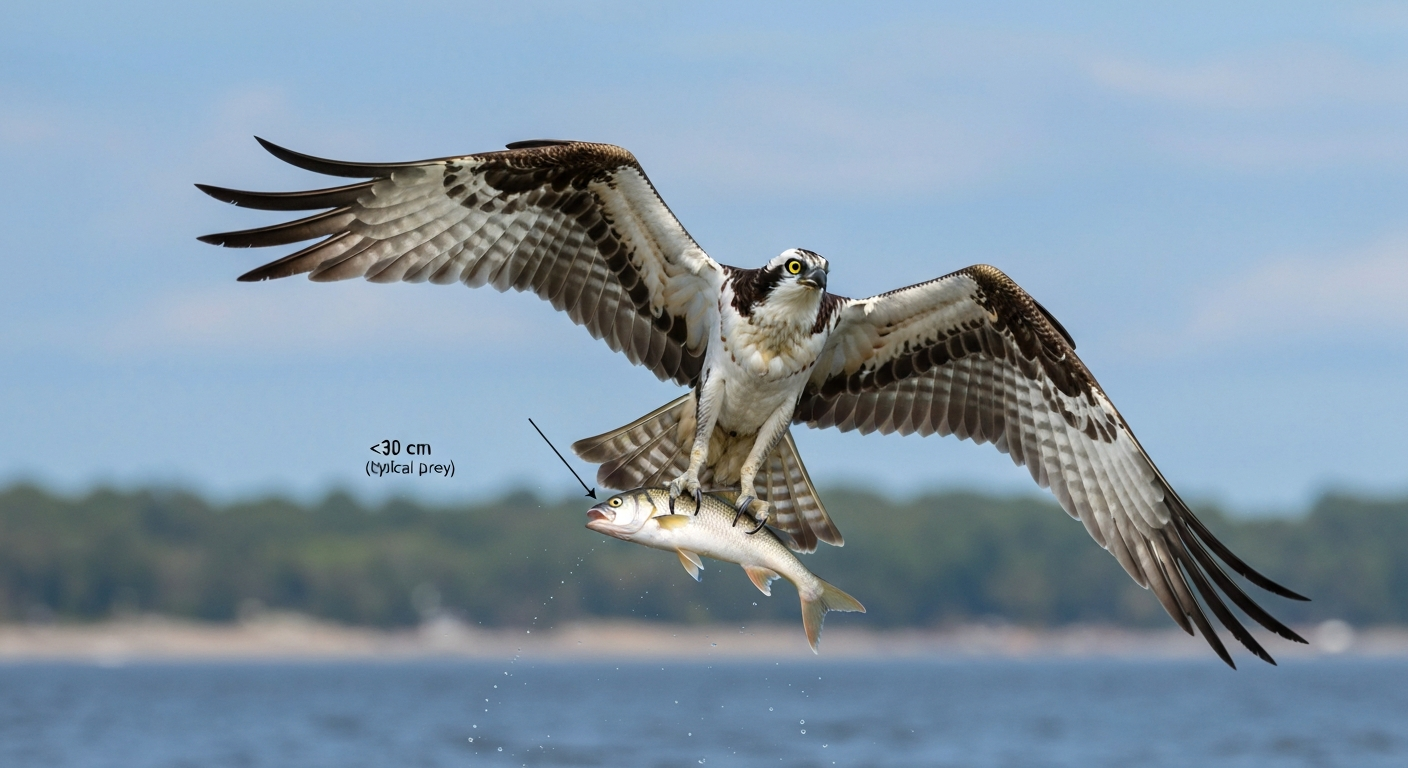
An osprey can typically carry a fish weighing around 150 to 300 grams, which works out to roughly 10 to 20 percent of its own body weight. On occasion they haul out something much larger: fish up to around 2 kg have been reported fairly regularly, and one documented regional record from Russia describes an osprey taking a 2.8 kg northern pike, which would be nearly twice the bird's mean body weight. That upper end is rare and extraordinary, not Tuesday afternoon behavior. For most dives on most days, you're watching a bird wrestle a fish that weighs about as much as a large apple.
How Much Weight Can an Osprey Bird Carry: Numbers & Limits

Marcus Chen
14 Jul 2026
Key terms worth knowing before we dig in
A few concepts come up repeatedly when talking about how much any bird can carry, so it helps to have them defined clearly upfront rather than buried in jargon later. For broader context on avian payload limits, see the guide how much weight can a bird carry.
- Wingspan: the total tip-to-tip measurement of both outstretched wings. For ospreys this typically falls between 127 and 180 cm depending on sex and subspecies.
- Wing area: the total surface area of both wings combined, used as a denominator in lift and loading calculations. For ospreys, comparative datasets place this at roughly 0.30 m².
- Wing loading: body mass divided by wing area (kg per m²). Higher wing loading means a heavier bird relative to its wing surface, which demands more speed and power to stay aloft. A payload adds directly to this number.
- Lift: the aerodynamic force generated perpendicular to airflow as the wing moves through air. Lift must equal or exceed total weight (bird plus prey) for sustained flight.
- Payload: the extra mass a bird carries beyond its own body weight, in this case the fish.
- Talon morphology: the shape, curvature, and arrangement of the claws. Osprey talons are unusually specialized compared with most other raptors, and that specialization matters enormously for gripping wet, slippery fish.
How big is an osprey, exactly?
Ospreys (Pandion haliaetus) are medium-to-large raptors, though they often look bigger in flight than they are on a scale. The global mean adult body mass compiled across studies is approximately 1,505 grams (about 1.5 kg). That number masks a significant split between sexes: males in North America typically run 1,200 to 1,600 g, while females range from roughly 1,600 to 2,000 g. Female ospreys are noticeably larger than males, a pattern called female-biased sexual size dimorphism, and in ospreys this difference runs about 15 to 25 percent.
Subspecies also matter here. The North American subspecies (P. h. carolinensis) averages around 1.7 kg and tends to be the largest. The Eurasian nominate subspecies (P. h. haliaetus) averages closer to 1.53 kg, while the smaller Australasian osprey (P. h. cristatus) comes in at roughly 1.25 kg. So when you see a percentage-of-body-mass figure for osprey carrying capacity, the actual kilogram limit shifts depending on which population you're talking about.
| Subspecies / Region | Mean Adult Mass | Typical Wingspan |
|---|---|---|
| P. h. carolinensis (North America) | ~1.7 kg | 150–180 cm |
| P. h. haliaetus (Eurasia) | ~1.53 kg | 145–175 cm |
| P. h. cristatus (Australasia) | ~1.25 kg | 127–160 cm |
| Global mean (all sexes combined) | ~1.505 kg | 127–180 cm |
What fish do ospreys actually eat, and how heavy are they?
Diet studies from multiple regions consistently show that ospreys prefer fish in a fairly narrow size window. Most prey caught falls in the 25 to 35 cm length range, which translates to roughly 150 to 300 grams for many common species. In North America, ospreys frequently target sunfish, shad, yellow perch, and trout. In inland Japan, regional diet studies identify largemouth bass and crucian carp as dominant prey, with similar size-class distributions. The preference for mid-sized fish is not random: smaller fish give poor energetic return, and very large fish create serious problems at the water surface (more on that below).
It is worth noting how researchers actually measure this. True direct weighing of prey in the field is uncommon. Most diet studies record fish species and length classes, then convert length to estimated mass using established fish length-weight relationships from ichthyology. This means prey mass values in the literature are often calculated estimates rather than measured weights, which is worth keeping in mind when you see very specific numbers cited.
| Prey Category | Typical Length | Estimated Mass | Notes |
|---|---|---|---|
| Small fish (e.g., small perch, juvenile shad) | 15–20 cm | ~50–100 g | Taken but energetically marginal |
| Modal prey (sunfish, trout, crucian carp) | 25–35 cm | ~150–300 g | Most commonly reported in diet studies |
| Large prey (large bass, pike, carp) | 40–60 cm | ~1–2 kg | Occasional; creates takeoff difficulty |
| Exceptional documented record (northern pike, Russia) | >60 cm | ~2.8 kg | Single observational record; treat as rare maximum |
Real-world carrying observations
Field observations, photographic records in archives like the Macaulay Library and iNaturalist, and regional monitoring reports give us a practical picture. Photos and videos often allow researchers to estimate fish length against known reference scales, though direct mass measurement is almost never available from this kind of evidence. What they consistently show is an osprey orienting its catch head-first before sustained flight, a behavior described in detail below.
The 2 kg figure comes up repeatedly in authoritative species summaries as a reasonably plausible upper end for prey ospreys have been documented carrying over distances. The 2.8 kg pike record from a Russian regional monitoring report represents the most extreme single-instance claim in the published literature, but it is a single observational record without detailed mass-measurement metadata, and should be understood as an extreme outlier rather than a repeatable benchmark. Carrying a fish that approaches or exceeds the bird's own body weight is genuinely extraordinary, and behavioral evidence suggests ospreys sometimes abandon prey that proves too heavy to lift cleanly from the water.
Three very different lifting challenges
Not all carrying situations are equal, and the osprey faces three distinct physical challenges that have meaningfully different energy costs. Understanding these differences explains a lot about why you sometimes see an osprey struggling in the water before it gets airborne.
Lifting from a perch
This is the easiest scenario. An osprey sitting on a branch or nest post with a fish already in its talons simply spreads its wings and drops into flight. There is no added water resistance, no surface tension to overcome, and the bird has a moment to assess and orient its catch before committing to a takeoff run. The only physics at work are gravity and aerodynamic lift, and the osprey can choose whether the fish is worth carrying before it leaves the perch.
Lifting from water after a plunge dive
This is where things get genuinely hard. After a plunge dive, the osprey must accelerate upward from the water surface while simultaneously dealing with several compounding forces: the mass of water clinging to its feathers and the fish, surface tension and adhesion at the water-air interface, splash-induced drag during initial acceleration, and the resistance of pulling a slippery wet object through the surface layer. Biomechanics literature describes these collectively as added-mass effects and surface forces, and they substantially raise the mechanical power required for that initial haul-out compared with a clean perch takeoff. This is precisely why very large fish represent such a risk: an osprey that strikes a fish too heavy to overcome these forces can become trapped at the water surface, and there are documented cases of ospreys drowning when they could not release a large fish quickly enough. For context on physiological risk from injuries and blood loss in birds, see guidance on how much blood can a bird lose.
Sustained flight with a load
Once airborne, the challenge shifts to maintaining enough lift and power to fly with the added payload over any meaningful distance back to a nest or perch. This is where aerodynamic power margins become the limiting factor, and it is also where the head-first fish orientation becomes critical. Ospreys almost always rotate their catch so the fish faces forward, parallel to the direction of flight. This reduces frontal drag from the fish by a significant margin, making sustained flight with a large prey item far more efficient than carrying it crosswise.
The anatomy that makes this possible
Ospreys have a cluster of anatomical features that are unusually well-suited to catching and carrying fish, several of which are shared with no other raptor or shared in a much more developed form.
Talons and toe arrangement
Most raptors have a fixed three-forward, one-back toe arrangement. Ospreys have a reversible outer toe, meaning they can position two toes forward and two back (called a zygodactyl grip in some contexts, though ospreys are not permanent zygodactyls the way owls are). This gives them a symmetrical, four-point grip on a struggling fish that is far more secure than a standard raptor grip. Their talons are also strongly curved and have rough, spiny pads on the underside of the toes called spicules, which function like grip tape on a slippery wet surface. This combination of reversible toe and spicule pads is unique among diurnal raptors and is a direct adaptation for fish-carrying.
Legs and grip strength
Osprey legs are relatively long and powerful, built to absorb the impact of a high-speed plunge strike and transmit force to the talons during grip. The flexor tendons running to the toes are strong and arranged so that the grip tightens automatically as the leg bends, meaning a struggling fish actually causes the talons to grip harder rather than easier to escape. This passive mechanical locking is essential for holding large, powerful fish during the difficult water-exit phase.
Pectoral muscles and body shape
The pectoralis (chest) muscle is the primary flight engine in birds, and in active soaring and flapping raptors it typically accounts for 12 to 20 percent of total body mass. This muscle drives the downstroke, generating most of the lift and thrust needed during powered flight. Osprey body shape is relatively streamlined for a bird that carries bulky, irregular loads: long narrow wings suited for both soaring and flapping, a relatively deep keel (sternum) for muscle attachment, and a compact body that keeps its own drag contributions modest.
The aerodynamics and biomechanics of carrying a payload
Here is where I had to go back to basics when I first looked into this properly, because the physics is more interesting than a simple weight limit implies.
Wing loading and what a fish does to it
Using the osprey's mean body mass of approximately 1.505 kg and a measured wing area of roughly 0.30 m², the baseline wing loading works out to about 5. Derived wing loading (simple calculation): using mean body mass 1.5055 kg (Newton et al. 2016 / Dunning) and wing area 0.30 m² (comparative dataset) => wing loading ≈ 1.5055 kg / 0.30 m² ≈ 5.02 kg·m⁻² (≈49.2 N·m⁻² when multiplied by g=9.81 m·s⁻²) Using mean body mass 1.5055 kg (Newton et al. 2016, citing Dunning) and wing area 0.30 m² (Hot wings PMC table) yields a derived wing loading of ≈5.02 kg·m⁻² (≈49.2 N·m⁻²).. 02 kg per square meter (or approximately 49 N per square meter). Add a 300 g fish and wing loading rises to around 6.02 kg/m². Add a 2 kg fish and it climbs to roughly 8.35 kg/m². Wing loading increases directly translate into higher minimum flight speeds and greater power requirements, especially at the low speeds characteristic of takeoff and initial climb. There is no sharp cutoff point where the bird suddenly cannot fly; instead, the aerodynamic power margin narrows progressively until takeoff either becomes impossible or requires an impractically long running start across the water surface.
Lift, power, and the payload ceiling
Classical avian flight models (particularly the framework developed by Colin Pennycuick) treat available mechanical power as the key constraint on payload. The pectoralis muscle can only produce so much power per kilogram of muscle mass: experimental measurements in raptors place short-burst outputs at several hundred watts per kilogram of muscle, but sustained cruise power is considerably lower. As payload increases, more of that available power is consumed just maintaining level flight, leaving less margin for the acceleration and climbing required after a water exit. This is why very large fish are a genuine physical risk and not just awkward: the bird may simply not have the power available to accelerate to flying speed while also pulling against the surface forces holding it at the water.
Drag reduction and the head-first orientation
Once airborne, the osprey's habit of rotating its fish head-first is a real aerodynamic optimization, not just tidiness. A fish carried crosswise presents its full width as frontal area, dramatically increasing parasitic drag. Head-first, the tapered fish nose points into the airflow and the body trails behind in a shape that is considerably more streamlined. Field observations and species accounts consistently document this reorientation behavior, and it is one of the cleaner examples in bird biology of an animal effectively solving an aerodynamic problem through learned or instinctive behavior.
How ospreys compare with other raptors
Comparing ospreys with eagles, kites, falcons, and other birds of prey puts their carrying capacity in useful context. For related context on raptor lifting ability, see how much weight can a kite bird lift, which compares payload limits across different raptor species. For broader context on lifting limits across species, see how much can a bird lift. For broader context on payload limits across raptors, see how much weight can a bird of prey carry (internal ref: fc1bf52f-dd39-44c9-aab2-500b5521aaa8). Ospreys are genuinely capable fish-haulers relative to their body size, but they are not the absolute champions in the raptor world by raw payload mass. For related information on payload limits in other large birds, see how much weight can a crane bird lift.
| Bird | Approx. Body Mass | Typical Prey / Payload | Notable Carrying Feature |
|---|---|---|---|
| Osprey (Pandion haliaetus) | 1.2–2.0 kg | 150–300 g typical; up to ~2 kg recorded | Reversible toe, spicule pads for fish grip |
| Bald Eagle (Haliaeetus leucocephalus) | 3.0–6.3 kg | ~1–2 kg typical; larger in exceptional cases | Greater absolute mass; broad wing for soaring with load |
| Peregrine Falcon (Falco peregrinus) | 0.3–1.0 kg | ~100–300 g typical prey | Speed-adapted; carries proportionally lighter prey |
| Red Kite (Milvus milvus) | 0.8–1.3 kg | ~100–250 g typical | Buoyant, low wing loading; prefers carrion and small prey |
| Crane (Grus grus) | 3.5–6.1 kg | Not a predatory carrier; rarely lifts live prey | Large size used for foraging, not prey transport |
The osprey's position in this comparison is interesting: it is a mid-sized raptor that is extraordinarily specialized for aquatic prey, and its anatomy allows it to carry fish that represent a much higher fraction of body mass than most comparable raptors routinely manage. A peregrine falcon, for example, is built for speed and aerial prey interception rather than hauling heavy loads. For comparison with raptors built for speed rather than hauling, see how much weight can falcon bird carry to learn typical falcon payload limits. Eagles can carry heavier absolute masses but are also far heavier birds themselves. The osprey sits in a practical sweet spot for fish-carrying specifically.
What this means for osprey behavior and conservation
The physics of carrying capacity has direct behavioral consequences. Ospreys select prey that offers a good energy return relative to the effort of catching and hauling it, which is why they strongly favor that 150 to 300 g modal prey size even when larger fish are available. Chasing and catching a large fish takes time and energy; hauling a 2 kg fish back to a nest while managing elevated wing loading over a long distance is genuinely expensive. The energetic calculation tips toward medium-sized prey across most populations.
From a conservation angle, prey availability within that optimal size range matters enormously. Ospreys nesting on heavily fished lakes or rivers where mid-sized fish are depleted may be forced to target either very small fish (poor return) or attempt larger, riskier catches. Monitoring prey-size distributions at active nests is therefore a useful indirect measure of aquatic ecosystem health in osprey habitat.
There are still genuinely open questions here, which is worth acknowledging honestly. The 2.8 kg pike record is a single observational report without rigorous mass verification. We do not have controlled experimental data on the exact power output of osprey pectoralis muscles during water-exit haul-outs. And the extent to which individual birds learn to assess prey mass before committing to a strike is not fully understood. The carrying capacity figures given throughout this article are based on the best available diet studies, allometric scaling, and biomechanical models, but bird biology frequently surprises us.
FAQ
How much does an adult osprey weigh?
Adult osprey mass varies by region and sex. Global mean (sexes combined) ≈1,505.5 g (1.5055 kg). Typical North American ranges: males ≈1,200–1,600 g; females ≈1,600–2,000 g (females ~15–25% larger on average). Subspecies means vary (e.g., P. h. haliaetus ≈1.53 kg, P. h. carolinensis ≈1.7 kg, P. h. cristatus ≈1.25 kg).
What is a typical osprey wingspan and wing area?
Adult wingspan is commonly reported ≈1.27–1.80 m (typical regional values ≈1.5–1.8 m). Comparative datasets report mean wingspan ≈1.59 m and wing area ≈0.30 m² for Pandion haliaetus, values used in flight and wing‑loading calculations.
What prey sizes and masses do ospreys usually carry?
Most diet and field studies report modal/typical fish catches ≈150–300 g (fish lengths often ~25–35 cm for many populations). These values represent the common, everyday prey items rather than occasional large-capture events.
What percentage of body mass do ospreys typically carry when flying with prey?
Using typical prey masses (150–300 g) and the global mean body mass (≈1,505.5 g), typical carried loads are roughly 10–20% of the osprey's body mass. Percent ranges will vary by individual size and local prey sizes (smaller males carry a greater percent for the same fish mass).
What are the documented maximum prey masses ospreys have been reported carrying?
Reports of much larger prey exist but are rare and often anecdotal. Authoritative summaries note ospreys commonly take fish up to ~2.0 kg on occasion; exceptional single-record reports (regionally cited) list captures such as a 2.8 kg northern pike. Such maxima should be treated as rare, possibly uncertain records rather than representative capabilities.
Why are those weight limits observed — what anatomical and aerodynamic factors matter?
Limits arise from multiple interacting constraints: (1) Aerodynamics: additional payload raises required lift and increases induced and profile power; wing loading (mass/wing area) increases with load, reducing climb rate and manoeuvrability. (2) Muscle power: available mechanical power is set by flight‑muscle (pectoralis) mass and muscle physiology; short burst power limits takeoff with heavy loads. (3) Talons and grip: talon size/curvature and toe arrangement (reversible outer toe) determine secure grip on slippery fish; grip and orientation affect how fish present drag in flight. (4) Hydrodynamics when exiting water: lifting a wet fish from the water incurs added‑mass, adhesion, and transient drag penalties that greatly raise initial power required. These factors are quantitatively framed by standard flight‑mechanics models (e.g., lift, power curves) and empirical observations.
Next Article
How Much Weight Can a Bird Carry Payload Limits Explained
Realistic payload ranges for different birds plus a method to estimate how much weight they can carry safely.