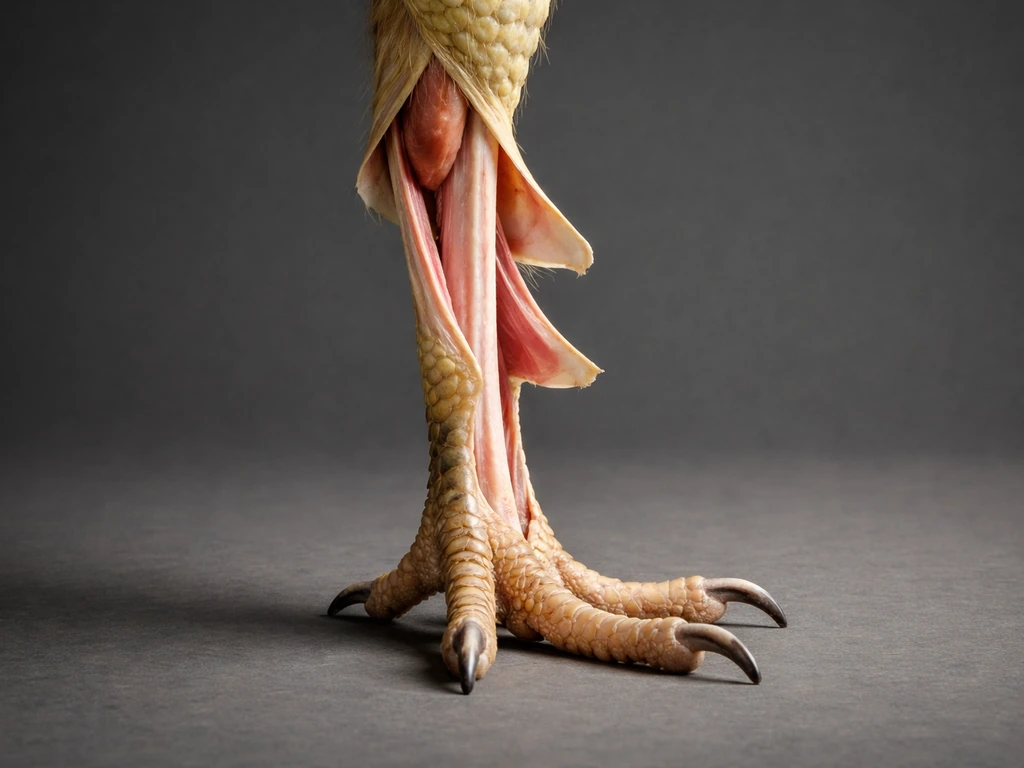
Bird legs work through a system of fused bones, spring-like tendons, and a few clever passive locking tricks that let birds stand, grip, run, and land without burning much energy at all. The segment you think is a bird's knee bending backward is actually an ankle joint. The real knee is tucked up close to the body, hidden under feathers. Tendons running through the leg store and release energy like compressed springs, and a passive tendon-locking mechanism lets perching birds sleep on a branch without gripping consciously. The whole system is lighter and more efficient than it looks.
How Do Bird Legs Work? Anatomy and Motion Explained

Marcus Chen
10 Jul 2026
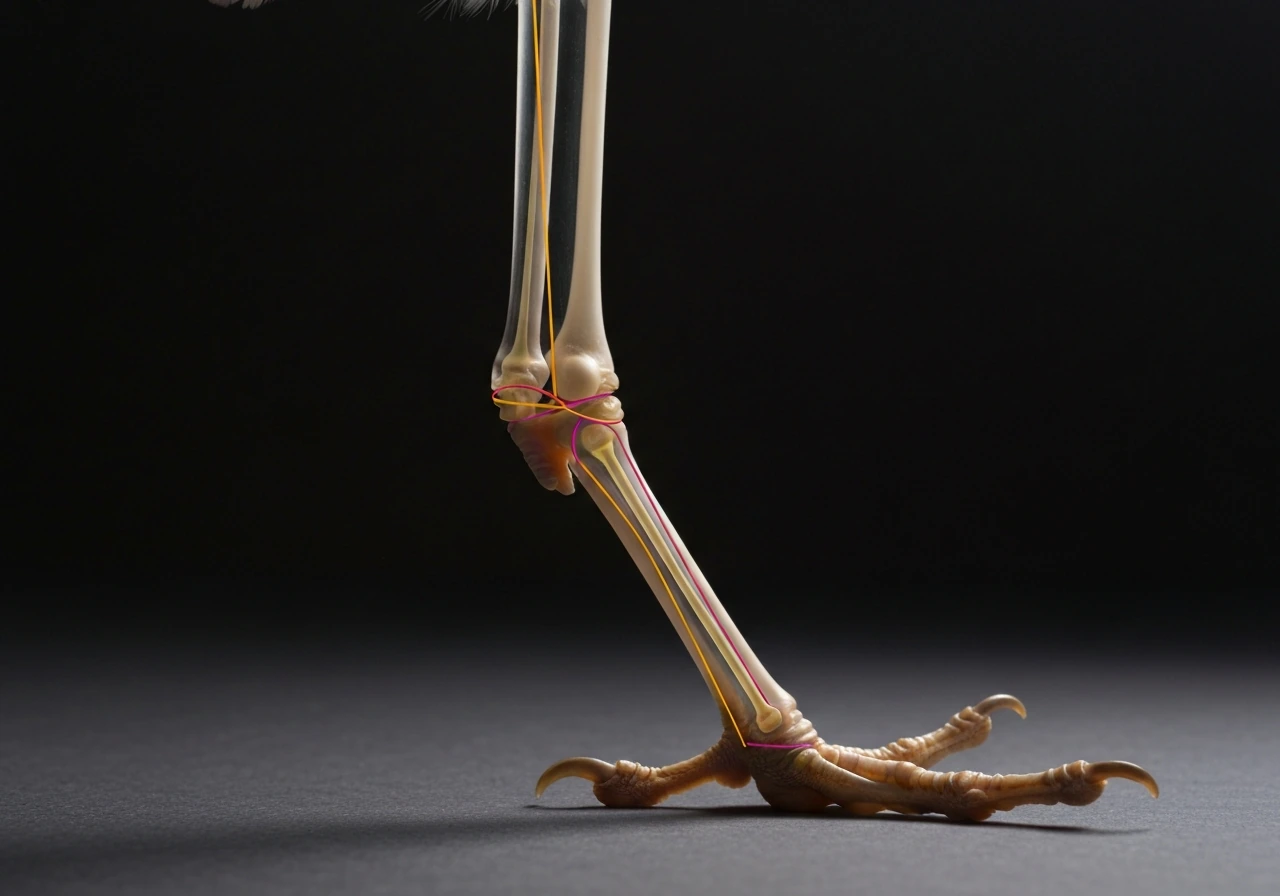
Bird leg anatomy: bones, joints, muscles, and tendons
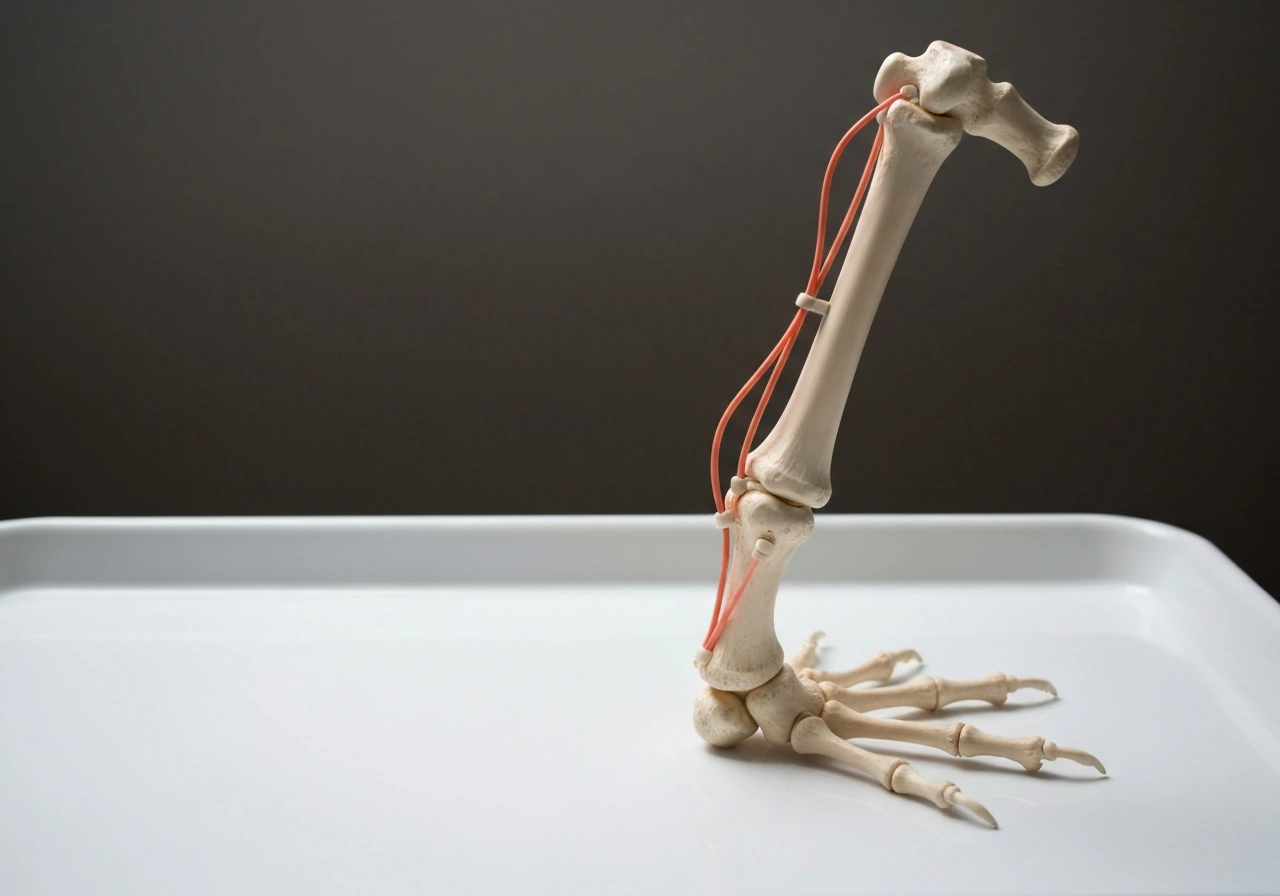
Start from the top and work down. The hip connects the leg to the pelvis, just like in us. Below the hip is the femur (thigh bone), which is short, horizontal, and mostly hidden inside the body cavity. This is why birds look like they have no thighs. Then comes the tibiotarsus, a long bone formed by the fusion of the tibia with the upper ankle bones. That gives it extra rigidity without extra weight. Below that is the tarsometatarsus, another fused bone formed from the lower ankle bones and the metatarsals (the foot bones). Birds essentially walk on their toes, with the tarsometatarsus functioning as an elongated foot segment.
This fusion business is worth paying attention to. By merging bones that would be separate in most vertebrates, birds end up with fewer moving parts to manage and a leg that is genuinely simpler in its lower section. Fewer joints below the knee mean fewer points of potential failure, less muscle mass needed down in the lower leg, and a lighter swinging limb overall.
The joint most people misidentify as the knee is the intertarsal joint, which sits between the tibiotarsus and the tarsometatarsus. It flexes in the same direction as a human ankle, because that is essentially what it is. The actual knee joint, connecting the femur to the tibiotarsus, bends in the familiar direction but stays so close to the body that you almost never see it move when watching a bird walk.
Muscles controlling leg movement are mostly concentrated in the upper leg and body, not spread down into the lower limb. Long tendons carry those muscle forces all the way down to the toes. The extensor tendons run down the front of the leg to extend (straighten) the toes, restrained by fibrous retinaculum bands that act like pulley guides across the intertarsal joint. The flexor tendons run down the back to curl the toes closed. This arrangement keeps the swinging part of the leg lean and light, which matters enormously for the energy cost of each stride.
How tendons store and release energy like springs
Here is where bird locomotion gets genuinely elegant. Tendons are not just passive ropes connecting muscle to bone. When they are stretched under load, they store elastic strain energy, then release it when the load is removed. In running birds, especially large cursorial species like ostriches, the tendons crossing the ankle and tarsometatarso-phalangeal joints behave like compressed springs: they load up during the stance phase as the bird's weight pushes down, then snap back to help propel the bird forward. Estimates in ostriches put elastic energy recovery in the digital flexor tendons alone at around 60 joules per stride. That is a meaningful fraction of the total energy budget for each step.
The long distal tendons in birds are a key part of this. Because the muscles are positioned high on the leg and the tendons run a long distance to the toes, those tendons are proportionally long relative to the muscle fibers they connect to. Long tendons stretch and recoil more readily than short ones, making them better elastic springs. Research on bird running gaits suggests this tendon architecture is a big reason birds can run economically, sometimes without even switching to a bouncing gallop the way mammals do.
Posture also interacts with tendon energy storage. A more crouched posture during midstance, which you can actually observe in emus moving at moderate speeds, increases the effective range over which tendons and joints can store energy. It is not just about tendon stiffness in isolation. The whole leg geometry shapes how well the spring mechanism works.
Feet and grip: how claws, perching, and balance actually work
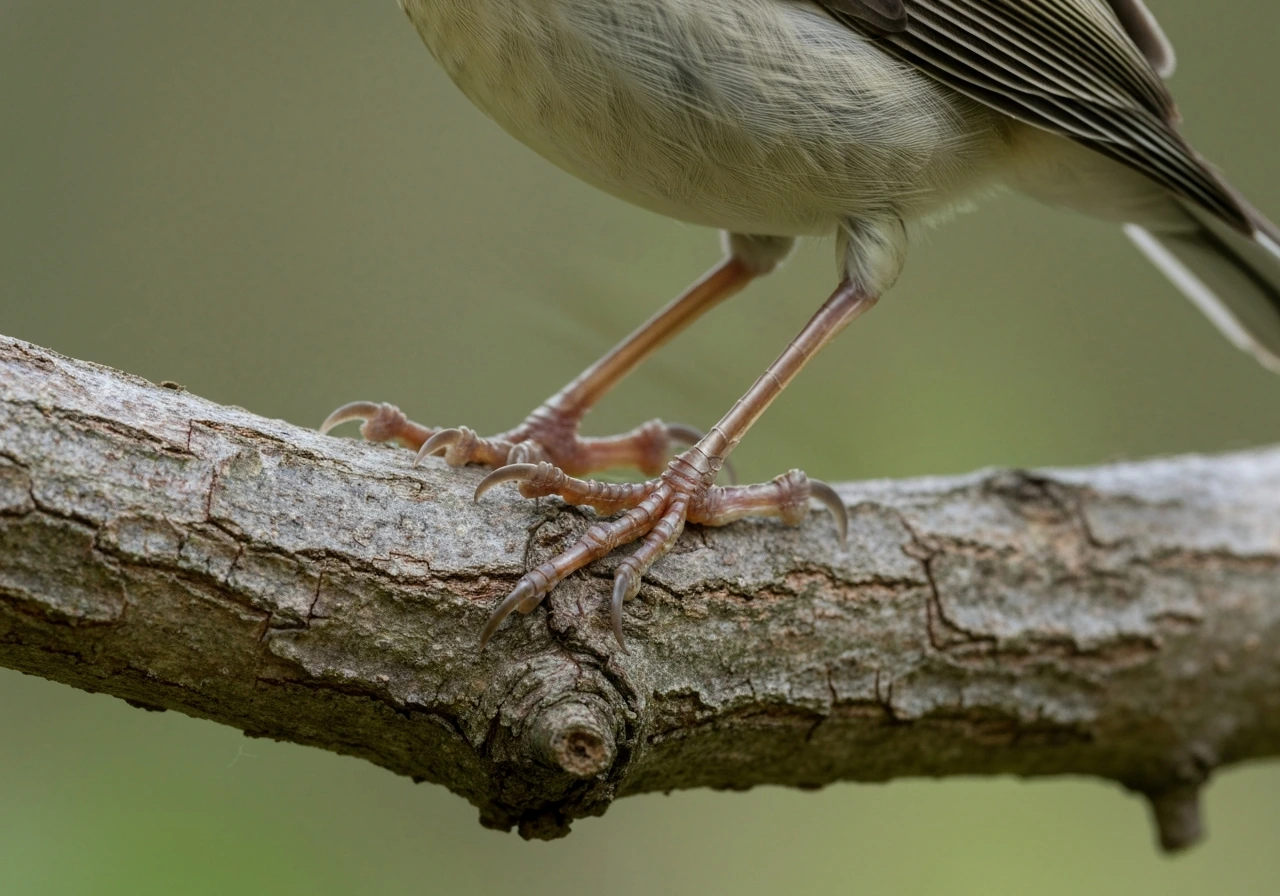
Most backyard songbirds have what is called an anisodactyl foot arrangement: three toes pointing forward, one (the hallux) pointing backward. That backward toe is the one that does the heavy lifting when a bird wraps its foot around a branch. Other arrangements exist too. Woodpeckers and parrots have zygodactyl feet (two toes forward, two back), which improves grip on vertical surfaces. Ospreys can rotate one toe to face backward for grabbing fish. Swifts have all four toes pointing forward (pamprodactyl), optimized for clinging to walls.
The gripping mechanics themselves are more passive than you might expect. When a bird lands on a branch and bends its leg, the flexor tendons running through the leg are pulled tight automatically as the intertarsal joint flexes. This is the Automatic Digital Flexor Mechanism (ADFM): the leg bending triggers toe curling without any active muscle contraction. Then, once the toes are curled around the branch, a second mechanism called the Digital Tendon Locking Mechanism (DTLM) engages. Tendon surface irregularities and fibrous sheaths create a kind of ratchet effect that locks the flexed digits in place passively. The bird can now sleep on that branch without its muscles working to maintain the grip.
This passive locking system turns out to be widespread across bird species, not just in perching songbirds. It shows up in wading birds, swimming birds, and climbers too. The locking mechanism is not exclusive to any one lifestyle. What varies is how strongly developed it is and how the toe proportions and claw curvature are tuned to the specific gripping task.
Balance during perching involves constant micro-adjustments coordinated through sensory feedback from the feet and legs. The mechanoreceptors in the foot pads and around the joints send position and pressure information back to the nervous system continuously. When the bird shifts its center of mass even slightly, small tendon and muscle corrections keep it from toppling. In practice, birds are remarkably stable on branches because the passive locking does the heavy work and only small corrections are needed on top of that.
Walking, hopping, running, and landing: what the legs actually do
Walking and running
Birds that walk use an inverted-pendulum gait at slow speeds, much like humans: the body vaults over a stiff, nearly straight leg, and energy swaps between potential and kinetic forms. If you are mainly curious about the actual on-the-ground movement itself, see how does a bird walk on the ground for the step-by-step mechanics behind those gaits walking. As speed increases, they shift toward a spring-mass bouncing gait where the leg compresses and rebounds like a pogo stick. The transition between these gaits happens smoothly in most birds, and the crouched posture many birds naturally maintain actually helps extend the range of speeds over which they can run efficiently without needing a full-gallop transition.
Some birds, including emus, use what researchers call a grounded run: a running-like gait where both feet never leave the ground simultaneously. This sounds like a walk, but the leg mechanics are spring-like rather than pendulum-like. Long elastic tendons make this possible at moderate running speeds, allowing the bird to move quickly without the high energy cost of an aerial phase in each stride.
Hopping
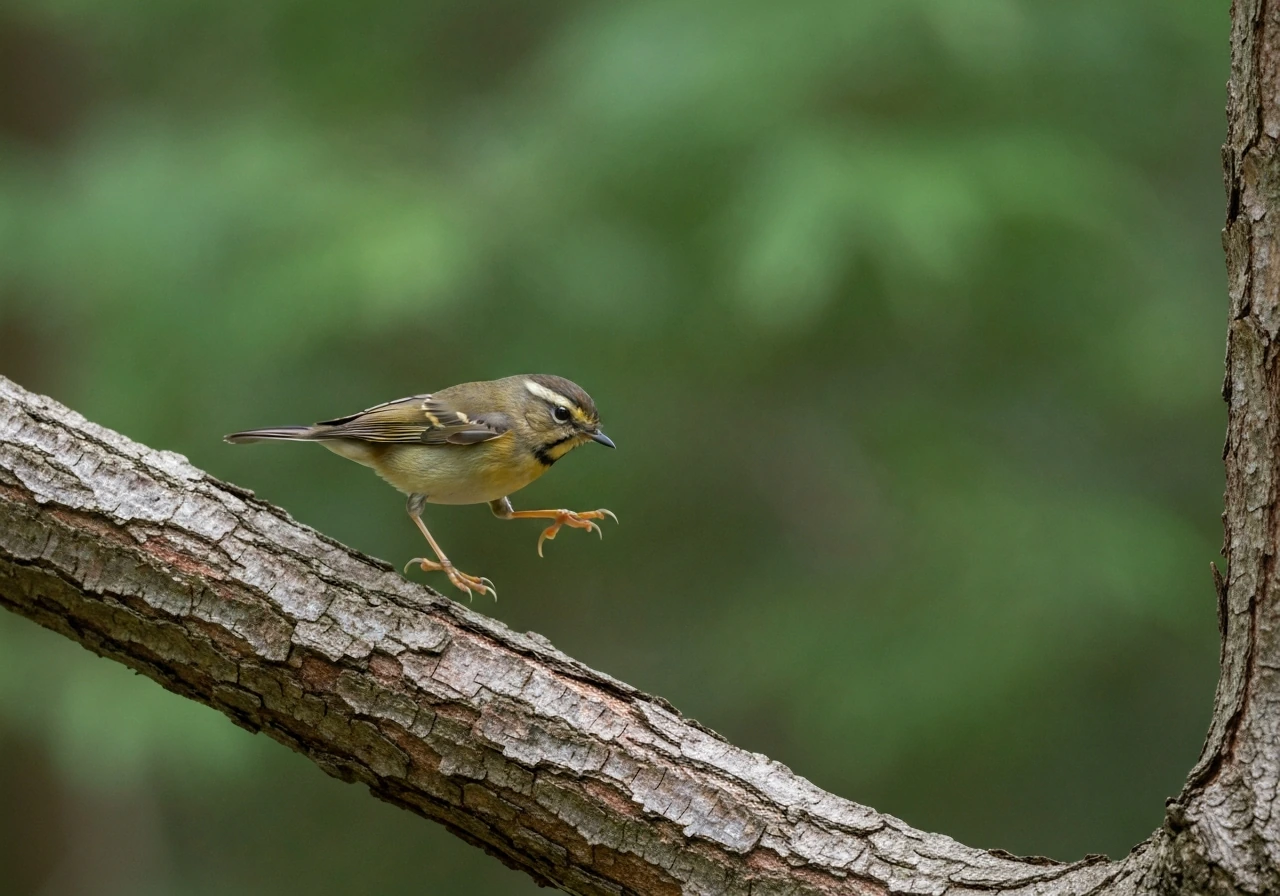
Many small perching birds hop rather than walk, meaning both feet leave and land together. Hopping is actually biomechanically efficient for small, light birds on broken terrain like branches and leaf litter. The leg joints flex and extend symmetrically during each hop, and the tendon spring mechanism contributes to the push-off. Knowing how the tendons and joints work also helps you understand how leg bands should be positioned and identified on a bird's legs tendon spring mechanism. You can think of it as the bird using both legs as a single compressed spring.
Takeoff and landing
Takeoff from a perch involves a rapid coordinated extension of the hip, knee, intertarsal joint, and tarsometatarsophalangeal joint in sequence, essentially an explosive leg straightening. The legs contribute meaningful initial velocity before the wings take over. Muscle activation and timing across all these joints is precisely coordinated, with EMG studies in pigeons showing distinct neural activation patterns during the push-off phase compared to normal standing.
Landing is the reverse challenge: the bird must bleed off airspeed, judge the perch location, and then absorb the remaining kinetic energy through leg flexion on contact. Pigeon landing studies show the bird decelerates with its wings first, then uses leg bending to absorb the final impact. The leg acts as a shock absorber at that moment, and the passive tendon locking engages immediately as the joints flex, securing the grip before any active muscle command needs to catch up.
How bird legs coordinate with the whole body
A bird's center of mass sits relatively far forward because of the flight muscles on the chest. That forward-heavy torso has to be balanced over the legs during walking and standing, which is why birds lean slightly forward and keep their legs positioned under their center of mass rather than directly below the hip. The crouched knee position (remember, that is the real knee tucked up near the body) actually helps with this, allowing the leg to fine-tune its effective length and angle during each stride.
During takeoff and landing, the wings and legs work together as a system. Muscle activity in the flight muscles changes in the moments right before and after leg contact with a perch, coordinating the whole-body energy transition. The nervous system is managing both limb systems simultaneously, not in strict sequence. This coordination is part of why watching a bird land on a thin branch and immediately settle into a stable perch looks so effortless.
Head movements also tie into leg coordination. Birds use head-bobbing during walking partly to stabilize their visual field between steps, which helps them monitor their foot placement and maintain balance. The bobbing is not random; it is phase-locked to the stride cycle. So the neck muscles, legs, and visual system are all running on the same timing loop.
How leg structure varies by bird type
Different lifestyles have pushed bird leg anatomy in noticeably different directions. Here is a quick comparison of the major functional types:
| Bird type | Example species | Key leg features | Primary function |
|---|---|---|---|
| Perching (passerines) | Robins, sparrows, finches | Short tarsometatarsus, well-developed hallux, strong DTLM passive locking | Gripping branches; hopping on ground |
| Wading birds | Herons, egrets, flamingos | Very long tibiotarsus and tarsometatarsus, reduced toe webbing, moderate DTLM | Standing in water; slow deliberate walking |
| Running birds (ratites) | Ostriches, emus, rheas | Massive tarsometatarsus, reduced toe count, long elastic tendons, digitigrade posture | High-speed sustained running; energy storage in tendons |
| Raptors | Hawks, eagles, owls | Strong curved talons, powerful digital flexors, anisodactyl or zygodactyl toes | Prey capture; gripping and killing with feet |
| Climbing birds | Woodpeckers, nuthatches | Zygodactyl or reversed-hallux layout, stiff rectrices for bracing, robust DTLM | Vertical clinging; moving along bark |
| Swimming/diving birds | Ducks, penguins, loons | Legs positioned far back on body, webbed or lobed toes, reduced terrestrial walking ability | Underwater propulsion; paddling at surface |
The proportions of leg segments shift substantially across these groups. Wading birds have elongated lower leg bones for standing in deep water while keeping the body dry. Running birds have reduced toe counts (ostriches are down to just two toes) because fewer, sturdier toes are better for ground contact at speed. Perching birds prioritize the hallux and the passive locking mechanism over raw speed or reach. These are not random differences; each one trades off one capability for another depending on what that bird actually needs to survive.
If you are curious about why bird legs look so thin given all the mechanical work they do, that leanness is largely explained by the muscle-high, tendon-long arrangement. Most of the mass is up near the body, not hanging out at the end of the limb where it would cost more energy to swing. The lower leg is mostly bone and tendon, which is why it looks so spare. The same fused bone architecture that keeps things simple also sheds weight where it matters most.
What to actually watch for next time you see a bird move
Now that you have the framework, here are a few things worth looking for when you are out watching birds. They make the anatomy click in a way that reading about it does not quite match. If you are wondering about birds with unusual prey, a limbless prey is typically linked to prey like snakes or eels that lack limbs what is a limbless prey for a bird.
- Watch the joint that bends backward on a walking bird. That is the intertarsal joint (ankle), not the knee. The real knee barely moves visibly.
- When a bird lands on a branch, notice how the toes snap closed almost the instant the feet touch. That is the passive ADFM engaging, not a conscious grip.
- Compare a heron standing still in water with a sparrow hopping on pavement. The heron's legs are doing almost nothing actively; the sparrow's are firing repeatedly with each hop.
- Watch a pigeon walk: the head bob is perfectly timed to the stride. Each bob forward coincides with a foot hitting the ground.
- Look at the lower leg of any bird closely and notice how little bulk there is below the intertarsal joint. That is the tendon-heavy, muscle-light architecture at work.
- Running birds like turkeys or roadrunners show a noticeably more upright posture at speed compared to their slow walk. The crouch shifts as gait changes.
Bird legs are a genuinely efficient solution to bipedal locomotion, and a lot of what makes them work so well is passive rather than active. Tendons storing energy, joints locking automatically, bones fused to reduce complexity: the leg is doing a lot of work without the bird necessarily having to think about any of it. Once you see that, it is hard not to watch every bird that walks past and notice something new.
FAQ
When I watch a bird, which joint is actually bending, the knee or the ankle?
Often it is the intertarsal region you are seeing, not a human-style knee. The true knee is higher up near the body where the femur meets the tibiotarsus, so most visible “bending” during walking looks like an ankle-type motion.
Do birds always use the same passive toe-locking mechanism, even while running?
Not always. Perching species use the passive locking more reliably at rest, while birds that mainly walk or run depend more on active muscle control and elastic recoil for propulsion. If a bird is moving briskly, you may see less obvious “sleep-lock” behavior.
How can I tell whether a bird is using tendon locking versus actively gripping?
If you see the bird standing still with toes curled, that is the locking at work. If the bird is stepping and frequently uncurling its toes, the lock is either being released or not needed because joints and tendons are cycling normally for gait.
Does a bird’s posture change how efficient its leg tendons are?
Yes, but the timing differs. A crouched posture increases the effective working range so tendons can stretch and recoil over a larger portion of stance, but if the bird is too upright it may get less elastic benefit and rely more on joint motion and muscle effort.
What is the difference between a grounded run and hopping in birds?
Large running birds can keep both feet from leaving the ground at once in a grounded run, and smaller birds can hop on unstable surfaces where the tendons and symmetric flexion provide a push. The shared theme is elastic tendons helping at moderate speeds without requiring an airborne phase every stride.
How do toe directions (forward and backward) affect what a bird can do?
In most cases, the forward-pointing toes provide traction and the rear toe acts like a clamp for perching, but the exact digit roles depend on the foot type. Species with different toe arrangements (like zygodactyl or pamprodactyl feet) tune toe orientation and claw curvature for their specific surfaces.
How do birds coordinate toe extension and toe curling during a step?
If you are looking at tendon function, look for how toe extension and curling happen relative to each step. Birds extend toes using tendons guided by fibrous pulley-like bands, and they curl toes when the relevant flexor tendons get pulled during joint bending, even before any deliberate toe “effort” looks obvious.
Is the toe lock purely about tendons, or do claws and sheaths matter too?
Tendon surface irregularities and surrounding fibrous sheaths create the ratchet-like effect for locking. In practice, claw shape and sheath arrangement must also match the digit geometry, so a “similar-looking” toe curl can still differ in how well it holds.
If toe locking is passive, how do birds stay balanced on a branch?
Yes. Sensory feedback from foot pads and joints continuously updates balance, even when locking reduces the need for active gripping. If a bird shifts its center of mass slightly, you can often see small corrective posture and micro-timing adjustments in the legs and body.
What do birds do differently with their legs during takeoff versus landing?
Yes, and it depends on where the bird is in the gait. During takeoff, the leg joints extend explosively, and after contact during landing, the wings help bleed speed first, then the legs flex to absorb the remaining impact and secure the perch quickly.
Does elastic recoil mean birds “save all” the energy during running?
Recovery is not 100 percent efficient. Even with strong elastic energy return, birds still spend energy on muscle activation, internal losses in tendons and joints, and stability control, so net savings are meaningful but not perfect.
Why can some birds look smooth on perches but less stable when landing on thin branches?
Takeoff and landing are also where coordination between wings and legs is most critical. If a bird misses timing and stiffens too much, it can increase impact forces on the legs, so coordinated muscle activation patterns and joint sequencing matter.
Next Article
What Are Bird Legs Made Of Inside Out Materials Explained
See what bird legs are built from: bones, joints, muscles, skin scales, and keratin toes and claws.