Headline: How Fast Can a Secretary Bird Run? Speed, Anatomy, and What the Science Actually Says
How Fast Can a Secretary Bird Run: Speeds, Anatomy, Evidence

Marcus Chen
16 Jul 2026
Meta description: Secretary birds can run around 1.82 m/s in measured trials. Learn what the science says about their speed, leg anatomy, and why 20 mph claims are unsupported.
The only peer-reviewed, instrument-measured running speed on record for a secretary bird is 1.82 ± 0.09 meters per second (roughly 6.6 km/h or 4.1 mph), recorded during three running strides from a single captive bird named Madeleine in a 2016 Current Biology study. That is a brisk trot, not a blazing sprint. Popular sources often claim secretary birds can hit around 32 km/h (20 mph), but none of those figures come with a measurement protocol, a sample size, or a primary data citation. For now, 1.82 m/s is the only number you can hold up against actual evidence.
Why anyone is even asking this
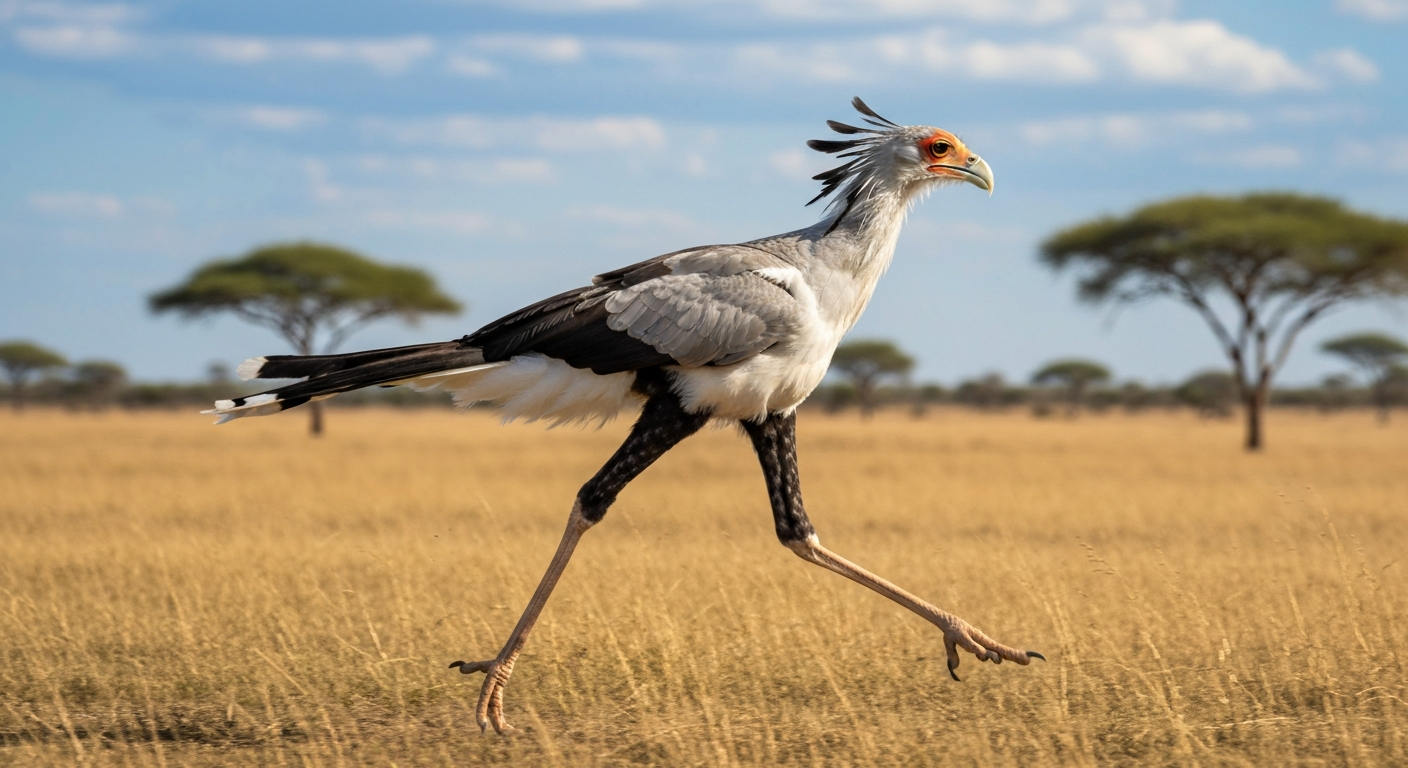
I'll be honest: when I first saw a secretary bird, my immediate thought was 'that thing looks like it was designed by a committee.' It has the body of an eagle, the legs of a crane, and what appears to be a punk-rock crest made of quill feathers. Then I found out it hunts by literally stomping snakes to death with its feet, and suddenly I needed to know exactly how fast those legs could carry it. Turns out I was not alone in wondering. The secretary bird (Sagittarius serpentarius) is one of the very few large raptors that spends most of its day walking across African grasslands rather than soaring overhead, which makes it a genuinely interesting case study in avian locomotion and leg biomechanics. Understanding its running speed is not just trivia: it connects directly to how the bird hunts, how its skeleton is built, and how biologists model running mechanics in large bipedal animals.
What the actual research measured (and what it did not)
The most rigorous data on secretary bird running comes from Portugal et al. (2016), published in Current Biology. The researchers were primarily interested in measuring the kicking forces the bird uses to dispatch prey, but as part of that work they also recorded overground running kinematics using synchronized high-speed video and a portable force plate sampling at 500 Hz. The subject was a single trained captive bird, Madeleine, with a body mass of 3.96 kg and a measured hip height of 0.692 m. Three running strides were captured, yielding the 1.82 ± 0.09 m/s value. The researchers then fitted a spring-loaded inverted pendulum (SLIP) model to the data, which is a standard biomechanics framework for understanding how running animals store and return elastic energy through their legs.
Three strides from one bird is a very small dataset, and the researchers themselves did not claim it represents a maximum sprint speed. It is a measured running velocity, probably somewhere in the bird's comfortable cruising-to-moderate-effort range. No published study has attached a GPS logger, accelerometer array, or force platform to a wild secretary bird specifically to record sprint speed during a prey chase. The field data that exist for wild individuals come from broader tracking studies focused on home range and habitat use, where GPS fix rates are typically too coarse (one fix per minute or slower) to capture instantaneous sprint speeds accurately. At those sampling rates, a brief five-second burst of fast running is essentially invisible in the data.
There is also an important methodological point worth understanding: accelerometers attached to birds can estimate speed through a technique called dead-reckoning (combining body acceleration and compass heading over time), but those estimates are species- and substrate-dependent and drift without frequent GPS ground-truthing. Qasem L et al. (PLOS ONE 2012) and Bidder et al. (Zoology 2012) review ODBA/VeDBA calibration and dead‑reckoning limitations, noting that acceleration–speed relationships are species‑ and substrate‑dependent and require frequent GPS ground‑truthing to avoid drift and large errors Qasem L et al., 'On Higher Ground: How Well Can Dynamic Body Acceleration Determine Speed in Variable Terrain?' PLOS ONE 2012; and Bidder et al., 2012 (Zoology) — reviews of ODBA/VeDBA and dead‑reckoning limitations.. On uneven grassland terrain, the error margins are substantial. So even if a biologger study did exist for secretary birds, interpreting the speed outputs would require careful calibration work that has not yet been published for this species.
The 20 mph claim: where it comes from and why it does not hold up
A speed of roughly 32 km/h (20 mph) appears on zoo websites, wildlife encyclopedias, and popular nature pages with remarkable consistency. The problem is that none of these sources explain how that number was obtained. There is no named study, no measurement protocol, no sample size. The figure appears to have propagated from one secondary source to another. Biomechanics provides a useful reality check here: using the Froude number framework (a dimensionless ratio of speed squared divided by the product of gravitational acceleration and hip height), reaching 32 km/h (roughly 8. Gatesy SM. Bipedal locomotion: effects of speed, size and limb posture in birds and humans. Journal of Zoology, 1991 (discussion of Froude/dynamic similarity in birds) discusses using the Froude number Fr = u²/(g·h) to compare gait and speed across birds and humans Gatesy SM. Bipedal locomotion: effects of speed, size and limb posture in birds and humans. Journal of Zoology, 1991 (discussion of Froude/dynamic similarity in birds).. 9 m/s) with a hip height of 0.692 m would require a dimensionless Froude number of about 11.6. That is far beyond the range seen in comparable large ground birds and would demand stride lengths and frequencies with no kinematic support in the published secretary bird literature. The measured 1.82 m/s corresponds to a Froude number of about 0.49, which sits neatly in the expected moderate-running range for a bird of this size, consistent with other large terrestrial birds. Speeds much above roughly 3 to 4 m/s (about 11 to 14 km/h) seem plausible during short bursts based on anatomy alone, but there is no measurement record to confirm a specific higher sprint value.
The anatomy that makes running possible at all
Secretary birds belong to their own monotypic family, Sagittariidae, and their body plan is quite different from most raptors. While hawks and eagles are built for aerial attack with powerful wing muscles and relatively short, grasping legs, the secretary bird has redirected much of its investment into its lower limbs. The overall body plan is relatively lightweight for a raptor, with a long neck and small head sitting on a deep keel-bearing thorax, and most strikingly, legs that are dramatically elongated compared to what you would expect for a ground bird of its mass.
Portugal et al. (2016) noted that the secretary bird's tibiotarsus (the lower leg bone, equivalent roughly to our shin and ankle combined) and tarsometatarsus (the long foot bone between the ankle and toes) are more than twice the length expected for a ground bird of equivalent body mass. This is not just an aesthetic quirk: longer distal limb segments change the rotational inertia of the leg, affect how quickly the bird can swing its leg forward during a stride, and alter the mechanical advantage available to the muscles driving each kick or running step. Museum specimen data compiled in large comparative datasets confirm these proportions across multiple individuals, not just Madeleine.
The bird is also broadly built for sustained walking rather than explosive speed. Field observations describe typical foraging paces of roughly 2.5 to 3.0 km/h with step rates around 120 steps per minute, covering large areas of open grassland systematically to flush and pursue small prey. Wings are sometimes spread during rapid terrestrial acceleration, which likely provides both balance and a small amount of lift to reduce effective ground reaction forces during a chase. This is a bird whose locomotor system evolved to cover ground efficiently over hours, not to outsprint a gazelle.
Leg and foot structure: the bones, joints, and toes
If you have ever seen a secretary bird skeleton (museum natural history collections have them, and they are worth seeking out), the legs are the first thing that stops you. The femur (thigh bone) is relatively short and held nearly horizontal under the body, which is typical of birds and keeps the center of mass stable. The elongated tibiotarsus drops steeply from there, and the tarsometatarsus adds another long segment before reaching the toes. This multi-segment leg design functions a bit like a spring: as the foot strikes the ground, the joints flex, storing energy in tendons and muscles, then release it to power the next stride.
The feet themselves are quite different from other raptors. Secretary birds have short, blunt, almost hoof-like toes compared to the long curved talons of a hawk or eagle. The hallux (back toe) is small and elevated, which is a feature shared with other primarily ground-dwelling birds. This toe arrangement provides a stable platform for walking and running on uneven grassland but sacrifices the gripping power used by perching raptors. The short toes also mean the bird delivers kicks more like a punch than a grasp: the Portugal et al. study recorded mean peak kick forces of about 195 ± 34 newtons (roughly 5.1 times the bird's body weight) with contact durations of only about 15 milliseconds, making each strike extraordinarily fast and forceful despite the relatively small toe surface area.
| Limb segment | Relative length | Functional role | Notable feature |
|---|---|---|---|
| Femur (thigh) | Short, near body mass center | Hip extension and stabilization during stance | Held subhorizontally under torso, typical of birds |
| Tibiotarsus (lower leg) | Very long (2x expected for body mass) | Spring-like energy storage and return during running | Elongation increases stride length and changes leg inertia |
| Tarsometatarsus (foot shaft) | Very long (2x expected for body mass) | Lever arm for toe extension; transmits ground forces | Proportionally longer than in most ground raptors |
| Toes | Short and blunt | Ground contact platform for walking, running, kicking | Reduced hallux; hoof-like rather than talon-like |
| Hallux (back toe) | Small and elevated | Minimal ground contact; vestigial gripping function | Elevated off ground during walking and running |
Muscles, tendons, and what actually powers each stride
Running in a large bird like the secretary bird is not simply a matter of strong muscles contracting harder and faster. It is a coordination problem involving tendons, bones, and the way elastic energy is stored and released. The SLIP (spring-loaded inverted pendulum) model used by Portugal et al. treats the entire leg as a single compressible spring during running: as the foot lands, the leg spring compresses and stores energy, then rebounds to propel the bird forward and upward into the next aerial phase. The measured running kinematics for Madeleine fit this model well, suggesting the secretary bird's running mechanics are broadly similar to other large bipedal runners despite its unusual leg proportions.
The tendons of the lower leg, particularly those running behind the tibiotarsus and through the ankle joint, are key to elastic energy storage. In many running birds (and the secretary bird appears to follow this pattern), the gastrocnemius and digital flexor tendons act as biological springs, stretching under load and recoiling to reduce the metabolic cost of each stride. This is the same principle that makes tendons so energetically important in running humans and ostriches. Classic scaling work by Alexander and Biewener established that larger animals generally have lower stride frequencies but longer stride lengths, and that muscle cross-sectional area (which sets maximum force output) scales in ways that constrain achievable sprint speeds. A bird of roughly 4 kg with 0.69 m hip height lands in a size range where moderate running speeds are energetically sustainable, but true high-speed sprinting requires either unusually high stride frequency or very long strides, both of which demand disproportionate muscle mass.
The secretary bird's unusually long distal leg segments present a biomechanical trade-off. Longer leg segments increase stride length, which is good for covering ground efficiently, but they also increase the rotational inertia of the leg, making it harder to swing forward quickly. This means the bird can take long strides but may not be able to cycle those strides at the rapid frequency needed for extreme sprinting. This is part of why the measured and estimated speeds for secretary birds are in the moderate range rather than the extreme range seen in ostriches, which have evolved a very different combination of fiber type, tendon geometry, and leg proportion specifically optimized for high-speed running.
Typical speed versus top speed: what varies and why
The distinction between foraging pace, comfortable running speed, and maximum sprint speed matters a lot here, and the data only really address the middle category. At a normal foraging walk, field accounts describe secretary birds moving at roughly 2.5 to 3.0 km/h with a deliberate, high-stepping gait that helps them spot prey in tall grass. The 1.82 m/s (about 6.6 km/h) measured in the lab is a running gait, clearly faster than a walk, but not necessarily a maximum effort.
Several factors would reasonably affect speed in wild birds that the lab study could not capture. Younger birds may run less efficiently due to immature musculoskeletal development. Substrate matters: running on firm, short grassland is mechanically easier than running on soft or uneven ground, and secretary birds hunt across a range of savanna conditions. Motivation is huge: a bird chasing a fleeing cobra or puff adder is presumably running harder than a captive bird in a controlled kinematic trial. Sex differences are possible but not well documented for running speed specifically. None of these variables have been systematically measured in this species, which is an honest gap in the literature.
Why the secretary bird runs in the first place: hunting on foot
The secretary bird's terrestrial locomotion is not just incidental to its lifestyle, it is the core of its hunting strategy. Species accounts in The Birds of Africa and the Handbook of the Birds of the World describe a bird that covers several kilometers of open grassland each day, systematically flushing invertebrates, small mammals, lizards, and snakes. When prey is spotted, the bird uses a short rapid chase, sometimes spreading its wings for balance and intimidation, to close distance. Prey is then dispatched with those extraordinarily fast, forceful kicks rather than with the beak, which is an unusual approach among raptors.
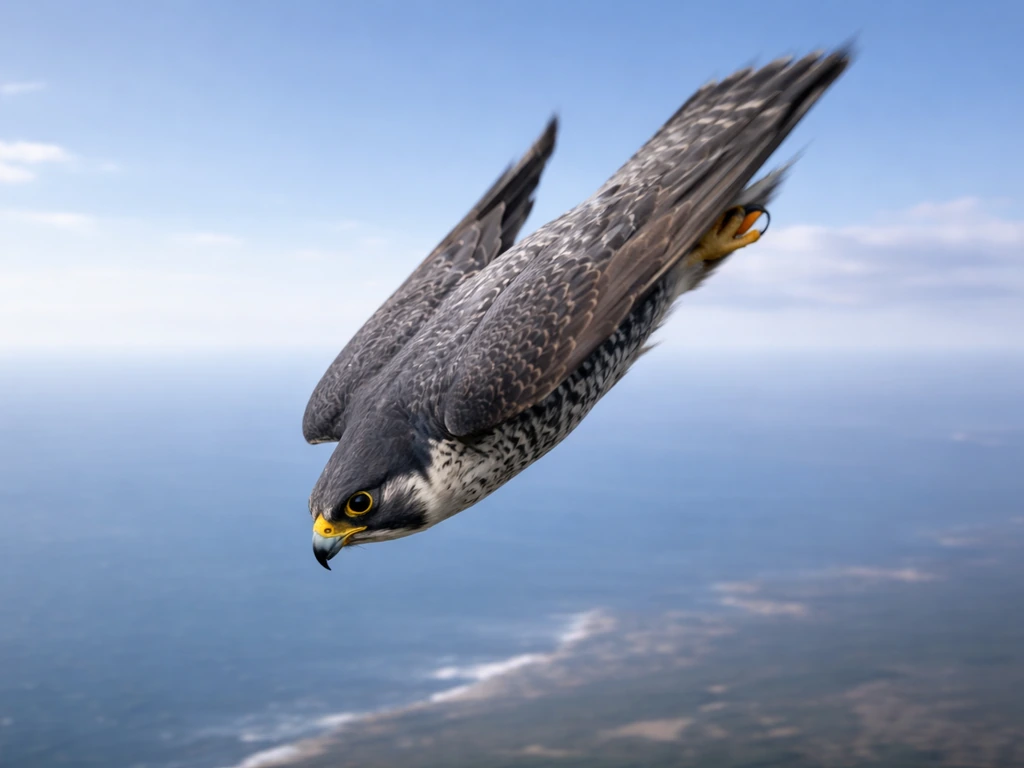
This strategy requires a locomotor system optimized more for sustained, efficient walking and moderate-speed chasing than for maximum sprint velocity. The secretary bird does not need to outrun a swallow or match the dive speed of a peregrine falcon, which can reach speeds well over 300 km/h in a stoop. It needs to close a few meters on a surprised snake before the snake reaches cover. A moderate burst speed in the range of perhaps 10 to 15 km/h (estimated, not measured) would be more than adequate for that purpose, and the anatomy supports exactly that kind of locomotion.
Speed in context: how the secretary bird compares to other notable birds
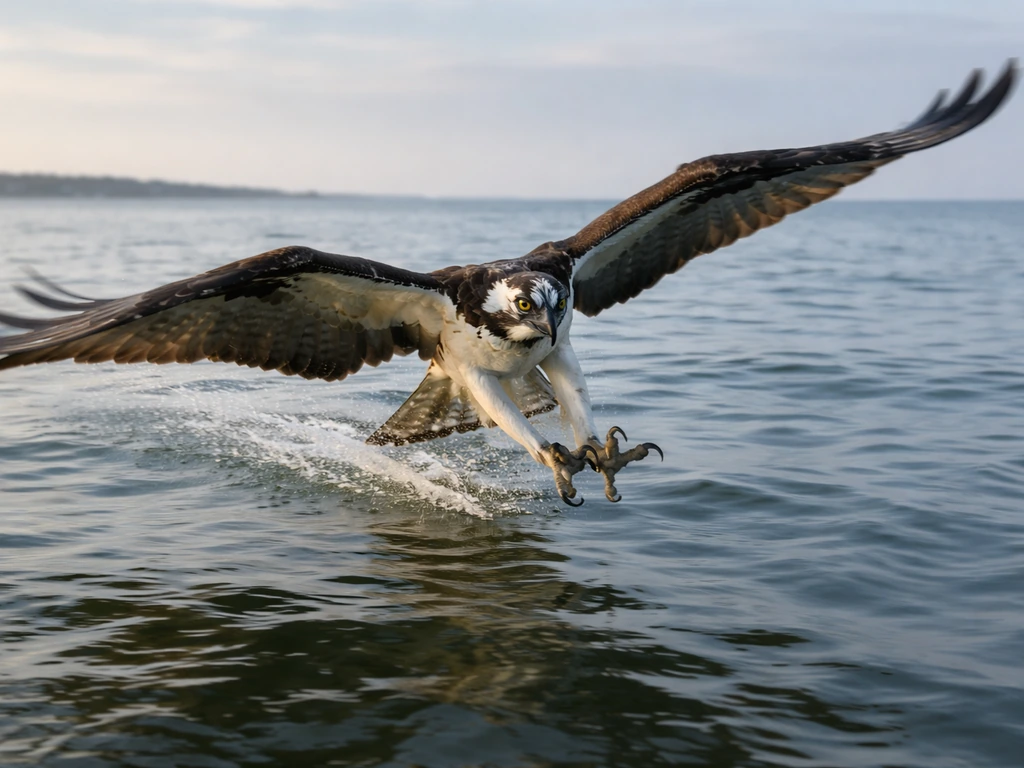
Comparing the secretary bird's running speed to other birds requires some care because most of the famous bird speed records are for flight, not ground running. Peregrine falcons are the fastest animals on Earth in a dive, and ospreys are impressive aerialists, but those speeds have nothing to do with how fast a bird moves on the ground. For readers interested in osprey flight performance, see a focused summary on how high can an osprey bird fly. For a direct comparison of aerial speeds, see how fast does an osprey bird fly. The honest comparison for the secretary bird is with other large terrestrial runners, and within the small set of birds that primarily run rather than fly to hunt. For a very different scale of avian speed, see sparrow bird top speed for small passerine sprint figures.
| Animal | Speed type | Measured or estimated speed | Data quality | Notes |
|---|---|---|---|---|
| Secretary bird | Overground running (captive) | 1.82 ± 0.09 m/s (6.6 km/h) | Peer-reviewed, 3 strides, 1 individual | Probably not maximum sprint speed |
| Secretary bird (popular claim) | Claimed top speed | ~32 km/h (20 mph) | Secondary/anecdotal, no primary data | Unsupported; likely unreliable |
| Ostrich | Sprint (field/treadmill) | Up to ~70–72 km/h | Peer-reviewed field and treadmill studies | Fastest living biped; specialized ratite morphology |
| Emu | Running | ~48 km/h | Field and treadmill measurements | Ratite; large but slower than ostrich |
| Peregrine falcon | Dive (flight) | ~320 km/h+ | Peer-reviewed radar/GPS studies | Flight speed only; irrelevant to ground running |
| Osprey | Flight cruise | ~50–80 km/h | GPS tracking studies | Flight speed only; not a runner |
| Sparrow | Flight | ~45 km/h | Field estimates | Small passerine; flight speed, not running |
| Common roadrunner | Running | ~32 km/h | Field measurements | Much smaller bird; highly cursorial relative |
The contrast with ostriches is instructive. Ostriches are built specifically for speed: two toes, dense extensor muscles, and long tendons that store huge amounts of elastic energy. Their sprint speeds of up to 70 km/h or more reflect decades of selective pressure on pure running performance. The secretary bird's legs are long but built around a different constraint set, namely the need to deliver powerful, precise kicks and to walk long distances efficiently rather than to sprint. It is a different kind of terrestrial bird entirely. It is also worth noting that the peregrine falcon and osprey comparisons, while interesting as examples of avian speed diversity, are flight specialists and their speed figures reflect aerial locomotion in fundamentally different conditions from ground running.
A summary of the key anatomy and speed metrics
| Measurement | Value | Source / context |
|---|---|---|
| Body mass (Madeleine) | 3.96 kg | Portugal et al. 2016, captive individual |
| Hip height | 0.692 m | Portugal et al. 2016, measured |
| Measured running speed | 1.82 ± 0.09 m/s (6.6 km/h) | Portugal et al. 2016, 3 running strides |
| Froude number at measured speed | ~0.49 | Calculated from u²/(g·h) |
| Tibiotarsus + tarsometatarsus length | More than 2x expected for body mass | Portugal et al. 2016 (morphological note) |
| Mean peak kick force | 195 ± 34 N (~5.1 bodyweights) | Portugal et al. 2016, force plate at 500 Hz |
| Mean kick contact duration | ~15 ± 4.4 ms | Portugal et al. 2016, high-speed video + force plate |
| Typical foraging walk pace | ~2.5–3.0 km/h | Brown, Urban & Newman, Birds of Africa; species accounts |
| Step rate at walking pace | ~120 steps/min | Species accounts summarizing Birds of Africa |
What we still do not know
This is the section I find myself writing a lot when I dig into avian biomechanics, and I think it is genuinely useful rather than just a disclaimer. The secretary bird's maximum sprint speed in the wild has not been measured. The 1.82 m/s value is from three strides of one bird at what was likely a moderate running effort. Whether wild birds can sustain or briefly exceed something like 5 to 7 m/s (18 to 25 km/h) during a prey chase is biologically plausible based on limb length and the Froude scaling framework, but it remains an estimate without empirical support. The 32 km/h popular figure is not well supported and probably inflated. A well-designed telemetry study using high-frequency GPS or a calibrated accelerometer harness on wild secretary birds during hunts would be an excellent contribution to the literature.
There are also open questions about variation between individuals, age classes, and habitat types that simply have not been addressed. Musculoskeletal development in juvenile secretary birds, differences in tendon stiffness between individuals, and the effect of prey-chase motivation on maximal effort are all unstudied in this species. Scientists still debate the finer details of how very long distal limb segments affect running efficiency trade-offs in large birds generally, and the secretary bird is an interesting and underexplored data point in that conversation.
The honest takeaway on secretary bird running speed
If someone asks you how fast a secretary bird can run, the most accurate answer is: we have one peer-reviewed measurement of 1.82 m/s (about 6.6 km/h), from a single captive bird in a controlled trial, and that is almost certainly not the bird's maximum effort. Anatomy and scaling suggest top sprint speeds of perhaps 10 to 15 km/h are plausible during short chases, but that range is an informed estimate, not a measurement. The popular claim of 32 km/h (20 mph) lacks any traceable primary data and should be treated skeptically. The secretary bird is a remarkable terrestrial runner with a highly specialized leg structure built around powerful, precise kicking and efficient long-distance walking, not around raw straight-line speed. Its legs are its most extraordinary feature, and the biomechanics of how those long limbs store and release energy with each stride is genuinely fascinating biology, even if the top-speed headline number remains frustratingly uncertain. For a related look at sprint abilities in a very different predator, see how fast can a bird-eating spider run.
FAQ
Title and meta description (SEO) — provide a concise headline and meta description (≤160 characters).
Headline: How Fast Can a Secretary Bird Run? Science‑Backed Speed, Anatomy & Ecology Meta description: Measured secretary‑bird running ≈1.8 m/s; here’s the evidence, anatomy, methods and realistic speed comparisons.
Quick numeric answer — single concise speed estimate with range and uncertainty.
Measured overground running speed (peer‑reviewed): 1.82 ± 0.09 m·s⁻¹ (≈6.6 ± 0.3 km·h⁻¹), based on three running strides in a trained captive individual (Portugal et al. 2016). Reasonable typical range for walking/foraging: ~0.7–1.0 m·s⁻¹ (2.5–3.6 km·h⁻¹) from field accounts; short, motivated bursts could plausibly reach somewhat higher speeds (unknown upper bound) but there are no peer‑reviewed sprint recordings above ~2 m·s⁻¹ for wild birds. Reported popular claims (~32 km·h⁻¹ / 20 mph) lack primary data and should be treated as unreliable.
How were secretary‑bird speeds measured and what are the evidence types and limits?
Measured methods and evidence - Primary peer‑reviewed source: Portugal et al. (Current Biology, 2016). High‑speed video and synchronized force‑plate recordings measured running kinematics and kicking mechanics for a trained captive bird ('Madeleine'). Running velocity reported: 1.82 ± 0.09 m·s⁻¹ (three strides). Kick forces were measured with a 500 Hz force plate (mean peak ≈195 ± 34 N). - Secondary evidence: field guides and species accounts describe typical foraging walking paces (~2.5–3.0 km·h⁻¹) and behavior but do not provide instrumented sprint data. - Methods that can estimate speed but require care: GPS tracks (low fix rates underestimate peak speed), high‑frequency accelerometers/IMUs calibrated to speed (need species‑ and substrate‑specific ground‑truthing), and dead‑reckoning combined with periodic GPS corrections. Limits & uncertainties - Sample size: peer‑reviewed running kinematics are from one trained captive individual and three stride measurements — not a population sample. - Context: captive trial conditions and motivation differ from wild escape/chase behavior; surface substrate, incline, and motivation strongly affect peak speed. - Instrument limitations: GPS smoothing and low sampling rates miss instantaneous peaks; accelerometer proxies require calibration. Therefore, higher top speeds reported online without primary data are unsupported.
What anatomical and physiological features enable secretary‑bird terrestrial running? (include anatomy/metrics table)
Key anatomy & metrics that support terrestrial running - Long distal limb segments: tibiotarsus and tarsometatarsus are unusually long relative to body mass, producing long strides and higher hip height (Portugal et al. 2016; museum datasets). - Muscles & tendons: relatively large leg muscle mass and elastic tendons provide force and recoil for repeated stepping and kicking; measured kick forces show high peak force and short contact times. - Foot and claw morphology: long toes with robust tarsometatarsus for weight support and striking/kicking prey. - Body mass and center of mass: moderate mass (~3.5–5 kg typical adult range) with a high hip height (~0.692 m measured in the study individual) affecting dynamic similarity and Froude scaling. Anatomy / metrics table (text table) Metric | Representative value (Portugal et al. 2016 / museum data) ---|--- Body mass (captured individual) | 3.96 kg Hip (functional) height | 0.692 m Measured running speed (3 strides) | 1.82 ± 0.09 m·s⁻¹ Tibiotarsus + tarsometatarsus length | >2× expected for a ground bird of same mass (relative measure) Peak kick force | ≈195 ± 34 N (~5.1 ± 0.9 bodyweights) Stride period / duty factor | Measured and used to fit SLIP model (see Portugal et al. 2016) Interpretation: long leg segments increase stride length and hip height (raising potential speed at given stride frequency), while muscle/tendon capacities set peak force and acceleration limits.
How do biomechanics and scaling principles predict plausible speeds?
Biomechanical context - Dynamic similarity: the Froude number Fr = u²/(g·h) (u = speed, g = 9.81 m·s⁻², h = hip height) is used to compare gait across sizes. Using h ≈0.692 m and measured u ≈1.82 m·s⁻¹ gives Fr ≈0.49 — within typical running ranges for birds. - Scaling constraints: larger birds have lower stride frequencies and greater limb inertia, limiting high sprint frequencies. Muscle physiological cross‑sectional area and lever arms scale non‑isometrically, constraining maximal sustainable force and acceleration. - Modeling: Portugal et al. used a spring‑loaded inverted pendulum (SLIP) running model fit to the measured kinematics; model outputs gave stiffness and force estimates comparable to other ground birds at the measured speed, supporting the empirical value. Conclusion: measured speed fits expectations from limb geometry and Froude scaling; extrapolating to much higher speeds would conflict with known scaling and kinematic data for similarly sized birds.
Typical vs top sprint speeds — variability and influencing factors (age, sex, substrate, motivation)
Typical vs top speeds - Typical foraging walking: ~0.7–1.0 m·s⁻¹ (≈2.5–3.6 km·h⁻¹) per field accounts and species descriptions. - Measured running (captivity): 1.82 ± 0.09 m·s⁻¹ (≈6.6 km·h⁻¹). - Plausible short bursts: might exceed measured value slightly if highly motivated (predator/escape/chase), but no validated peer‑reviewed records show sustained speeds near the commonly quoted 32 km·h⁻¹. Sources of variability - Age and sex: younger birds may be less powerful; adults of different sexes may differ slightly in mass and muscle condition — no published large sample to quantify sex/age speed differences. - Substrate and incline: soft or uneven ground reduces effective speed; hard flat substrate enables higher stride length and frequency. - Motivation and behavior: deliberate chase or escape increases acceleration and top speed versus casual locomotion during foraging. - Health/condition and training: captive trained individuals (like the study bird) may differ in performance from wild birds.