
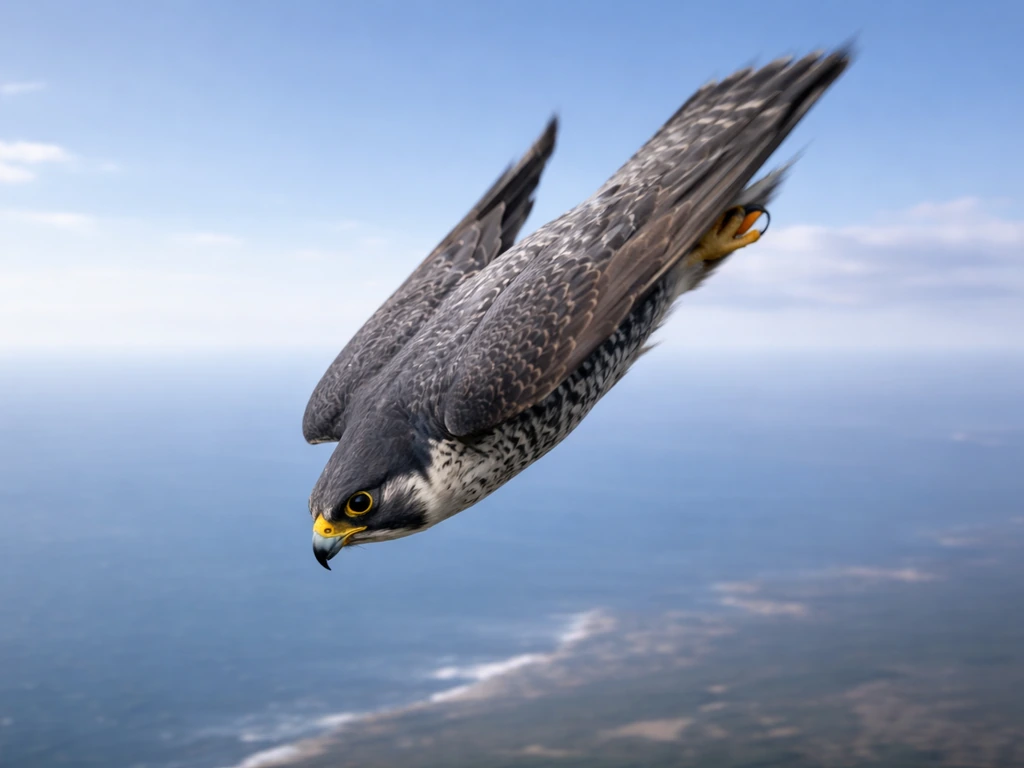
A peregrine falcon can hit 320 km/h (200 mph) during a hunting dive, making it the fastest animal on the planet. In normal level flight, though, it cruises at a much more modest 40–55 mph. Those two numbers are both correct, and the gap between them is exactly what trips people up when they go looking for a single "falcon speed" answer.
How Fast Is a Falcon Bird? Speeds, Stoops, and Facts

Marcus Chen
10 Apr 2026
The actual speed ranges, straight up
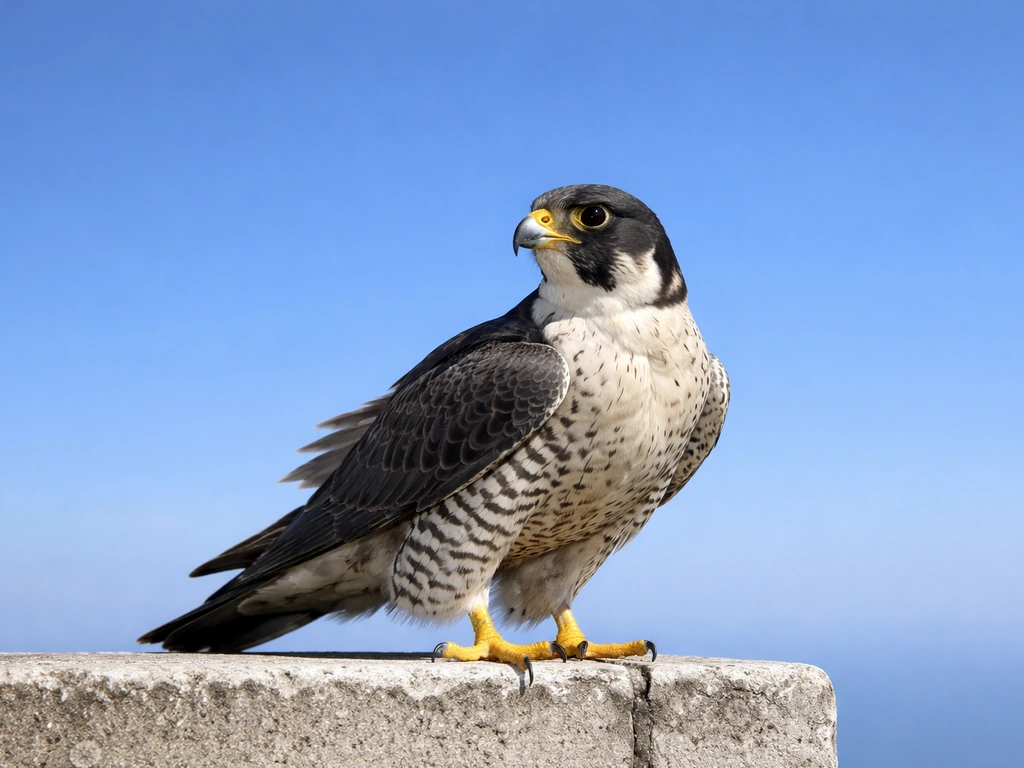
Here are the numbers you need, broken out by flight type for the peregrine falcon, which is the species almost every speed record refers to:
| Flight Type | Speed (mph) | Speed (km/h) | Context |
|---|---|---|---|
| Normal cruising/travel | 40–55 mph | 64–89 km/h | Everyday flying between perches or territories |
| Direct pursuit (level chase) | Up to 69 mph | Up to 112 km/h | Chasing prey horizontally |
| Typical hunting dive (stoop) | ~100 mph | ~161 km/h | Most common dive speeds observed |
| High-end hunting stoop | 200+ mph | 320+ km/h | Peak speed from heights over 1 km |
| Recorded maximum (Frightful) | 242 mph | 389 km/h | Ken Franklin's trained falcon in controlled conditions |
The 242 mph figure comes from a famous series of experiments with a trained peregrine named Frightful, documented by falconer Ken Franklin. That number is real, but it represents close to the absolute ceiling. The Cornell Lab of Ornithology puts the stoop maximum at around 200 mph (320 km/h), which is a fair working figure for most stoops from altitude. If someone asks you how fast a falcon bird is and you say "about 200 mph diving, 40–55 mph flying normally," you're being accurate and honest.
Cruising speed vs the hunting stoop: why they're so different
The stoop isn't just fast flying. It's controlled falling. A peregrine climbs high, sometimes well above 1 km, then tucks its wings close to its body and drops toward its target, letting gravity do most of the work while using its wings for steering and fine control. That's fundamentally different from level flight, where the bird has to generate all of its own forward thrust with each wingbeat.
In level flight, the peregrine is working against drag the whole time. Cruising at 40–55 mph is actually energy-efficient for the bird's size. When it needs to chase prey horizontally, it can push up to around 69 mph (112 km/h), but that's a sprint, not a sustainable pace. The stoop, by contrast, converts altitude into speed for free, then adds muscular thrust on top. It's a completely different flight mode, and treating both numbers as "falcon speed" without that context is like comparing a car's highway speed to its speed rolling down a steep hill.
Which falcon, which situation
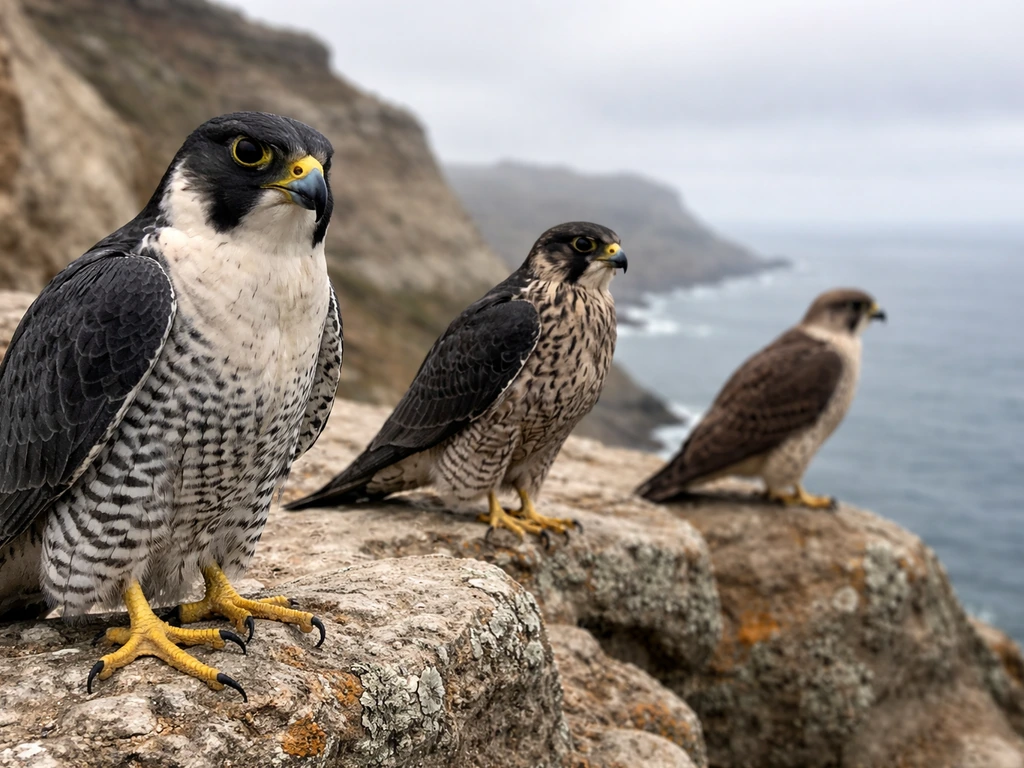
"Falcon" covers around 40 species worldwide, and the speed numbers vary quite a bit depending on which one you mean. The peregrine (Falco peregrinus) is the speed champion and the species behind every record-breaking headline. Other falcons are fast, but not in the same league when it comes to dive speed.
- Peregrine falcon (Falco peregrinus): the fastest, with dive speeds of 200+ mph and the highest documented stoop at 242 mph
- Gyrfalcon (Falco rusticolus): the largest falcon, capable of sustained fast level flight and powerful horizontal pursuit, but not known for extreme stoop speeds
- Prairie falcon (Falco mexicanus): a strong flier adapted to open country, typically stoops at speeds well below the peregrine
- Kestrel (Falco tinnunculus or Falco sparverius): much smaller, hovers in place hunting insects and small mammals, far slower overall
- Merlin (Falco columbarius): a compact, agile falcon built for horizontal speed and chasing small birds, not record-breaking dives
The hunting context matters just as much as the species. A peregrine hunting over flat marsh country may never need a full stoop. One hunting above cliffs or open ocean will use the stoop constantly. If you're reading a speed figure for a falcon, check whether it's a stoop measurement, a level pursuit figure, or just a general estimate, and which species it actually refers to. For a useful comparison with another bird of prey built for a very different kind of speed, it's worth reading about how fast an osprey flies, since ospreys are also diving hunters but work at completely different speeds.
The biology that makes falcons this fast
Wing shape and feather structure
Falcons have long, pointed wings, a shape called a high-aspect-ratio wing in aerodynamics. This is optimized for speed, not for the slow, soaring flight you see in broad-winged hawks. The primary feathers (the long outer flight feathers) are stiff, narrow, and tightly interlocked during a stoop, reducing drag dramatically. A peregrine in full stoop pulls its wings partially in against its body, creating a teardrop silhouette that minimizes air resistance. Compare that to a hawk spreading wide wings to thermal-soar, and you can see the trade-off: falcons gave up passive gliding efficiency for raw speed.
The feathers themselves are dense and structured to resist deformation at high speed. At 200+ mph, air pressure on a loosely arranged feather would cause flutter and drag. The peregrine's feather arrangement holds its shape under those loads in a way that most birds' feathers simply couldn't. This is one reason the peregrine falcon's top speed is so far above other birds: the entire feather and wing system is engineered (by evolution) for this specific task.
Body shape and the aerodynamic frame

A peregrine's body is compact and streamlined, with a relatively small frontal area. The skull, chest, and tail all taper in a way that channels airflow smoothly. The beak even has a small notch, called the tomial tooth, which helps kill prey quickly but also happens to channel airflow past the nostrils at high speed, preventing the kind of pressure buildup that would make high-speed breathing difficult. Some researchers think the bony tubercles (small projections) inside the peregrine's nostrils help manage airflow during a stoop, similar in principle to how jet engines use intake cones to manage supersonic airflow.
Muscle performance and skeletal structure
Falcons have a deep keel (the ridge of the sternum/breastbone) that anchors massive pectoral muscles. These muscles drive the downstroke of the wing, which is where most of the thrust comes from. The muscle fiber composition in peregrine falcons skews toward fast-twitch fibers for explosive bursts, which matters most for the powerful pull-out from a stoop and for rapid wingbeats during level pursuit. The skeleton is lightweight but rigid, with fused bones in the pelvis and a relatively inflexible torso that keeps energy losses from body flexion to a minimum during fast flight.
How breathing and energy work at these speeds
Birds in general have a respiratory system that is genuinely superior to mammalian lungs for sustained high-output exercise. Instead of a simple in-and-out breathing cycle, birds use a series of air sacs that create a one-way airflow through the lungs. Oxygen is extracted on both the inhale and the exhale, meaning birds get roughly twice as much oxygen per breath cycle as a mammal would from the same volume of air.
During a stoop, the peregrine is not actually flapping hard for most of the dive. It's managing the descent, using small wing adjustments for steering and braking. The muscular demand during the stoop itself is lower than during sustained level pursuit. The real oxygen and energy demand comes at the end: the pull-out, where the bird curves its flight path from vertical to horizontal, generating g-forces that require enormous muscular effort, and then the strike, which has to be timed and aimed precisely. This is also why most stoops don't hit 200 mph. The bird pulls out earlier, either to strike prey or to reset, before reaching terminal velocity.
It's a genuinely different picture from, say, a sprinting mammal. The peregrine isn't exhausted by a stoop the way a cheetah is exhausted by a 70 mph sprint. The energy cost is managed differently across the dive, strike, and recovery phases. For comparison, it's interesting to look at how altitude affects other birds of prey: how high an osprey can fly gives some useful context on how raptors use altitude as a hunting tool.
Eyesight: the piece people forget
Speed without targeting is useless. The peregrine's visual system is part of what makes extreme stoop speeds viable. Falcon eyes have two foveas (areas of high photoreceptor density) rather than the single fovea humans have. One handles forward sharp focus, and the other handles lateral sharp focus. During a stoop, the peregrine tracks its target using a slightly curved interception path rather than a straight-line dive, which is more aerodynamically efficient and keeps the prey in its lateral fovea for continuous tracking. Research has modeled this curved-path behavior and found it's the mathematically optimal strategy for a high-speed pursuer. The bird isn't just fast; it's solving a ballistic interception problem in real time at 200 mph.
How these speed numbers are actually measured

This is where things get genuinely complicated, and where a lot of inflated or deflated falcon speed claims come from. Measuring a free-flying wild bird at full stoop speed is technically difficult. You need either radar tracking, high-speed video from known altitudes with reference points, or GPS data loggers attached to the bird.
The 242 mph record for Frightful was measured using a GPS data logger and video in controlled but realistic conditions. Ken Franklin worked with Frightful over many years, with the falcon stooping on a lure from altitude. That setup allowed precise speed measurement rather than estimate. Most wild peregrine speed figures in older literature are radar estimates or calculations from video footage, which introduce more uncertainty.
The Cornell Lab's 200 mph (320 km/h) figure is a well-supported upper bound for wild birds. The NPS notes that while 200+ mph dives are possible, [most actual dives are closer to 100 mph](https://www. nps. gov/miss/learn/nature/birdspere.
htm) because the bird pulls out before reaching maximum velocity. [The NPS notes that while 200+ mph dives are possible, most actual dives are closer to 100 mph because the bird pulls out before reaching maximum velocity. ](https://www. nps.
gov/zion/learn/nature/peregrinefalcon. htm)
If you're evaluating a speed claim you found somewhere, ask these questions: Is it a stoop speed or level flight speed? Is it measured or estimated? Which species? Was it a captive/trained bird or wild observation? A claim of "falcon speed: 200 mph" is technically defensible for peregrine stoop maximums. A claim of "falcons fly at 200 mph" would be misleading about everyday flight. For a sense of how speed varies even among fast-flying birds in very different body types, it's useful to compare with something like the top speed of a sparrow, which shows just how wide the range is across avian species.
Falcon speed vs other fast birds and animals
The peregrine is universally recognized as the fastest animal on earth when the stoop is counted. No other animal, bird or otherwise, has a confirmed speed above 200 mph under its own power. The next fastest birds in level flight are swifts and some ducks and geese, which can sustain 60–80 mph in straight-line flight. The peregrine's level flight speed of 40–55 mph is actually unremarkable for a medium-sized bird.
For context on fast movement in the broader animal world, it's fun to note that speed records come from unexpected places. You might be surprised that how fast a secretary bird can run is a real question worth knowing about, since ground-based speed in birds is its own separate phenomenon from aerial speed. And on the stranger end of animal speed trivia, the question of how fast a bird-eating spider can run is a reminder that fast predators exist across very different body plans.
What numbers to use and when
Here's the practical summary for whatever you're trying to do with these numbers:
- For general reference to falcon speed: use 40–55 mph (64–89 km/h) for normal flight and 200 mph (320 km/h) as the stoop maximum. Both figures are from reliable sources and hold up to scrutiny.
- For the peregrine falcon specifically: the Cornell Lab and NPS agree on 40–55 mph cruising and 200+ mph stoop. The 242 mph record is real but exceptional.
- For school or casual research: 200 mph diving speed is the defensible headline figure for the peregrine.
- For scientific or serious writing: cite the specific flight mode (stoop vs. level vs. pursuit), the source, and the measurement method. Don't present 200 mph as the bird's general flying speed.
- For comparing species: only compare like for like. A peregrine's stoop speed vs. a kestrel's cruising speed is not a useful comparison.
- For verifying a claim you read: check whether it specifies the species, the flight mode, and whether it was measured or estimated. If it doesn't specify, treat it as approximate.
The bottom line: if someone asks how fast a falcon bird is, the honest answer is "it depends enormously on what kind of flight you mean, but a peregrine falcon's hunting dive can reach 200 mph, making it the fastest animal alive." That's accurate, interesting, and actually useful.
FAQ
If I see a “falcon speed” number online, which speed should I assume it means for normal flight?
For “everyday” flying, think level pursuit and cruising rather than the headline dive. A peregrine is typically around 40 to 55 mph when it is not stooping, and it can push higher (about 69 mph) only during short horizontal chase bursts.
How can I tell whether a falcon speed claim in a video is a true stoop measurement?
Many videos feel like a stoop but are not, because apparent steepness does not guarantee the same airspeed. Wind, altitude, and camera angle change what you can infer visually, so treat smartphone “mph” readouts as unreliable unless they clearly measure the bird’s speed with known reference points.
Why do most real-world stoops measure closer to 100 mph than 200+ mph?
A peregrine’s pull-out is part of why you often see fewer than “maximum” speeds in the wild. Birds usually curve out earlier for timing, targeting, and safety, so the speed you observe depends heavily on the moment the bird is at the bottom of the dive versus when it is already recovering.
Are all falcons really capable of peregrine-level dive speeds?
If the species is not specified, the most common mistake is assuming all falcons share peregrine-class dive speeds. Falcon speed varies by species, and the “fastest animal” claim is specifically tied to peregrines, not to the broad group of falcons.
Do captive or trained falcons usually get faster speed numbers than wild ones, and why?
Whether the falcon is trained or wild changes measurement quality. Captive or trained birds can be tracked from known altitudes and repeat runs, which makes it easier to record true peak airspeed, while wild observations often rely on estimates from footage or radar.
How does starting height affect how fast a peregrine falcon can get in a stoop?
Altitude and starting height matter because the dive is driven by converting potential energy into speed before the bird begins braking or steering. A “short” dive from lower altitude may never reach the same peak as a long stoop that has time to accelerate before the pull-out.
If I want an average speed for comparison, should I use the top stoop speed or something else?
The peak number is the outlier, not the average. If you want a usable comparison for how “fast” it feels over time, look for sustained level pursuit speed, not the instantaneous dive maximum.
Does “falcon speed” refer to airspeed or ground speed?
Yes, the key is whether you mean airspeed or ground speed. A falcon’s airspeed can be very high while ground speed may differ due to wind, and most headline figures are about airspeed rather than how fast it appears to travel over ground.
What’s the best way to compare falcon speeds to other birds without misleading myself?
If you are comparing to other birds, compare like with like. Swifts and waterfowl are often discussed in the context of sustained level flight, while peregrines are most famous for dive performance, so mixing those contexts can exaggerate or understate differences.