Most birds have three digits (fingers) in each wing and four toes on each foot. The wing digits are heavily reduced and partially fused compared to what you'd find in a lizard or a human hand, so they're not obvious at a glance, but they're there, buried inside the feathers and fused into the wing skeleton. If someone asks how many fingers a bird has and means the wing, the honest answer is three per wing, six total across both wings.
How Many Fingers Does a Bird Have? Wing Digits, Toes & More

Marcus Chen
28 Jul 2026
First, let's sort out what counts as a 'finger'
This question gets tangled fast because people sometimes mean 'fingers' when they're looking at a bird's foot, not its wing. Here's a quick breakdown of the terms so everything stays clear:
- Fingers (wing digits): The modified digit bones embedded in the wing. In birds these are called manual digits, and there are three of them per wing.
- Toes (pes digits): The digit bones on the foot. Most birds have four per foot.
- Claws: The keratinous sheaths capping the ends of the toes (and occasionally the wing digits in some species and juveniles). Claws are not digits themselves, they sit on top of them.
- Feet: The structural unit of tarsus plus toes. Birds have two feet.
- Legs: Birds have two legs, each ending in a foot.
So when someone says 'fingers,' they usually mean the wing digits, but if they're pointing at a perching bird's foot, they probably mean the toes. The anatomy is related, since wings and feet both evolved from the same ancestral five-fingered tetrapod limb, but they've taken very different shapes. It's also worth noting that claws sit on both toes and, in a few special cases, on wing digits too. Those come up later in this article.
How many wing digits (fingers) do modern birds actually have?
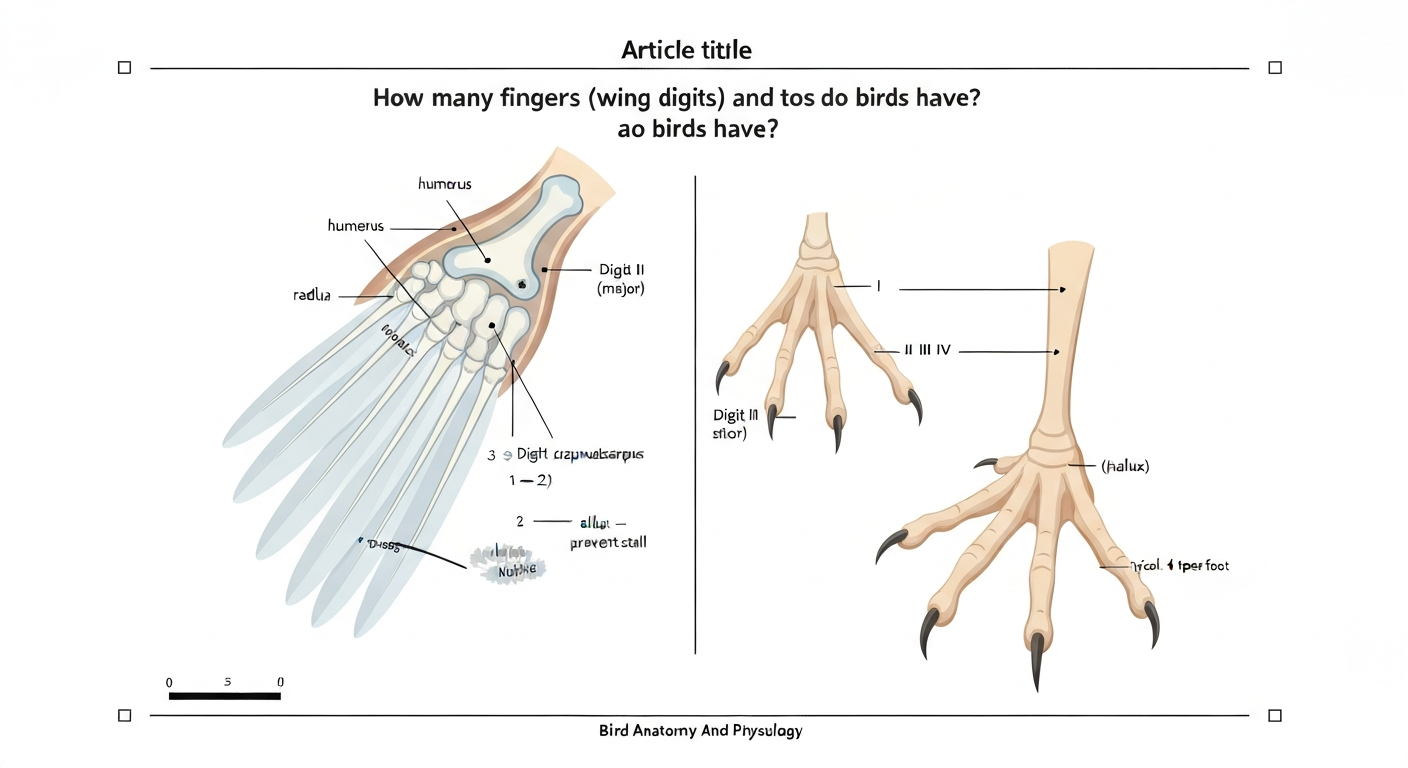
Modern adult birds have three manual digits per wing. The formal anatomical nomenclature labels them digit I (alular digit), digit II (major digit), and digit III (minor digit). They're not free-moving fingers the way yours are. Instead, the bones of the palm and wrist have fused together over evolutionary time into a single element called the carpometacarpus, and the three surviving digit segments are small, reduced, and tightly associated with it. If you ever handled a chicken wing before cooking it, you've probably noticed the odd little bony projection near the tip: that's roughly what remains of this digital apparatus, plus skin and feathers.
The phalangeal formula, meaning how many individual bones each digit has, runs approximately 2 phalanges in digit I, 3 in digit II, and 1 to 2 in digit III, though this varies somewhat across bird groups. Across neognath birds, the wing shows a reduced phalangeal formula summarized as [x‑2‑3‑4‑x], with the three preserved digits bearing approximately 2, 3 and 4 phalanges [Across neognath birds, the wing shows a reduced phalangeal formula summarized as [x‑2‑3‑4‑x], with the three preserved digits bearing approximately 2, 3 and 4 phalanges.](https://www.ncbi.nlm.nih.gov/pmc/articles/PMC8476175/). Digit II is typically the largest and most structurally dominant of the three. For reference, the ancestral five-fingered tetrapod limb had a formula more like 2-3-4-5-3 across digits I through V, so the avian wing is a dramatically simplified version of that.
One digit in particular has its own name and a visible job: the alular digit (digit I) supports the alula, a small tuft of feathers on the leading edge of the wing. The alula acts like a slot in an airplane wing, helping prevent stalling at low speeds during landing or slow flight. You can actually see the alula twitch independently when a bird comes in to land. It's a rare case where you can watch a wing digit doing something obvious in real time.
A quick side note for the curious: scientists still actively debate exactly which of the original five ancestral digits birds retained. The short version is that developmental studies show embryonic bird limb buds briefly form condensations in up to five digit positions, but only three continue to fully develop. Which three and how their identities map onto the ancestral digit positions has been argued in the literature since at least 1999. The 'frame-shift' hypothesis proposed that adult birds express digit identities I, II and III even though the embryonic tissue arises from positions II, III and IV. More recent work, including a 2019 transcriptomic study, complicates that picture further. For practical anatomy, the 'three digits per wing' part is settled science; the homology labeling is the part that's still being worked out.
Toes, feet and legs: the quick numbers
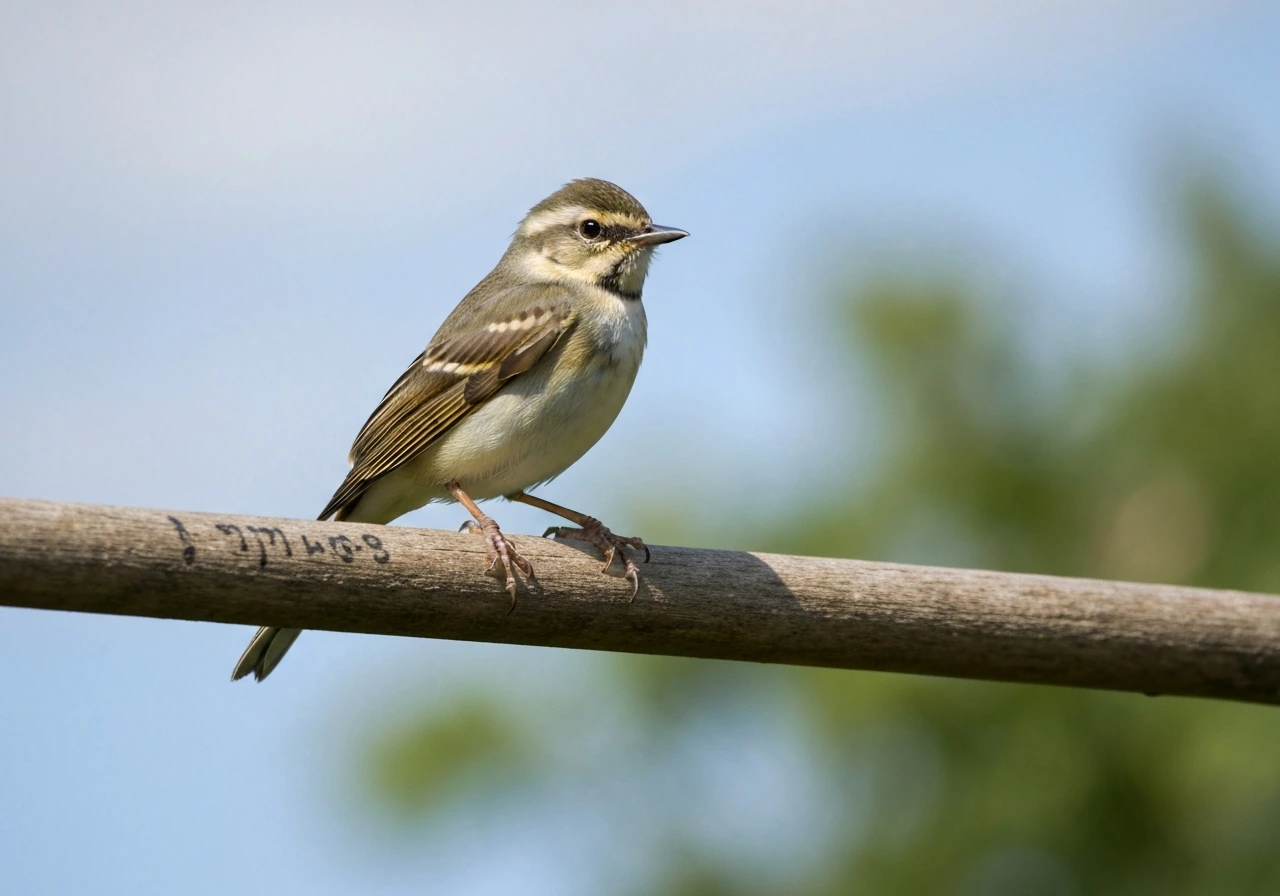
Birds have two legs and two feet, which is the easy part. For a species example and related details, see how many legs does a jacana bird have (details on jacana leg and toe adaptations). For a direct answer and quick summary on how many feet a bird has, see our short guide 'how many feet does a bird have'. For a quick related FAQ on posture and locomotion, see how many legs does a bird have, birds have two legs. The toe count is where it gets more interesting. Most modern birds have four toes per foot, labeled digit I (the hallux, which typically points backward) through digit IV (the outermost forward-pointing toe). If you want a simple answer to how many toes does a bird have: most birds have four toes per foot, though some species (like emus and rheas) have three and ostriches have two. The phalangeal formula for the foot is commonly around 2-3-4-5 bones across those four digits, which means the outer toes have more small bones than the inner ones. Most modern birds retain four toes (digits I–IV) with a typical hindlimb phalangeal formula of about 2–3–4–5 (Evolutionary and Developmental Aspects of Avian‑Specific Traits in Limb Skeletal Pattern, Journal of Morphology review).
Four toes is the default, but lineages have independently reduced that count several times. Emus and rheas typically get by on three toes, and the ostrich has gone all the way down to two, which is the minimum for any living bird. There are no birds with five toes. Once a digit is lost across a lineage, it does not come back, at least not in the fossil record of birds so far.
The six main foot arrangements
Having a certain number of toes is only part of the story. How those toes are arranged matters enormously for what a bird does with them. Here are the six main patterns you'll encounter:
- Anisodactyl: Three toes pointing forward, one (the hallux) pointing backward. This is the most common arrangement, seen in most perching birds (passerines), chickens, pigeons, and many others. It's the classic 'perching grip.'
- Zygodactyl: Two toes forward, two backward (digits II and III face forward; I and IV face back). Parrots, many woodpeckers, ospreys, and cuckoos use this arrangement. It gives a powerful gripping and climbing ability.
- Heterodactyl: Unique to trogons. Digits I and II point backward, while III and IV point forward. It's the mirror image of what you'd expect, and trogons are the only birds that have it.
- Syndactyl: Some or all of the forward toes are fused or partially connected along part of their length. Kingfishers are a well-known example. The fused toes can still function but look joined near the base.
- Pamprodactyl: All four toes can rotate to point forward. Swifts can do this, and it helps them cling to vertical surfaces like rock faces and cave walls.
- Didactyl: Only two functional toes per foot. This is the rarest arrangement and is found only in the common ostrich among living birds.
Claws: how many, and where are they?
Most birds have one claw per functional toe, so the typical four-toed bird has four claws per foot, eight total. For a concise summary on this topic, see how many claws does a bird have. A two-toed ostrich has two claws per foot. The claw itself is a keratinous structure, the same protein family as your fingernails, grown over the last bone of each digit. They range from the blunt, hoof-like nail on the inner ostrich toe to the hypertrophied, blade-like inner claw of the cassowary, which can reach around 12 cm (about 5 inches) and is genuinely dangerous.
Some people wonder whether the beak counts. The beak (or bill) is a separate keratinous structure covering the upper and lower jaw bones and is not a claw, anatomically. It doesn't grow from a digit. So the beak does not count toward claw or finger totals.
Wing claws are where it gets genuinely interesting. Most adult modern birds have no functional claws on their wings at all: the wing digits are too reduced and are buried under feathers. However, hoatzin chicks (more on them below) have two small but functional claws on their wing digits that they actively use for climbing. Some other birds, like the African jacana, occasionally show a small vestigial spur near the wing bend, and fossil birds like Archaeopteryx had prominent curved claws on all three wing digits. Developmental biology studies confirm that the claw-forming pathway is still present in modern bird embryos but is suppressed in most species before hatching.
Notable exceptions worth knowing
A few species and extinct lineages break the standard patterns in ways that come up a lot in biology classrooms and trivia. Here's a concise rundown:
| Bird / Group | Notable Digit Feature | Brief Explanation |
|---|---|---|
| Ostrich (Struthio camelus) | 2 toes per foot (didactyl) | The only living two-toed bird. The larger inner toe bears most of the body weight and has a broad, hoof-like nail. The outer toe is smaller with no nail in some individuals. |
| Emu, Rhea, Cassowary | 3 toes per foot (tridactyl) | These large ratites lost the hallux. The cassowary retains a hypertrophied inner-toe claw up to ~12 cm long used for defense. |
| Jacana (family Jacanidae) | 4 toes with extremely elongated toes and claws | The toes and claws spread body weight across a large area, letting jacanas walk on floating lily pads and other vegetation. The middle claw alone can exceed the length of the toe itself. |
| Hoatzin chick (Opisthocomus hoazin) | 2 functional wing claws (on digits I and II) | Nestlings use these claws to grip and climb among branches near their riverside nests. The claws are lost as the bird matures into an adult. |
| Archaeopteryx (extinct) | 3 clawed wing digits + 4-toed foot with hallux | The most famous early bird fossil, from the Late Jurassic (~150 million years ago). It retained prominent curved claws on all three wing digits, a feature lost in most modern bird lineages. |
| Ospreys and some raptors | Reversible outer toe (semi-zygodactyl) | Ospreys can rotate digit IV backward when gripping fish, giving a two-and-two grip. This is functionally useful but not as fixed as true zygodactyly. |
Why birds have fewer digits than their ancestors, and why they have no teeth
Birds descended from theropod dinosaurs, a group that typically had five-digit forelimbs. Over tens of millions of years, the two outermost digits were gradually reduced and lost, leaving the three-digit wing we see today. The same kind of reduction happened in the hindfoot: most lineages dropped from five to four toes, and some went further. This isn't unique to birds. Many vertebrate lineages have independently lost digits when the ancestral five-digit plan was no longer useful: horses are essentially walking on a single digit (digit III), and ostriches got down to two.
The developmental mechanism behind digit loss and fusion involves the same toolkit of genes responsible for building the limb in the first place. Key players include the 5' HoxD genes (Hoxd11, Hoxd12, Hoxd13), the Sonic Hedgehog (Shh) signaling pathway, and Zic genes. Experimental studies in chick embryos have shown that altering Shh pathway activity can change both the number of digits that form and their identities, which explains at an molecular level how digit patterns can shift across evolutionary time. The three-digit wing of modern birds is effectively the endpoint of millions of years of selective reduction of this developmental program.
Juvenile birds sometimes show features that adults lose. Hoatzin chicks with wing claws are the clearest living example, but embryological studies confirm that all bird embryos transiently form pre-cartilage condensations in positions corresponding to five digits before three are selectively suppressed. The bird egg does not hatch with five fingers that then fall off: the extra condensations are reabsorbed early in development, long before hatching. So you won't find a five-fingered baby sparrow. The suppression happens quietly in the egg.
Teeth are a different story but follow the same general logic. All modern birds lack true teeth, a condition sometimes framed as surprising since their dinosaur ancestors were toothed. For more on bird dentition and fossil evidence, see how many teeth does a bird have. The tooth-forming genetic program (involving Pitx2, Osr2, and enamel matrix protein genes) is still partially present in bird genomes as vestigial sequences, but it is silenced. Early fossil birds like Hesperornis and Ichthyornis retained functional teeth as recently as 66-80 million years ago, but the lineage leading to modern birds lost them completely. The beak took over the food-processing job, reinforced in many species by gizzard action internally. So if you're comparing bird anatomy across multiple fronts, teeth follow the same evolutionary trajectory as extra digits: ancestral, present in early forms, progressively lost, and developmentally silenced in modern birds.
All the counts at a glance
| Feature | Typical Count (most modern birds) | Range / Notable Exceptions |
|---|---|---|
| Wing digits (fingers) per wing | 3 | No living bird has more or fewer in adults; fossil birds like Archaeopteryx also had 3 (but with full claws) |
| Total wing digits (both wings) | 6 | Same across virtually all modern birds |
| Toes per foot | 4 | 2 (ostrich), 3 (emu, cassowary, rhea) |
| Feet | 2 | All living birds |
| Legs | 2 | All living birds |
| Claws per foot (typical) | 4 (one per toe) | 2 (ostrich), 3 (emu/cassowary), varies with toe count |
| Wing claws (adults) | 0 in most modern birds | Functional in hoatzin nestlings; present in Archaeopteryx; vestigial in some species |
| Beaks | 1 | All modern birds; no modern bird has teeth |
The one question that still doesn't have a clean answer
The total count of three wing digits per wing, six across both wings, is agreed upon. What researchers still debate is the precise evolutionary identity of those three digits: are they the first three digits of the ancestral hand, the middle three, or something in between due to a developmental identity shift? The frame-shift hypothesis argues for a partial remapping of identity in the embryo. More recent molecular work suggests the picture is more complex, possibly different in the front digit compared to the rear two. It's the kind of question that sounds like it should have been resolved decades ago, but the deeper you look at Hox gene expression patterns in embryonic chick wings, the more nuance emerges. Scientists are still publishing on it, which I find oddly reassuring: even something as fundamental as counting a bird's fingers has layers worth exploring.
FAQ
Quick answer: How many fingers does a bird have?
In modern adult birds the ‘fingers’ of the wing (manual digits) are three reduced digits. These are the three ossified digital elements in the wing (often described as the three manual digits of the avian manus) and are incorporated into a highly modified, partly fused wing skeleton.
What is meant by “fingers” in birds — how do they differ from toes and claws?
In birds, “fingers” refers to the manual digits in the wing (part of the forelimb/manus). Toes are the digits on the hindlimb (pes). Claws are the keratinous sheaths at the tip of a digit (on fingers or toes) and are not bones; most adult birds lack functional manual claws, whereas many have claws on their toes.
How many toes does a typical bird have on each foot?
Most modern birds have four toes per foot (digits I–IV). The arrangement and relative orientation differ by group (see foot types), and some lineages show reductions (for example, ostriches have two toes per foot).
What are the common toe/foot arrangements and what do the terms mean?
Common arrangements: anisodactyl — three toes forward and one backward (hallux) and the most common arrangement (passerines, chickens); zygodactyl — two toes forward (II and III) and two back (I and IV) (parrots, many woodpeckers); heterodactyl — unique to trogons (like zygodactyl but with a different pair reversed); syndactyl — two or more toes partially fused or joined by skin/webbing (some kingfishers); pamprodactyl — outer toes can rotate forward (some swifts). Each arrangement matches a functional lifestyle (perching, climbing, grasping, running, etc.).
What are well‑known exceptions to the typical toe counts or foot structure?
Notable exceptions: ostriches (Struthio camelus) are didactyl with two toes per foot (a large medial toe plus a smaller lateral toe); most other ratites vary (emu, cassowary often have three). Jacanas have extremely long, slender toes and claws to spread weight over floating vegetation. Some species have highly specialized toe mobility (pamprodactyl swifts) or partial fusion (syndactyl kingfishers).
Do any adult birds have 'fingers' or claws on their wings?
Most adult birds lack functional manual claws. A few species retain small wing claws as adults (very rare); more commonly, juvenile stages of some species (notably hoatzin chicks) have two functional wing claws used for climbing; these are lost during maturation.
Next Articles
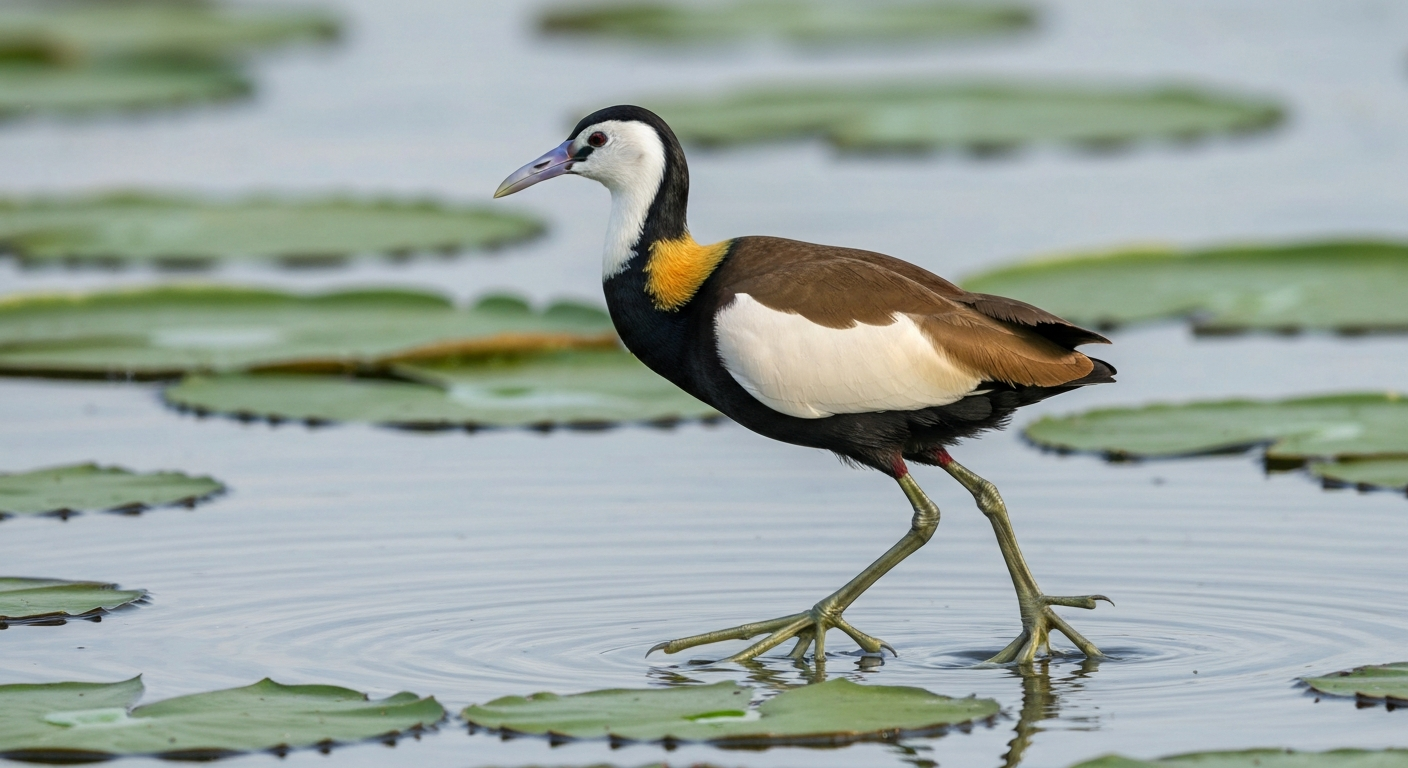
How Many Legs Does a Jacana Bird Have? Quick Answer & Anatomy
Jacana birds have two legs, each with long toes to walk on floating vegetation; read anatomy, function, and comparisons.
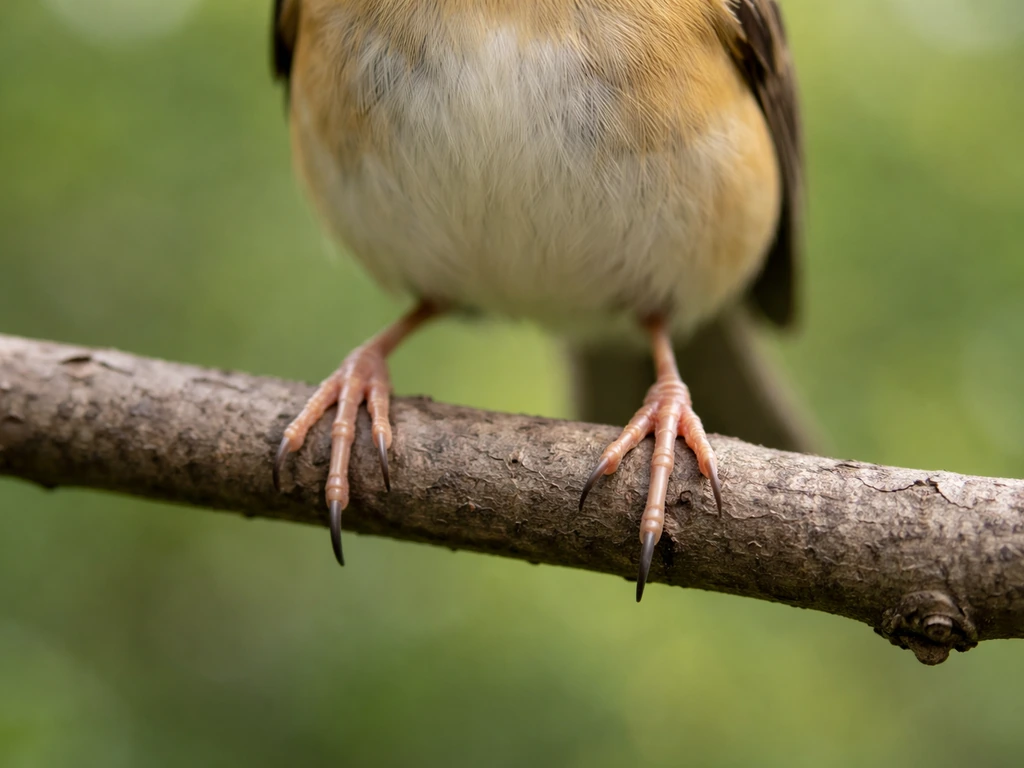
How Many Feet Does a Bird Have? A Simple Guide
Most birds have 2 feet with two legs and toes, plus tips to spot feet, claws, and wing confusion in photos.
How Many Legs Does a Bird Have? Easy Anatomy Answer
Most birds have two legs and two feet; learn what counts as a leg, how wings differ, and common exceptions.