
Title: How Many Legs Does a Jacana Bird Have? Anatomy, Toes & Adaptations Explained
How Many Legs Does a Jacana Bird Have? Quick Answer & Anatomy

Marcus Chen
25 Jul 2026
Meta description: Jacana birds have 2 legs like all modern birds. Learn about their remarkable foot anatomy, long toes, and how they walk on floating lily pads.
A jacana bird has two legs, just like every other modern bird alive today. No more, no less. If you went looking for a bird with a different leg count, I understand the impulse, jacanas look so improbably long-limbed when they go tiptoeing across lily pads that it is tempting to count again. But the answer is a firm two: one left hindlimb, one right hindlimb, the standard equipment for all living birds.
Quick answer: how many legs does a jacana bird have?
Two legs. For a general overview on bird limb counts and evolution, see the article on how many legs does a bird have which explains why two legs are universal among modern birds. Jacanas belong to the family Jacanidae, and every species in that family, from the Northern Jacana (Jacana spinosa) of Central America to the African Jacana (Actophilornis africana), has exactly two hindlimbs. This is true of all modern birds (the group scientists call Neornithes). Birds evolved from bipedal theropod dinosaurs, and the two-legged body plan has been locked in ever since. The 'extra-legged' illusion with jacanas comes entirely from how long and dramatic those two legs look, especially the toes.
Jacana leg and foot anatomy: bones, joints, and toes
Each jacana leg is made up of the same set of bones found in virtually every bird's hindlimb. Starting from the body and working downward, you have the femur (thigh bone, mostly hidden under feathers and body muscle), then the tibiotarsus (the long, visible segment of the leg, it is actually the shin bone fused with some upper ankle bones), and finally the tarsometatarsus (the section most people mistake for a backwards-bending knee, which is really the ankle region fused with the foot bones). Below that come the toes. This naming system comes from the Nomina Anatomica Avium, the authoritative standardized reference for bird anatomy, the fused names like 'tibiotarsus' just reflect the fact that in birds several bones have merged into single rigid structures over evolutionary time.
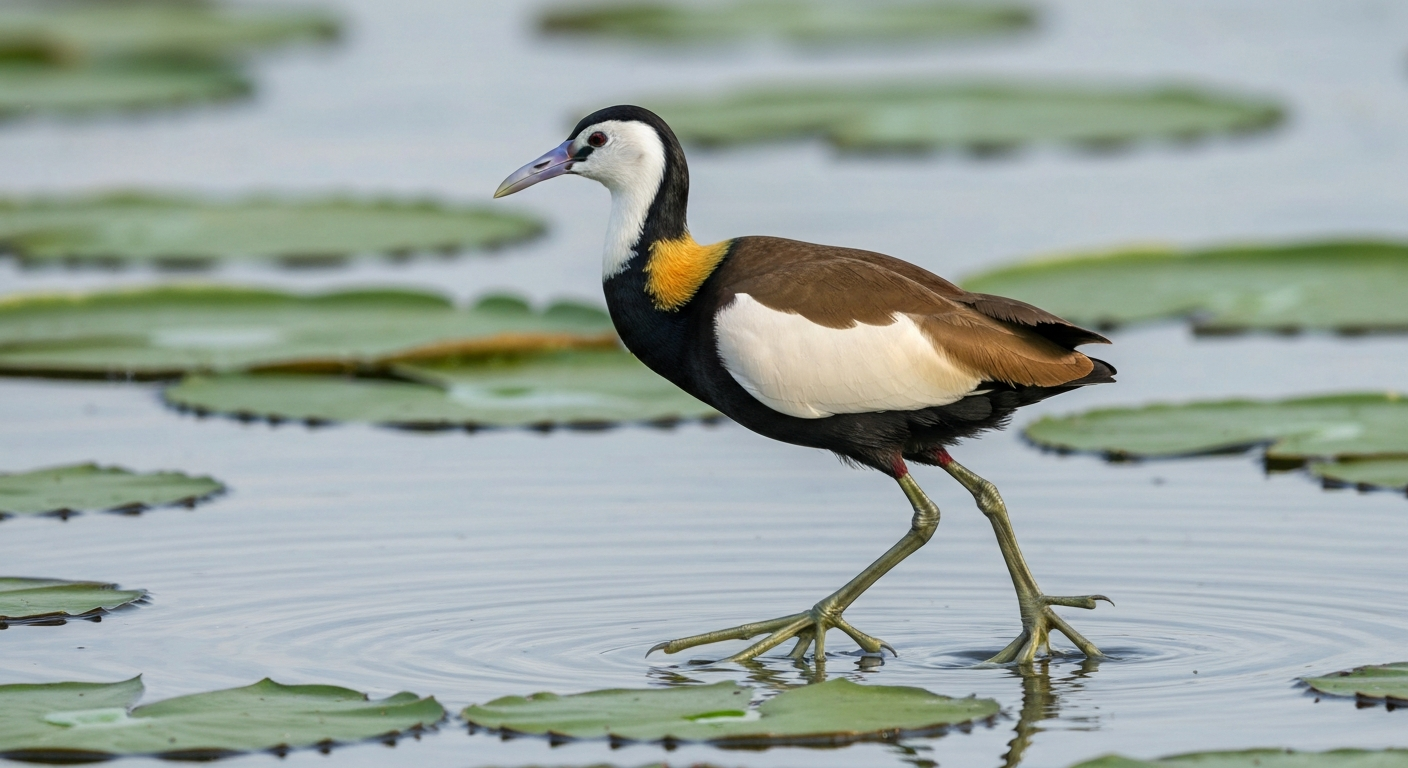
Jacanas have four toes per foot. The arrangement is called anisodactyl, which simply means three toes point forward (digits II, III, and IV) and one toe, the hallux or digit I, points backward. This is the most common toe arrangement in birds and is shared by most wading birds and shorebirds. What sets jacanas apart is not the count or the layout, it is the sheer length of those toes and their claws. In many jacana species, the middle toe plus its claw can be longer than the entire tarsometatarsus segment of the leg.
Scientists have measured these proportions in detail. Field studies of the Wattled Jacana (Jacana jacana) document strong sexual size dimorphism in tarsus length, meaning females (who compete for and defend territories in this polyandrous species) are measurably larger than males, with longer tarsal segments. Museum osteological work by ornithologist Storrs Olson compared tarsometatarsus dimensions across multiple Jacanidae species, recording distal tarsometatarsus widths for Jacana spinosa in the range of roughly 5.8 to 6.5 mm for males and 7.0 to 7.5 mm for females, practical data that shows how precisely anatomists track these structures.
How jacanas actually walk on floating vegetation
This is the part that genuinely surprised me when I first looked into it. Jacanas are sometimes called 'lily-trotters' because they walk across floating aquatic plants, lily pads, water hyacinth, and similar vegetation, without sinking. The trick is not magic. It is physics, executed through some remarkable anatomical specialization.
The key adaptation is the extraordinary length of the toes. When a jacana steps onto a floating leaf, those long toes spread out radially, distributing the bird's body weight across a much larger surface area than a compact foot would allow. Popular summaries such as EarthSky: 'Jacana birds: Walking on water, breaking the rules' synthesize the same functional mechanisms, long toes spread weight, claws aid purchase, and careful stepping, and are useful for accessible figure captions and public-facing descriptions EarthSky: 'Jacana birds: Walking on water, breaking the rules' (popular summary of jacana functional adaptations). Think of it like the difference between pressing one finger onto a sponge versus pressing your whole spread palm, the pressure per unit area drops dramatically, and the sponge (or leaf) sinks far less. Jacana claws add to this by giving the toes extra reach and a slight grip on flexible plant surfaces.
The muscles and tendons running through those elongated toe segments also matter. Research on avian foot mechanics (including open-access work by Backus and colleagues in Royal Society Open Science) has mapped how multiarticular digital flexor and extensor tendons insert along the tarsometatarsus and phalanges, controlling the degree of toe spread and grip. In jacanas, the unusually long pedal phalanges (the individual finger-like bones making up each toe) give these tendons a longer lever arm, producing wider toe spread with relatively modest muscle effort. The bird also steps carefully and continuously shifts its weight, rarely trusting all of its mass to a single unstable pad.
One honest caveat: most biomechanical detail on jacanas specifically is inferred from anatomy and behavioral observation rather than direct force-plate experiments. Jacana-specific functional data remain limited compared to, say, perching passerines. Experimental work on perching in other species, for example, Galton P.M. & Shepherd J.D. (2012) 'Experimental analysis of perching in the European starling' (Journal of Experimental Zoology), found that some birds do not engage a passive tendon‑locking mechanism during sleep, highlighting that anatomical presence of the digital tendon‑locking mechanism does not guarantee its functional use across all species. So while the long-toe weight-distribution explanation is well supported and widely accepted, scientists have not yet run the same level of controlled mechanical testing on jacanas that they have on some other groups.
How jacana limbs compare to other birds
All modern birds have two legs. That baseline never changes. What does vary enormously across species is what those legs look like, how many toes they carry, and how those toes are arranged. Jacanas sit at an extreme end of the toe-length spectrum among birds with the standard four-toed anisodactyl plan. Ostriches, by contrast, have reduced to just two functional toes. Emus and rheas have three. Most perching songbirds have four in the same anisodactyl pattern as jacanas but with much more compact proportions suited for gripping a branch rather than spreading weight on water.
Some bird groups evolved radically different toe arrangements altogether. Woodpeckers and parrots are zygodactyl (two toes forward, two back), giving them a powerful vice-like grip on vertical surfaces. Trogons are heterodactyl (the two inner toes point back). Kingfishers are syndactyl (some toes are fused at the base). These variations all evolved from the same basic four-toed hindlimb template, shaped by different locomotory demands. Jacanas kept four toes and the anisodactyl layout but pushed the length of those toes to an extreme that no other shorebird family matches.
Clearing up the common confusions: toes, fingers, feet, beaks, claws, and teeth
Bird anatomy terminology trips people up constantly, and jacanas are a good case study because their feet prompt so many follow-up questions. Here is a plain-language rundown of the terms that come up most often.
Toes vs. fingers
Birds do not have fingers on their feet, those are toes. A jacana has four toes per foot. Birds do technically have finger-like digits in their wings (vestigial remnants of the forelimb digits, reduced and fused during evolution into the structures that anchor flight feathers), but calling them fingers in casual conversation is a stretch. The digits you see on the feet are always referred to as toes.
Feet vs. legs
A jacana has two feet and two legs, same as all birds. For more on bird foot counts and terminology, see how many feet does a bird have. The leg is the full hindlimb structure from where it meets the body down to the ankle. The foot is specifically the tarsometatarsus and toes, the part that contacts the ground. Colloquially people sometimes call the entire visible lower limb a 'leg,' which is fine in casual use, but anatomically the terms describe different segments.
Claws
Jacanas have claws on all four toes of each foot, that is eight claws per bird, four per foot. For general information on claw counts across bird species, see how many claws does a bird have. Those claws are made of keratin (the same protein that forms human fingernails) and are particularly long in jacanas, contributing to the weight-spreading and vegetation-gripping function described above. All birds have claws on their toes; the count simply matches however many toes the species has.
Beaks
Jacanas have one beak, as does every modern bird. For a broader look at how many beaks birds have and related beak anatomy, see how many beaks does a bird have. The beak (also called the bill) is a keratinous structure covering the upper and lower jaw bones. It is a single unified structure, not two separate beaks. Jacanas have a fairly simple pointed bill suited for picking invertebrates and seeds from vegetation surfaces.
Teeth
Jacanas have zero teeth, same as all living birds. For more on bird dentition and why modern birds lack teeth, see how many teeth does a bird have. Modern birds are edentulous, meaning toothless. Their distant ancestors, early avialans and the theropod dinosaurs before them, did have teeth, but that trait was lost in the lineage leading to modern birds. Macroevolutionary research has dated and analyzed this tooth loss across the bird family tree. Today, birds replace the tooth function entirely with their keratinous beaks and, in many species, a muscular gizzard that grinds food internally.
Jacanas vs. other birds: a quick comparison
| Feature | Jacana (Jacanidae) | Typical songbird (passerine) | Woodpecker | Ostrich |
|---|---|---|---|---|
| Number of legs | 2 | 2 | 2 | 2 |
| Number of feet | 2 | 2 | 2 | 2 |
| Toes per foot | 4 | 4 | 4 | 2 |
| Toe arrangement | Anisodactyl (3 forward, 1 back) | Anisodactyl (3 forward, 1 back) | Zygodactyl (2 forward, 2 back) | 2 toes only (no hallux) |
| Claws per foot | 4 | 4 | 4 | 2 |
| Toe length | Extremely elongated | Compact | Moderate, curved | Short and broad |
| Key locomotory adaptation | Weight distribution on floating plants | Branch gripping, perching | Vertical surface clinging | Running at high speed |
| Beaks | 1 | 1 | 1 | 1 |
| Teeth | None | None | None | None |
Diagrams and images: what to look for
Two visual aids are especially useful for understanding jacana leg and foot anatomy, and I would recommend editors place them at the following points in the article.
Diagram 1: labeled jacana leg and foot anatomy
Placement: after the section on leg and foot anatomy, before the functional adaptations section. This diagram should label the femur, tibiotarsus, tarsometatarsus, and each of the four pedal digits (I through IV), with an arrow or callout indicating the hallux (rear toe). A side-by-side silhouette comparing a jacana foot to a typical shorebird foot at the same scale would make the toe-length difference immediately obvious. Alt text suggestion: 'Labeled diagram of a jacana bird leg showing femur, tibiotarsus, tarsometatarsus, and four elongated toes in anisodactyl arrangement, compared with a typical shorebird foot at the same scale.' A freely licensed photograph or line drawing from Wikimedia Commons (for example, from the Actophilornis africana category) or a redrawn diagram based on the foot geometry figures in Backus et al. 2015 (Royal Society Open Science, open access) would both work well here.
Diagram 2: weight distribution on floating vegetation
Placement: within or immediately after the functional adaptations section. This illustration should show a top-down view of a jacana foot resting on a lily pad, with arrows or shading indicating how the body weight spreads outward along each elongated toe toward the tips. A comparison inset showing a compact foot of similar body weight pressing into the same surface (and sinking deeper) would reinforce the physics explanation. Alt text suggestion: 'Top-down illustration of a jacana foot on a lily pad, showing how elongated toes spread body weight across a large surface area to prevent the leaf from sinking.' A photograph from Wikimedia Commons showing an African Jacana or Wattled Jacana standing on floating vegetation works as a real-world complement to the diagram, with appropriate attribution and license details taken from the image page metadata.
Why the jacana's two legs are worth a closer look
Two legs is the universal bird answer, and honestly it is a little anticlimactic as answers go. But the follow-up details, four toes per foot in an anisodactyl layout, tarsometatarsal bones fused for strength, pedal phalanges stretched to extraordinary lengths, the whole assembly calibrated by tendons and muscles to spread weight across unstable floating plants, those details are anything but boring. Jacanas make a compelling case that asking 'how many legs?' is really just the opening question. The anatomy hiding behind that simple answer is where things get genuinely interesting. If you want to keep pulling on that thread, the questions of how many toes birds generally carry, what different toe arrangements mean for locomotion, and how claws are structured across species all connect naturally to what jacanas are doing on those lily pads. For a broader overview of bird toe counts and variations, see how many toes does a bird have.
FAQ
Quick answer: How many legs does a jacana bird have?
A jacana has two legs — one left and one right hindlimb, like all modern birds (Neornithes). This bipedal arrangement is standard across the family Jacanidae (Gill et al.; Olson 1976).
What is the basic anatomy of a jacana’s leg and foot?
Each jacana leg contains the same major bird bones: femur (thigh), tibiotarsus (shank), and tarsometatarsus (lower leg). The foot bears four toes (digits): three forward-facing toes (digits II–IV) and one rear-facing hallux (digit I). Pedal phalanges (toe bones) are elongate, especially in the outer toes; claws cap the distal phalanges. Authoritative anatomical nomenclature: Baumel et al. (Handbook of Avian Anatomy, 1993).
How many toes does a jacana have on each foot?
A jacana typically has four toes per foot — an anisodactyl configuration (three forward, one back). The toes are exceptionally long and slender compared with many other birds, increasing contact area on floating vegetation (Shorebird Ecology; Natural History Museum summary).
Which adaptations let jacanas walk on floating vegetation (lily pads)?
Key functional adaptations: long, widely spread toes and elongated pedal phalanges increase surface area and reduce sinking; relatively long claws help grip slippery surfaces; limb proportions (long tarsometatarsus and toes) shift weight distribution to spread load; musculotendinous control lets jacanas place toes precisely on vegetation. These traits together create the ‘lily‑trotter’ habit documented in field guides and biomechanics literature (Backus et al. 2015; EarthSky summary).
How do jacana limb features compare with other birds?
Leg count: all modern birds are bipedal (two legs). Toe arrangement: many passerines and waders are anisodactyl (3 forward + 1 back) like jacanas; other arrangements include zygodactyl (2+2, e.g., woodpeckers), heterodactyl (trogons), syndactyl (kingfishers), and pamprodactyl (some swifts) (Gill et al.). Toe length: jacanas have unusually long toes relative to body size compared with most shorebirds, which is the family’s distinct adaptation for walking on floating plants (Olson 1976; Shorebird Ecology).
Do jacanas have fingers instead of toes? What’s the difference?
In birds the digits of the foot are called toes (pedal digits). 'Fingers' is a term used for manual (hand) digits in mammals and primates; birds do not have separate 'fingers' on their feet. Homologous skeletal elements are digitally numbered, but in common usage for birds use 'toes' not 'fingers' (Baumel et al., avian anatomical terminology).