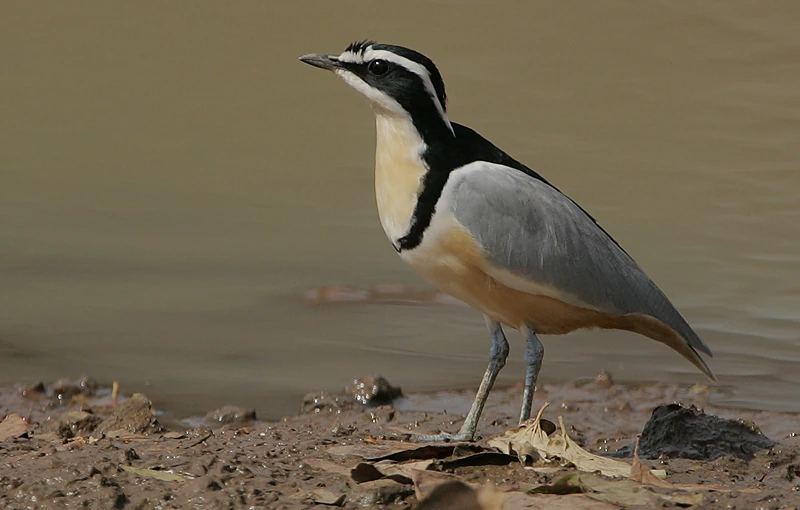
The bird most commonly linked to cleaning an alligator's (or crocodile's) teeth is the Egyptian plover, scientifically known as Pluvianus aegyptius. You'll also see it called the 'crocodile bird' in encyclopedias, which is exactly why it keeps showing up in answers to this question. But here's the catch: according to Britannica and modern naturalists, the actual blank" rel="noopener noreferrer">tooth-picking behavior has never been reliably observed in the field. The story is real and ancient, but the 'dental hygienist bird' image you've probably seen is largely a myth built on top of a much older, more interesting account.
What Bird Cleans Alligator Teeth? Myth vs Reality

Marcus Chen
31 May 2026
Where the myth actually comes from
The origin traces back roughly 2,500 years to Herodotus, the ancient Greek historian who traveled to Egypt and wrote about what the locals told him. He described a small bird called the 'trochilus' (later reinterpreted as a sandpiper or plover in modern retellings) that would enter a basking crocodile's open mouth and eat the leeches living inside. The crocodile, he explained, would lie with its mouth open facing the wind to get relief, and the bird would fly in and devour the parasites. That's the original story: leech removal, not tooth scrubbing.
Over centuries, later classical writers repeated the account and gradually shifted the emphasis toward 'cleaning the teeth,' probably because 'eating leeches' is a harder sell as a charming animal friendship. By the time the story hit modern nature documentaries and social media, it had fully transformed into the image of a brave little bird acting as a crocodile's personal dentist. The Egyptian plover got pinned with the role because it's a real African wading bird with a documented association with crocodiles in name, even if the specific inside-the-mouth behavior isn't confirmed.
What the 'tooth cleaning' would actually look like, biologically speaking
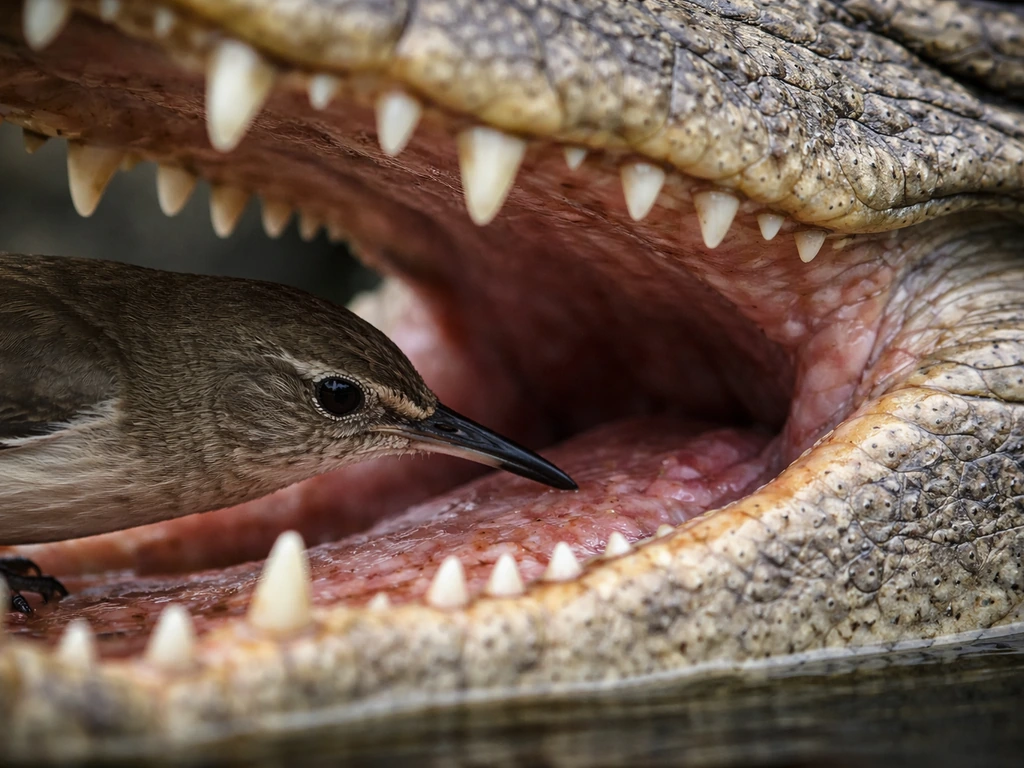
If a bird really did clean a crocodile's teeth the way the myth describes, here's what would have to happen: the bird would need to enter a fully open crocodilian mouth, navigate past a thick, nearly immobile tongue (Britannica notes the crocodilian tongue is firmly attached to the floor of the mouth and barely moves), probe along the gumline with its bill, and then safely exit without triggering a snap reflex. The crocodile would need to consistently suppress a closing response while a small animal pokes around its sensitive oral tissues.
That last part is genuinely relevant from a biology standpoint. Research on crocodilian oral anatomy shows that the tissues around the gumline and the inside of the mouth contain mechanosensory organs, meaning the area is sensitive to touch and pressure. The idea that a crocodile would routinely tolerate repeated bill-probing in those sensitive areas without a stress response is, to put it mildly, not well supported by what we know about crocodilian sensory biology.
Is any bird-alligator mouth interaction actually plausible?
Yes, some level of interaction is plausible, just not the dramatic dentist version. Birds and large reptiles do share space, and opportunistic feeding near a basking crocodilian is exactly the kind of low-energy foraging a wading bird would attempt. A bird landing near an open mouth and snatching something visible from around the jaw or gumline, without going fully inside, is a much more realistic scenario than sustained inside-the-mouth probing.
Britannica's own summary on the crocodile bird acknowledges that some form of mutualistic association between the Egyptian plover and Nile crocodiles is possible in principle. The crocodile might get parasite removal; the bird gets a meal. What Britannica specifically disputes is the tooth-picking behavior as commonly visualized, calling it unobserved. So the concept of mutualism isn't crazy, but the specific image of a bird scraping plaque off crocodile teeth like a hygienist is where the science runs out.
What the bird is more likely actually doing
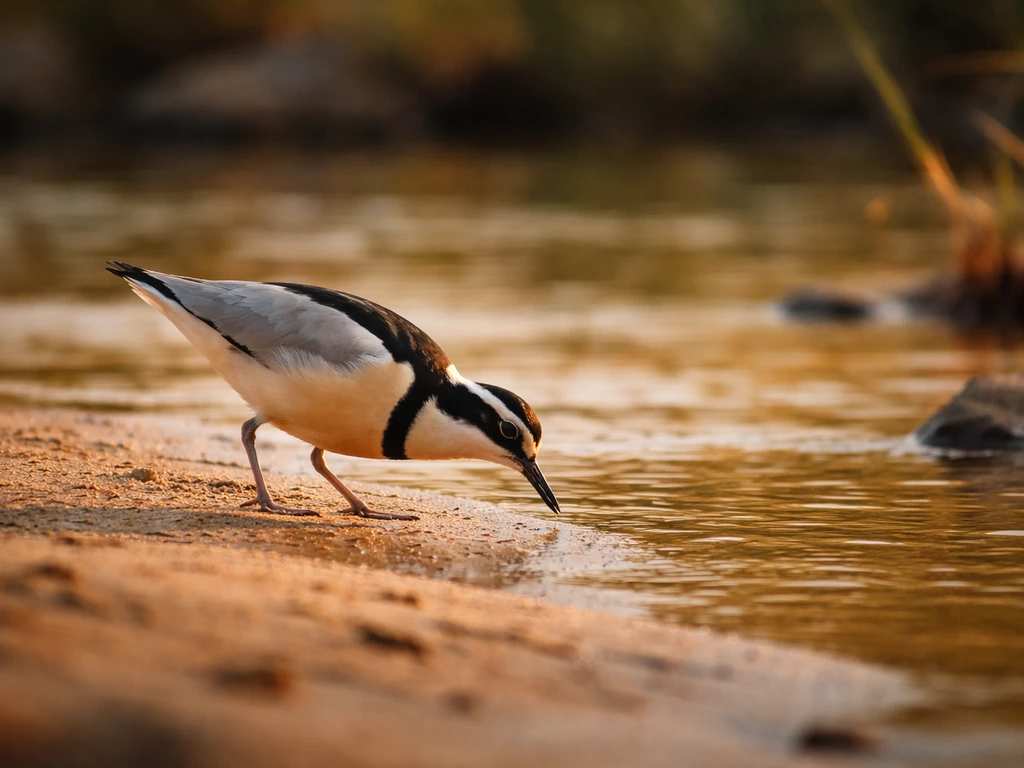
The most honest explanation based on the evidence is opportunistic feeding. Birds that forage near large animals, including reptiles, are well documented in other contexts. Think of oxpeckers on buffalo, or egrets following cattle to catch insects stirred up by their feet. That broader behavior pattern, called cleaning symbiosis, involves a bird removing ectoparasites, food scraps, or other accessible material from a host animal. It's real and documented across many species pairs.
For the crocodile case, the original Herodotus account points toward leech removal from inside or around the mouth as the meal, not teeth cleaning per se. Leeches and other parasites that attach to moist oral tissues are a plausible food source for a wading bird. Food particles trapped at the gumline from a recent crocodile meal are another option. The bird's bill mechanics support this: bird bills are made of keratin and in some species contain tactile sensory structures near the tip that help with precision probing, which can make 'picking at something small near the teeth' look very much like deliberate cleaning even when the bird is simply grabbing food.
Why so many videos seem to show it
This is where it gets a bit embarrassing for the internet. A fair number of widely shared images and videos purporting to show a plover entering a crocodile's mouth are either CGI reconstructions made for educational content, misidentified footage of different bird-reptile interactions, or extremely brief and ambiguous clips that don't actually show sustained tooth-cleaning behavior. Wikipedia's article on the Egyptian plover specifically notes that some media depictions are digital reconstructions, not real field footage.
If you see a compelling video circulating and want to know whether it's real, the first question to ask is: does this show the bird repeatedly entering and exiting the mouth over several minutes, or is it a two-second clip? Sustained, verifiable, repeated mouth-entry behavior in a natural setting is what would constitute actual documentation of the claimed mutualism. That footage doesn't seem to exist in any peer-reviewed or credibly documented form.
How to verify this yourself today
If you want to actually check the state of evidence right now, here are the most useful steps:
- Search Britannica's entry for 'crocodile bird' directly. It identifies the Egyptian plover by name and explicitly states that tooth-picking behavior has not been observed. That's your anchor point for the scientific consensus.
- Look up the relevant passage in Herodotus' Histories (Book 2, covering Egypt). The MIT Internet Classics Archive hosts a free English translation. Read what Herodotus actually wrote versus what modern retellings claim he wrote. The difference is telling.
- Search for peer-reviewed field studies on Egyptian plover behavior specifically. As of now, there is no published field study documenting confirmed inside-the-mouth cleaning interactions between plovers and crocodilians.
- When evaluating any video or image, check whether the source identifies it as a reconstruction, animation, or illustration before treating it as documentary evidence.
- For geographic context: if you want to observe Egyptian plovers in the field, your best options are sub-Saharan Africa and parts of the Nile region. The birds are real; what they're doing near crocodiles in person is something genuine wildlife researchers and ecotourists occasionally report, but always from a distance and without confirmed mouth-entry events.
If you want to observe or document bird-reptile interactions yourself
Practically speaking, observing this interaction in person requires traveling to central or sub-Saharan Africa, particularly along major river systems where Nile crocodiles bask in the open. If you're in North America, alligators in Florida and the Gulf Coast states do bask with mouths open (a thermoregulation behavior called 'gaping'), and various wading birds such as herons, egrets, and ibises do forage near alligators. I'd strongly advise keeping a very safe distance from any wild alligator, mouth open or not, as a reminder.
If you want to document bird behavior near reptiles responsibly, the most practical approach is using a camera with a long telephoto lens (400mm or longer for useful field shots) and focusing on what the bird is actually picking at: is it plucking something from a surface? Is it entering the mouth area at all? How does the reptile respond? Behavioral ethology, the study of animal behavior in the field, relies on systematic observation logs, not single dramatic moments. If you record something genuinely surprising, timestamped video with GPS coordinates is the format that wildlife researchers can actually use.
Why birds can handle rough environments like this at all
One part of this story that actually checks out biologically is that birds are remarkably well-equipped for the kind of environment a crocodile's mouth represents: wet, bacteria-laden, structurally complex, and physically risky. A few anatomical points that help explain this:
- Bird bills are made of a keratinous sheath called the rhamphotheca, which is tough, self-renewing, and resistant to abrasion. A bill repeatedly contacting hard tooth surfaces wouldn't damage it the way it would damage softer tissue.
- Some bird species, particularly shorebirds and waders, have a specialized sensory structure near the bill tip called the bill-tip organ, packed with mechanoreceptors called Herbst corpuscles. This gives them exceptional precision when probing for small items in confined or cluttered spaces, which is exactly what picking at material near teeth would require.
- Wading birds typically have strong immune systems relative to the microbial environments they forage in, since they probe mud, carrion, and decomposing matter regularly.
- The visual acuity and reaction time of most small birds is significantly faster than that of large reptiles, which may partially explain why a small bird could theoretically approach and retreat from a crocodile before a slow jaw-close response completes. That said, crocodile jaw-closing speed is famously fast, which is the other side of that equation.
It's also worth connecting this to the broader picture of bird anatomy. Birds do not have teeth themselves (a topic worth exploring on its own), so the concept of 'teeth' is one step removed from their own biology. What birds do have are highly adaptable bills shaped by evolution for specific feeding niches, and the precision feeding behaviors enabled by bill anatomy are genuinely remarkable. The fact that a bird's bill could handle the mechanical task of removing parasites from around teeth isn't anatomically implausible. Whether any bird actually does it regularly with a crocodile is the part that hasn't been verified.
The bottom line on the crocodile-bird story
The Egyptian plover is the bird attached to this story, and it's a real species with a real geographic range overlapping with Nile crocodiles. The idea that it removes parasites from around a crocodile's mouth is an ancient claim that goes back to Herodotus, who described leech removal, not tooth polishing. The modern 'tooth cleaning' framing is a later embellishment that has not been confirmed by field observation.
An analysis of the crocodile-plover myth also notes that the modern tooth-cleaning framing grew out of older parasite and leech accounts and persists despite limited verification the tooth-cleaning framing is a later evolution of older “parasite/leeches inside the mouth” stories. What's plausible is opportunistic feeding near or around a crocodile's open jaws.
In other words, the crocodile-bird myth does not show which bird breaks its beak; it frames an interaction that is largely unverified. If you're wondering about whether the “crocodile bird” ever got her teeth fixed, the available evidence points to myth-making rather than confirmed inside-the-mouth cleaning did bird brown get her teeth fixed.
If you’re specifically wondering about bite strength, a different category of animals, such as large raptors and carnivorous reptiles, is more relevant than this crocodile-bird myth. What's unverified is sustained, repeated, inside-the-mouth cleaning behavior as a regular mutualistic interaction. The myth is more interesting than the reality, but the reality, a bird and a crocodile navigating a cautious, opportunistic feeding relationship near the Nile, is genuinely worth paying attention to.
FAQ
Is the Egyptian plover definitely the alligator or crocodile tooth cleaner?
Most claims point to the Egyptian plover, but “cleaning teeth” is the disputed part. The original account centers on removing leeches or other parasites, and modern summaries say the inside-the-mouth tooth-picking behavior has not been reliably observed.
If the tooth-cleaning story is exaggerated, what signs would indicate the more realistic feeding version?
You can also look for behavior that matches opportunistic feeding rather than hygiene, for example a bird foraging near the jawline, catching something visible around the open mouth, or snapping at debris near the gums without repeatedly entering deep inside.
What should I look for in a video to tell whether it’s real evidence or just a myth clip?
A good red flag is a clip that shows only one brief interaction (for example, a sudden bill entry and exit) with no evidence the animal tolerates repeated probing. Verifiable documentation would involve sustained, repeated mouth-entry or consistent removal of a specific food item over time, ideally with clear context.
Is it safe to watch an alligator with an open mouth while birds are nearby?
Not safely. Even if you’re watching birds, alligators can close quickly and may lunge if they feel threatened. If you’re near gaping animals, treat distance as non-negotiable and keep viewing from a spot where you cannot trigger defensive behavior.
Does the myth completely rule out any kind of mutualism between birds and crocodiles or alligators?
Yes, in a broader sense. Birds and large reptiles can form loose mutualistic associations where the bird gains food and the reptile may benefit from parasite removal, but that does not automatically mean inside-the-mouth “dentistry” happens regularly.
Why do people say “alligators” if the main story involves crocodiles?
Technically, the article’s core example involves crocodiles, but the pattern people see is often transferred to alligators because both animals can gape while basking. In North America, you may observe wading birds foraging near alligators, yet that still does not confirm tooth cleaning.
Could the bird be doing something like parasite removal without truly scraping teeth?
If a bird is repeatedly entering a mouth area, you should also consider the chance it is targeting leeches or small prey displaced by the reptile, or grabbing food scraps stuck around the mouth. The bird’s bill sensitivity can make “picking” look deliberate even when it is simply grasping food or parasites.
Why is “cleaning teeth” an inaccurate description even in scenarios where the bird gets food from the mouth area?
Even if a bird removes something near the mouth, “teeth” is a misleading framing because birds do not have teeth, and many of the visible actions involve gums, jawline, or trapped debris rather than plaque scraping on tooth surfaces. “Cleaning” is more accurate as removing accessible material than as polishing teeth.
If I want to document this responsibly, what’s the best way to film it?
Distance and lens choice matter a lot. For wildlife documentation, use a long telephoto lens (the article suggests 400 mm or longer) and focus on what is being taken and how the alligator or crocodile responds, rather than zooming in on spectacle without clear behavioral context.
Next Article
What Bird Has the Strongest Bite Force? Top Contenders
Which bird has the strongest bite force, ranked and explained using anatomy, skull mechanics, and measurement methods.