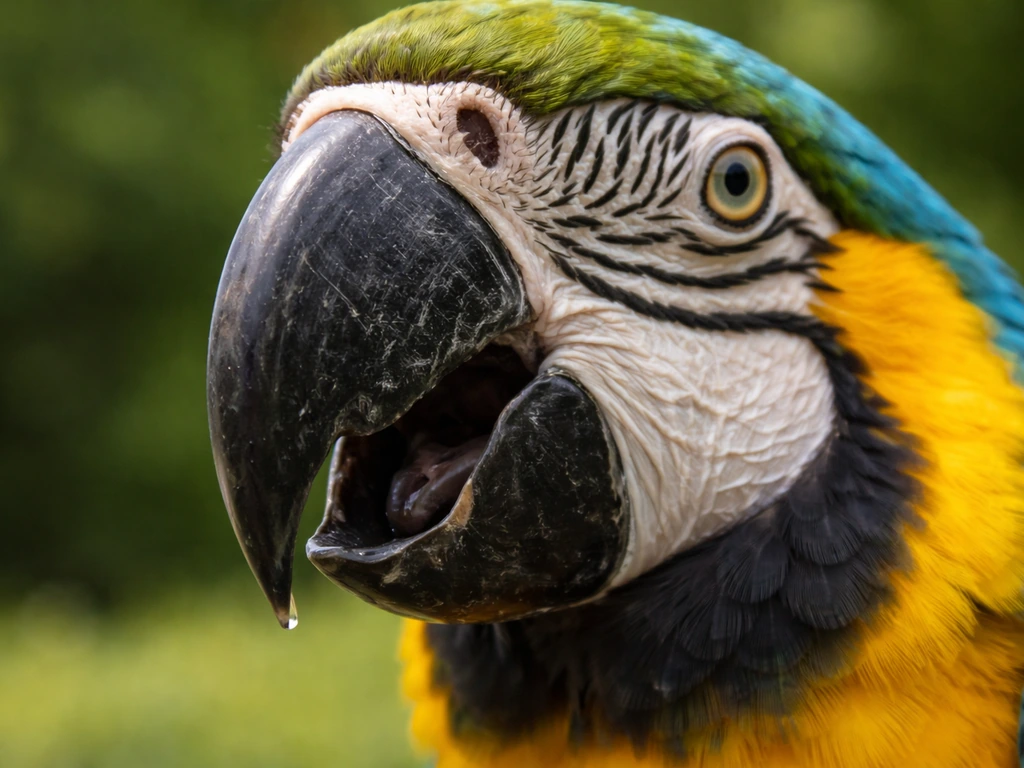
Macaws almost certainly have the strongest bite force of any bird. A 2023 study measuring and estimating bite forces across parrot species concluded that macaws produce the largest bite forces recorded for any bird to date. That said, the full picture is more interesting than a single number: Darwin's ground finches like Geospiza fortis hit around 47 Newtons relative to their tiny body size, raptors bring their own impressive clamping power, and how you measure bite force matters enormously to which species ends up on top.
What Bird Has the Strongest Bite Force? Top Contenders

Marcus Chen
17 May 2026
What 'strongest bite force' actually means for birds
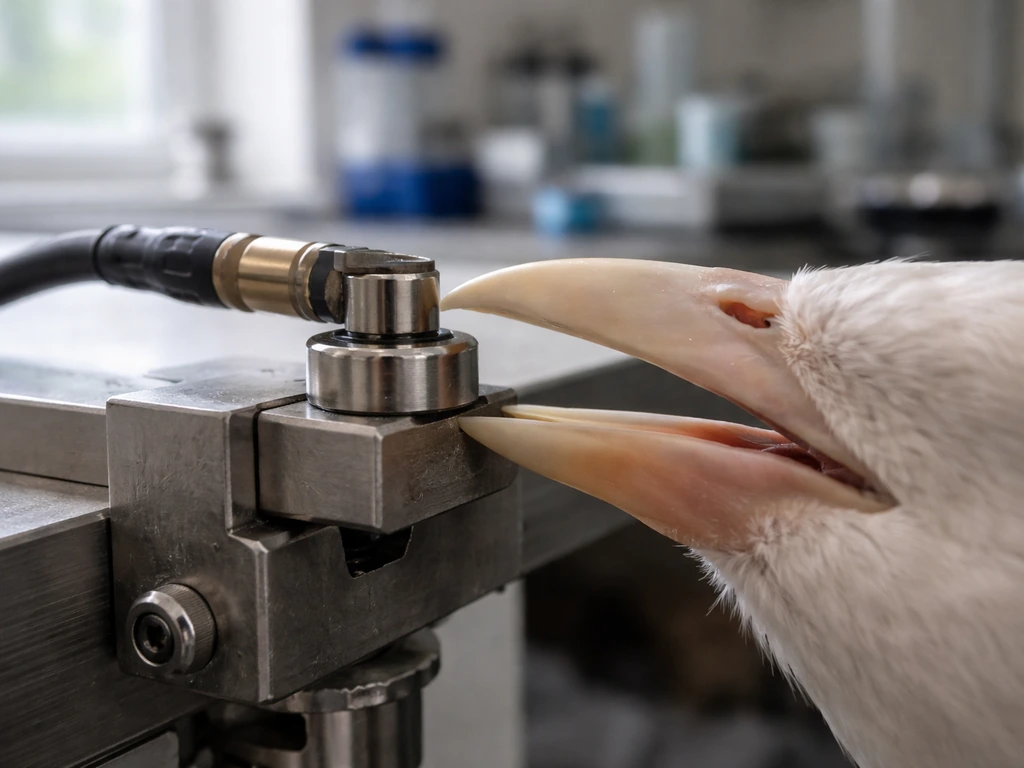
Bite force in birds is measured in Newtons (N), the standard unit of force. To get an in vivo (live animal) reading, researchers typically use a piezoelectric force transducer, which is basically a sensitive electronic sensor mounted between two stainless-steel bite plates. The bird bites down on the plates, and the device records force with precision down to about 0.1 N. Simple enough in theory, genuinely tricky in practice.
The biggest caveat is gape angle. How wide a bird opens its beak dramatically changes how much force it can produce. Jaw muscles operate at different mechanical advantages depending on gape, so a bird tested at a 20-degree gape will look much stronger than the same bird tested at a 60-degree gape. Good studies standardize this, but not all do, which makes cross-study comparisons messy. When you see a headline claiming one species has "the strongest bite," always ask: at what gape, at what bite point along the beak, and how motivated was the animal?
Motivation is a real issue. Birds don't always bite as hard as they can, especially in lab settings. Raptor bite-force studies often handle this by recording many trials and using only the maximum value per individual, reasoning that the peak effort is the least biased estimate of what the animal is actually capable of.
The top contenders, ranked honestly
Based on current evidence, here's how the strongest biters stack up across bird groups.
| Bird / Group | Estimated or Measured Bite Force | Key Strength Driver | Evidence Quality |
|---|---|---|---|
| Macaws (large species) | Highest recorded for any bird (absolute) | Large skull, massive jaw adductors, allometric scaling with body mass | In vivo + validated model (2023 study) |
| Darwin's ground finches (Geospiza fortis) | ~47 N maximum | Deep, wide beak; large jaw adductors relative to body size | Direct in vivo measurement + anatomical analysis |
| Large raptors (eagles, large falcons) | High, size-dependent | Cranial robustness, prey-handling morphology | Morphometrics + biomechanical modeling |
| Corvids (ravens, large crows) | Moderate-high | Generalist skull with strong adductors for processing hard food | Comparative morphology studies |
Macaws win on absolute force, which scales positively with body and skull mass. In other words, bigger skull equals more room for jaw muscles, and jaw muscle size is the primary driver of bite force. A large hyacinth macaw has a skull built around producing extraordinary clamping power to crack palm nuts that would defeat most tools. The 2023 parrot study is particularly credible because it both estimated bite force from muscle anatomy and validated those estimates against actual in vivo recordings, which is rare in the literature.
Darwin's ground finches deserve their own spotlight even though they're small. Geospiza fortis produces around 47 N, which is extraordinary for a bird that weighs roughly 20 grams. Relative to body size, ground finches are genuinely exceptional biters, and they've been studied intensively enough that the measurements are well-documented.
The anatomy behind a powerful bite
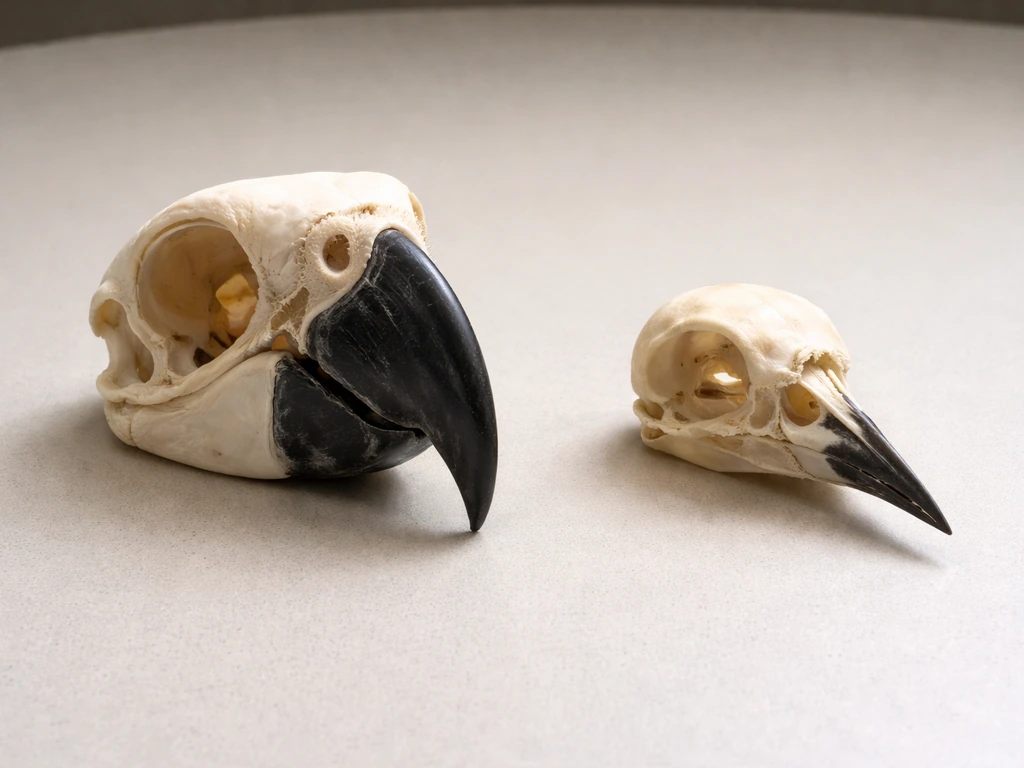
If you look at the skull of a macaw or a large ground finch next to the skull of, say, a warbler, the difference is immediately obvious even to a non-expert. Strong biters share a cluster of anatomical features that work together.
Jaw adductor muscles
These are the muscles that close the beak, and their cross-sectional area (technically called PCSA, or physiological cross-sectional area) directly determines how much force they can produce. Bigger muscles, more force. This sounds obvious, but the important detail is where those muscles attach and how the skull is shaped to accommodate them. Birds with wide, deep skulls have more attachment surface and more room to house large adductor muscles. Head width has been identified in Darwin's finch research as one of the best predictors of bite force capacity across species.
Beak depth, width, and keratin structure
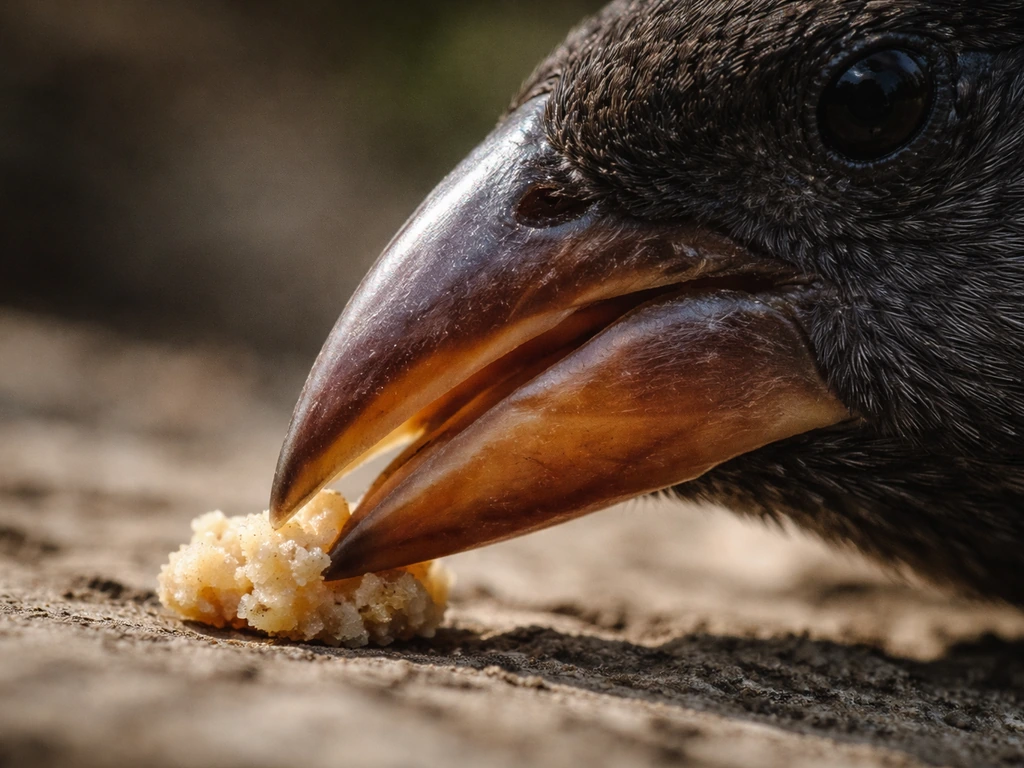
A deep, wide beak isn't just about looking imposing. Biomechanical research on ground finches shows that deeper and wider beaks redistribute mechanical stress during biting, reducing peak stress concentrations and making the beak less likely to crack or fail under load. This means the bird can apply more force without destroying its own beak. The keratin sheath covering the beak also plays a structural role, distributing loads across the underlying bone. It's a remarkably efficient system.
Jaw joint geometry and lever mechanics
Bite force isn't just muscle mass times motivation. The jaw works as a lever system: the jaw adductor muscles are the input force, the jaw joint is the fulcrum, and the bite point is where the output force is delivered. A shorter out-lever (the distance from the jaw joint to where the bird bites) amplifies force at the expense of speed. Birds that bite hard at the tip of a deep beak, like seed-crackers, have jaw geometry tuned for force rather than speed. Parrots add another layer: their upper beak can move independently of the skull (a feature called cranial kinesis), which allows fine control and adjustments during biting that can actually increase effective bite force in some configurations.
Why these birds evolved such strong bites
The ecology makes intuitive sense once you know which birds are top biters. Strong bites evolve when food resists processing. Hard seeds and nuts are the clearest case: if you eat palm nuts for a living, natural selection will ruthlessly eliminate any macaw whose beak can't crack them. The same logic applies to Darwin's ground finches cracking Tribulus cistoides seeds on the Galapagos, which are among the hardest seeds in the finches' diet and have been shown to drive selection on beak morphology and bite capacity.
Raptors are a different story. Their bite force relates more to prey killing and prey processing than seed cracking. Falcons in particular use a specific notch in their beak (the tomial tooth) to dispatch prey with a precise bite. Their skull and jaw morphology is shaped partly by prey size relative to the bird's own body, with larger relative prey driving more robust cranial architecture.
Corvids occupy an interesting middle ground. Ravens and large crows process a wide variety of hard food items, from cracking open shellfish to handling bones, and their generalist skulls reflect a compromise between bite force and versatility. They don't top the charts, but they punch well above their weight for non-specialist feeders.
How to actually compare bite-force claims across studies
This is where I had to do the most homework, because the literature can seem contradictory at first. Studies use different methods, different standardizations, and sometimes different definitions of what counts as "bite force." Here's what to look for when you're evaluating a claim.
- Check whether the study used in vivo measurement or biomechanical modeling. Direct measurements with calibrated force transducers are generally more trusted, but good validated models (like those in the 2023 parrot paper) can be highly informative when in vivo data is hard to collect.
- Look at gape standardization. Studies that don't report or control for gape angle are much harder to compare to others. The difference between a 20-degree and 60-degree gape can be dramatic.
- Check the bite point. Force measured at the bill tip differs from force measured further back on the beak. Lever arm differences make this matter.
- Consider body size. Absolute force and mass-corrected (relative) force tell different biological stories. Macaws win on absolute force; ground finches win on relative force. Both answers are correct for different questions.
- Look for validation. Studies that estimate bite force from anatomy and then validate against actual recordings (like the 2023 parrot work) are more reliable than pure estimates from skull geometry alone.
- Notice sample sizes. A single individual biting hard once is a data point, not a species characterization. Studies using multiple individuals and multiple trials per individual are more credible.
One more nuance worth knowing: muscle anatomy is often estimated using PCSA (cross-sectional area of the muscle fiber, adjusted for fiber angle), which can be measured from dissected specimens without needing a live animal. This is why older comparative studies can estimate bite force from museum specimens. The tradeoff is that PCSA estimates introduce their own sources of error, especially if fiber angle isn't carefully measured.
Spot a strong biter yourself: a practical field guide
You don't need a force transducer to make an educated guess about a bird's bite capacity. If you're watching birds in the field or examining a photo, here's a quick checklist of features that signal high bite force potential.
- Deep beak: measured top-to-bottom at the base, a tall beak indicates deep jaw muscles and good stress distribution. Ground finches and macaws both have this.
- Wide skull: a broad head provides more attachment surface for jaw adductor muscles. Head width is one of the best single predictors of bite force in finches.
- Short, stout beak: a shorter out-lever amplifies force at the bite point. Compare a Galapagos ground finch to a warbler and the difference is immediately visible.
- Heavy-duty keratin: a thick, robust beak sheath that looks built for punishment rather than probing. Macaw beaks look and feel like tools.
- Seed or nut diet: if the bird makes a living cracking hard seeds, palm nuts, or similarly resistant food, its anatomy almost certainly supports higher bite forces. Ecology is a strong clue.
- Obvious jaw musculature: in live birds, strong biters often have a visibly 'bulgy' head profile behind and above the eye where jaw muscles attach to the skull. Parrots are the easiest example to spot.
One honest caveat here: beak shape alone doesn't tell the whole story. A bird with a large beak isn't automatically a strong biter if its jaw muscles are small or its lever geometry is poor. Toucans, for example, have enormous beaks but those beaks are largely hollow and low-mass, used more for thermoregulation and display than for producing high bite forces. The full anatomy package matters.
The bottom line on strongest bird bites
If you want a single answer: macaws, particularly large species, produce the strongest bird bites measured to date in absolute terms, according to the best available evidence from 2023. Did bird brown get her teeth fixed? which bird breaks its beak. If you’re wondering about dental care for birds, it helps to know what problems commonly require veterinary treatment. If you're asking about the most impressive bite relative to body size, Darwin's ground finches are genuinely remarkable. The biology behind it is the same in both cases: large jaw adductor muscles, favorable lever geometry, and beaks structurally built to handle the stress. The feeding ecology writes the evolutionary story, and the anatomy is the result.
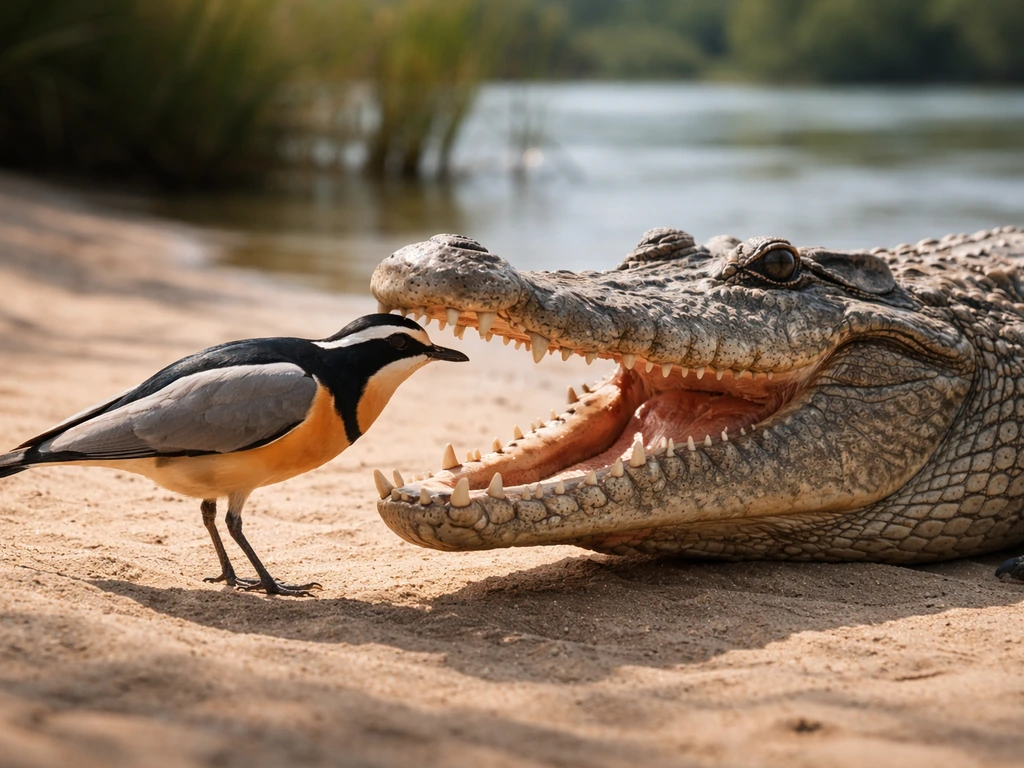
If this sparked curiosity about bird skull mechanics more broadly, it connects naturally to questions about whether birds have teeth (they don't, but some have interesting beak structures that functionally resemble them) and how beaks can degrade, break, or change over a bird's lifetime. The beak is one of the most mechanically active and evolutionarily plastic structures in avian anatomy, and bite force is just one window into how it works. One famous outlier claim is that a certain bird cleans alligators' teeth, even though bite-force rankings above do not cover that behavior what bird cleans alligators teeth. In the wild, a different question comes up entirely: which bird cleans crocodile teeth, and how does it get away with it what bird cleans crocodile teeth.
FAQ
Is “strongest bite force” the same as “most damaging bite” to people or pets?
Not necessarily. The rankings in bite-force studies refer to measured clamping force on a standardized device, not real-world injury severity. Species differ in behavior, grip duration, and where the beak contacts (tip versus base), so a “high Newtons” bird can still be less hazardous than a species that bites in a way that targets sensitive tissue.
Why do some articles list a different top species than macaws?
Most disagreements come from differences in test setup and how authors handle measurements. Key issues are gape angle, the bite point along the beak, whether results use a maximum-per-trial or an average, and whether researchers compare absolute Newtons or Newtons relative to body mass.
How can gape angle change the ranking?
When gape is standardized at a narrow angle, birds that generate force efficiently at that gape can look stronger, even if their peak capacity at wider gapes is similar. If one study uses, for example, a 20-degree gape and another uses 60 degrees, direct comparison becomes misleading.
Do raptors really have weaker bites because they are built for killing, not cracking?
They can still produce high bite forces, but their feeding mechanics and beak/jaw adaptations are tuned to prey dispatch and processing rather than seed cracking. That means you may see different “top” outcomes depending on whether force is compared at similar gape angles and bite locations, or whether the study includes behavioral bias from how often maximal bites occur.
If bite force is measured with sensors, what do researchers do about birds not biting at full power?
A common approach is collecting many bite attempts per individual and using the maximum value per bird, on the logic that the peak effort is the least biased estimate of capacity. Without that kind of strategy, the results can systematically understate a species’ true potential.
What’s the practical way to estimate bite strength from a picture?
Use a combination of indicators rather than beak size alone. Look for deep, wide skulls (more attachment surface), robust jaw muscle attachment areas, and beak geometry that suggests load-bearing rather than hollow or highly thermoregulatory structures. If the beak is very large but the skull appears lightweight or lacks strong muscle support, the bite-force potential may be lower than headlines suggest.
Are Darwin’s ground finches truly “strongest for their size,” and how is that determined?
Yes for the evidence base summarized in the article, they stand out when you scale bite force to body mass. The figure around 47 Newtons for Geospiza fortis is notable for an animal around 20 grams, so “relative strength” depends on using a comparable measurement method and the same units.
Do hollow beaks like toucans mean they cannot exert high force?
They can still exert force, but hollow or low-mass beak designs often limit the beak’s ability to act as a load-bearing structure in the way seed-cracking beaks do. The stronger takeaway is that the whole system matters: jaw muscle capacity and lever geometry usually explain more than beak size alone.
What is PCSA, and why does it matter for older bite-force estimates?
PCSA is a muscle-architecture measure used to infer potential force from specimens, not from live sensor recordings. It enables comparisons across museum samples, but it can introduce error if fiber angle and other anatomical details are not measured carefully, which can shift estimates and rankings.
Does “strongest bite” mean the same thing for breaking bones versus cracking seeds?
No. Seed crackers often have jaw geometry and stress distribution optimized to survive repeated high loads, while prey-handling specialists may evolve different mechanisms, such as specialized beak features used for precise dispatch. Because of that, ecological role influences anatomy, and anatomy influences what “strongest” means under different test conditions.
Next Article
What Bird Cleans Crocodile Teeth? Egyptian Plover Explained
Egyptian plover is the bird most often linked to crocodile “tooth cleaning,” explained with real foraging behavior.