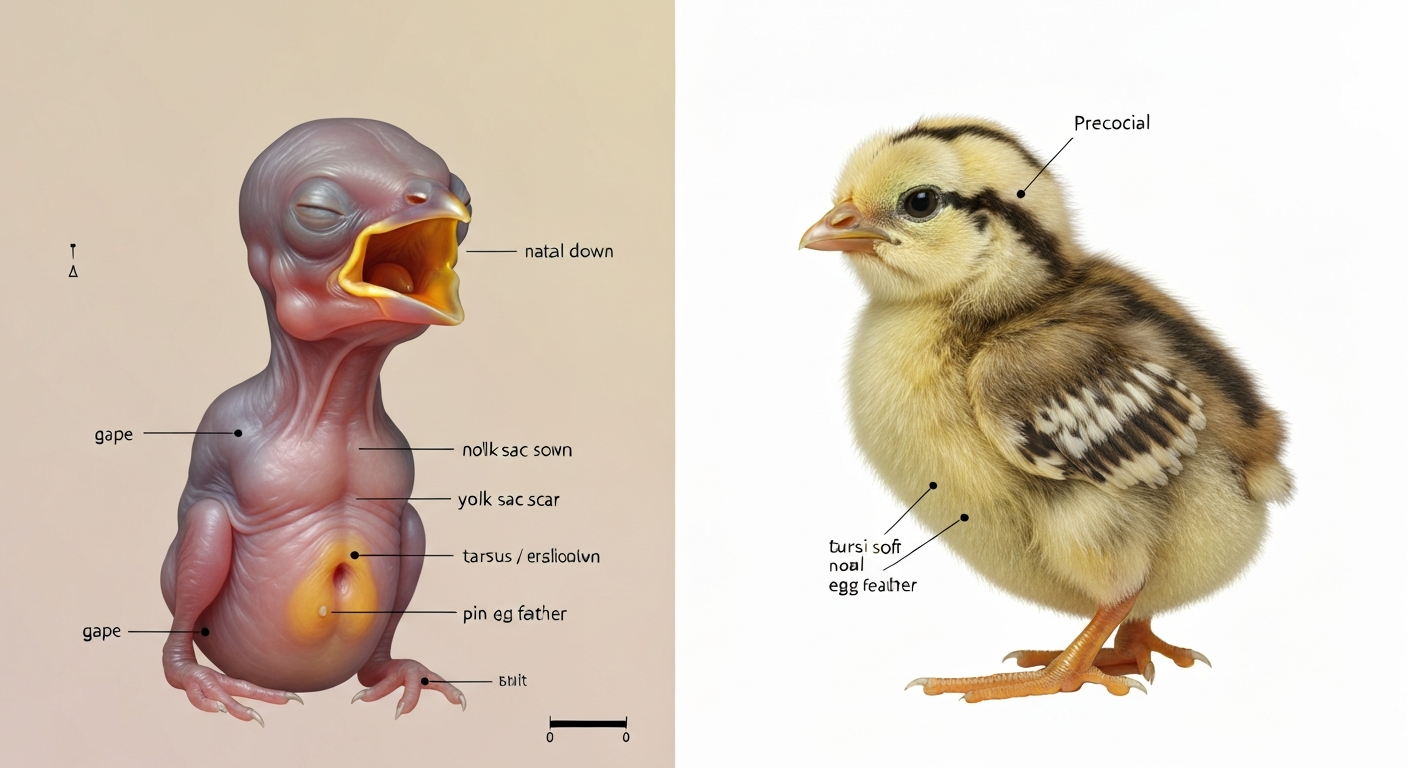
A newborn bird usually looks nothing like what most people expect. Depending on the species, you might be looking at a tiny, naked, pink creature with closed eyes and a wobbly head, or a fluffy, alert chick that's already trying to walk around. Both are completely normal, and which one you're seeing comes down to whether the species is what biologists call altricial (helpless at hatch) or precocial (up and running almost immediately). Most backyard songbird nestlings fall into the first category: skin that looks almost translucent, sparse tufts of wispy down if any, bulging closed eyes, a bright orange or yellow gape (the rim around the open beak), and legs that couldn't support a cracker crumb. Duck and chicken-type hatchlings are the opposite: covered in dense natal down, eyes open, legs sturdy enough to follow a parent within hours.
What Does a Newborn Bird Look Like: Guide to Hatchlings and Care

What a Newborn Bird Typically Looks Like
The first time I found a hatchling on the ground under a tree, I genuinely wasn't sure it was a bird at all. It was roughly the size of a grape, a purplish-pink color, with what looked like a closed pair of bulging domes where eyes should be and a beak so disproportionately wide it seemed like a cartoon. That's a perfectly typical altricial hatchling, and once you know what you're looking at, the anatomy makes a lot of biological sense.
Hatchlings just out of the egg show a few consistent external features regardless of species group: a large head relative to the body (the brain and sensory organs develop early and fast), a short neck that can barely hold that head up, and a body that seems mostly abdomen. You can often see the yolk sac absorption site on the belly of very fresh hatchlings, a small scar-like spot where the egg's nutrition was connected. The skin color is typically pink to red, reflecting the underlying blood supply through thin, unpigmented skin. Altricial species may have a few scattered tufts of natal down (the first downy feathers, sometimes called psilopaedic down) along the head and back, while precocial species hatch fully covered in it.
[IMAGE PLACEHOLDER: Close-up comparison of altricial hatchling (naked, pink, eyes closed) beside a precocial chick (downy, alert, eyes open) with labeled anatomy points: gape, natal down, eye dome, yolk sac scar, egg tooth]
Altricial vs. Precocial Hatchlings: The Big Difference
The altricial-precocial spectrum is one of the most practically useful concepts in bird biology. It was formally defined and systematized by researchers like Starck and Ricklefs, who identified specific diagnostic traits you can actually observe: how much natal down covers the chick, whether the eyes are open or closed, whether the legs can support weight and movement, whether the chick can feed itself or must be fed, whether it stays in the nest or leaves quickly, and roughly how long until first flight. These traits don't always neatly align, which is why scientists describe the spectrum as multidimensional rather than a simple two-way split. A bird can be precocial in leg development but still depend on parents for warmth.
| Trait | Altricial (e.g., robins, sparrows, jays) | Precocial (e.g., ducks, quail, sandpipers) |
|---|---|---|
| Natal down at hatch | Absent or sparse tufts only | Full, dense natal down coat |
| Eyes at hatch | Closed; open after several days | Open at or very shortly after hatch |
| Locomotion at hatch | Essentially none; cannot walk | Walk and run within hours |
| Feeding at hatch | Completely dependent on parent | Find own food shortly after hatch (most species) |
| Thermoregulation at hatch | Poikilothermic; relies on parent brooding for warmth | Partial to near-full endothermy within 1–2 days |
| Nest attendance | Remains in nest for days to weeks | Leaves nest within 24–48 hours |
| Relative brain development | Brain development continues after hatch | Well-developed sensory systems at hatch |
| Common examples | Most passerines, raptors, herons | Ducks, geese, grouse, many shorebirds |
[IMAGE PLACEHOLDER: Side-by-side photo of a day-old altricial passerine nestling vs. a day-old mallard duckling, annotated with developmental traits]
External Anatomy of Newborn Birds: Skin, Down, Eyes, Beak, and Legs
Skin
In altricial hatchlings, the skin is thin, almost translucent, and often appears purplish-pink or reddish because blood vessels lie very close to the surface. There's little to no melanin pigmentation yet. You can sometimes see the outline of developing organs through the abdominal wall. As feather follicles activate and pin feathers push through, the skin texture changes, and small bumps or rows of dark quill tips become visible along feather tracts (the defined paths where feathers grow). Precocial hatchlings have thicker, more developed skin at hatch, already populated with functioning feather follicles that produced the natal down.
Down
Natal down, described in detail in the classic Lucas and Stettenheim integument reference, grows from the same feather follicles that will later produce contour and flight feathers. In altricial species that have any down at all, it appears only in specific feather tracts, leaving bare skin patches visible between them. In precocial species, the natal down is dense, soft, and covers most of the body, functioning as the primary insulating layer from day one. This down is eventually replaced by juvenile feathers as the bird grows, with true natal down pushing out and falling off as pin feathers emerge.
Eyes
At hatch, most altricial nestlings have eyes that are visibly bulging beneath fused or barely separated eyelids. The eyeballs are proportionally enormous relative to the skull because birds rely on highly developed vision and the eye begins its full adult size early in development. In passerines, eyes typically begin opening between days 4 and 9 depending on species. Precocial chicks hatch with fully open, functional eyes. If you look closely at a newly hatched chick's eye, the iris color is often gray or blue-gray and will deepen in color as the bird matures.
Beak
The beak of a hatchling is soft and flexible at the edges, particularly the gape, which is the fleshy rim at the corner of the mouth. In many altricial species the gape is brightly colored, yellow, orange, or white, and acts as a visual target that triggers the parent to deposit food. You may also notice a small, hard, whitish point at the tip of the upper beak called the egg tooth, a temporary keratinous structure the chick used to pip (break out of) the egg. It falls off within days of hatching. The beak shape at this stage does not yet reflect the adult form clearly, but the general proportions that indicate diet type (short and stout for seed-eaters, long and narrow for insect-probers) are already present.
Legs and Feet
Altricial hatchlings have noticeably underdeveloped legs at hatch. The tarsus (lower leg bone, or more accurately the tarsometatarsus) is short, soft, and pale, and the toes can barely grip. The claws are present but soft. Precocial chicks are dramatically different: their legs are proportionally well-developed, with scaled skin on the tarsus already visible and claws firm enough for traction on ground surfaces. Leg development is one of the faster measurements banders and researchers use to track nestling age, since the tarsus elongates rapidly in the first week of life in most altricial songbirds.
How Hatchlings Function Physiologically
Thermoregulation
This is one of the most important things to understand if you ever find a hatchling. Altricial nestlings are essentially cold-blooded at hatch. They cannot generate enough metabolic heat to maintain a stable body temperature on their own, which is why parent birds brood (sit on) the nest almost continuously in the early days. Precocial chicks gain endothermic capacity much faster, often within 24 to 48 hours of hatch, but still need occasional warmth from a parent in cold conditions. For altricial species, the transition from poikilothermy (body temperature follows the environment) to true endothermy (self-regulating body temperature) takes anywhere from several days to over a week depending on species size and the rate of feather development.
Respiration
A hatchling's breathing often looks rapid and shallow compared to an adult bird, which is normal given the high metabolic rate of growing tissue. Birds breathe through a unique flow-through respiratory system involving air sacs, not the tidal (in-and-out) system of mammals, and this system is functional from the moment the chick begins breathing at internal pip (a day or so before the chick actually breaks the shell). Seeing a nestling breathe quickly with its beak closed is not a sign of distress. Open-mouth breathing at rest, gasping, or visible neck-stretching during respiration, however, can indicate a problem.
Feeding and Digestion
Altricial hatchlings hatch with residual yolk that sustains them for the first several hours without feeding, but after that they must be fed frequently. The metabolic rate of nestlings is high and peaks during the rapid growth phase when feathers are actively developing, which is energetically very expensive. Altricial parents typically deliver food by regurgitation or bill-to-bill transfer, and feeding frequency can reach every 10 to 20 minutes during peak growth. One important detail for anyone encountering an injured bird: pigeons and doves feed their young on crop milk, a nutritive secretion from the crop lining that is quite different from what insectivore songbirds feed their young. This matters enormously for rehabilitation feeding approaches and is one of many reasons species identification is important before attempting any supplemental feeding.
Feather Development and Growth Timeline
Feather development follows a predictable sequence that researchers and banders use as one of the most reliable ways to estimate a nestling's age. The USFWS technical guide on nestling aging in altricial passerines by Jongsomjit and colleagues laid out these staging criteria clearly, and they hold across most songbird groups with some variation in timing. The general progression goes from bare skin to natal down to pin feathers to emerging vanes to full juvenile plumage.
| Feather Stage | Typical Age (altricial passerine) | What You See |
|---|---|---|
| Bare / sparse natal down | Day 0–2 | Mostly pink skin; scattered tufts of thin, wispy down on head and back if any |
| Feather tract darkening | Day 2–4 | Rows of dark follicle bumps visible under skin along feather tracts; eyes still closed |
| Pin feathers emerging | Day 4–7 | Small, dark, sheathed quills breaking through skin; eyes beginning to slit open |
| Feather vanes opening | Day 7–10 | Pin feather sheaths split open; flattened feather vanes becoming visible; eyes open |
| Contour feathers expanding | Day 10–14 | Body increasingly covered in juvenile contour feathers; wing feathers visible and growing |
| Near-fledgling appearance | Day 14–21+ | Most body covered; may still have downy tufts on head; tail and wing feathers still short |
| Fledgling (full juvenile plumage) | Day 18–30+ (species dependent) | Able to leave nest; looks like a small, short-tailed version of adult |
Precocial species follow a different timeline. Their natal down functions through the first weeks of life while the underlying juvenile feathers develop beneath it. The natal down gradually wears and falls away as the juvenile plumage grows in, rather than following the abrupt stage-by-stage sequence of altricial nestlings. Waterfowl goslings and ducklings, for example, are recognizable fluffy chicks for several weeks before their pin feathers begin to show prominently.
Estimating Age and Species from Appearance
If you find a hatchling and want to estimate how old it is (and whether it's truly a helpless nestling or a fledgling that's supposed to be on the ground), use several features together rather than relying on just one. Banding field protocols from the North American Banding Council specifically caution against single-trait estimation because individual variation can be misleading. The most reliable combination of features to assess is:
- Feather stage (naked, pin feather, open vane, full juvenile) as described above
- Eye status (fully closed, slitting, fully open)
- Leg and tarsus development (soft and pale vs. firm and scaled)
- Wing chord length if you can measure it safely (requires care to not stress the bird)
- Beak and gape characteristics (gape fleshy and bright vs. firming up and less colorful)
- Behavior (completely limp vs. gaping for food vs. hopping/attempting flight)
Species identification matters a lot here. A bird with open eyes, some feather coverage, and the ability to hop is almost certainly a fledgling passerine that is meant to be out of the nest. It is not a lost baby. Most fledgling passerines spend 1 to 2 weeks on or near the ground while their parents continue feeding them. Picking up a hopping fledgling and moving it indoors is often the wrong call. A truly naked or pin-feathered bird that cannot perch, with closed or barely opening eyes and zero locomotor ability, is a nestling that has fallen out and needs to go back.
How Hatchlings Look by Bird Group
Songbirds (Passerines)
This is the group most people encounter in backyard nests. Hatchling passerines are almost always strongly altricial: naked or nearly so, with closed or barely open eyes, huge gape flanges in vivid yellow or orange, and a high-pitched, persistent begging call. The skin color is pinkish-red at first and the head wobbles when the bird begs. Robins, sparrows, wrens, warblers, finches, and jays all fit this description. Growth is fast: the tarsus nearly doubles in length within the first week.
Waterfowl (Ducks, Geese, Swans)
Waterfowl are strongly precocial. Mallard ducklings, for instance, are textbook examples of a chick that hatches looking already dressed for the world: dense, warm natal down in species-specific patterns (mallard ducklings show a dark stripe through the eye on pale yellow-brown down), fully open eyes, and legs capable of walking and swimming within hours. They are not dependent on being fed by parents and will peck at food items almost immediately. Their down is also treated with preen oil shared from the mother, giving it early water resistance.
Ground-Nesters (Quail, Pheasants, Plovers, Killdeer)
Ground-nesting species are mostly precocial to semi-precocial. Quail and pheasant chicks look similar to duckling-type birds: fuzzy, mobile, and already alert. Killdeer chicks are famously capable of running within hours of hatching, while still attached to a ball of natal down that makes them look like a cotton swab on legs. Many of these species rely on cryptic (camouflage) natal down patterning to avoid predators when the parent gives a warning call, which means the hatchlings have functional hearing and behavioral responses almost from the start.
Signs of Illness or Emergency in Hatchlings
Knowing what a healthy hatchling looks like makes it much easier to spot a sick or injured one. Clinical and wildlife rehabilitation references consistently identify the following as the key visual and behavioral warning signs in neonate birds:
- Cold or clammy skin to the touch, limpness or failure to lift the head when gently stimulated (hypothermia)
- Sunken or dull eyes (in a species where eyes should be open), tacky or dry tissues around the mouth and gape (dehydration)
- Open-mouth breathing or gasping while at rest (respiratory distress)
- Visible neck-stretching, head-bobbing, or repeated swallowing motions without food present (possible obstruction or choking response)
- Bleeding, visible broken bone, asymmetric wing or leg posture, or puncture wounds from predator attack
- Pale, bluish, or mottled skin coloring beyond normal pink (circulatory compromise)
- Neurological signs: seizure-like movements, spinning, inability to hold the head upright, unresponsiveness to touch
Respiratory emergencies in birds are particularly complex because avian airway anatomy differs significantly from mammals. See blank" rel="noopener noreferrer">The avian respiratory system: implications for anaesthesia (PMC review) for detailed clinical information on avian upper airway anatomy and management during airway emergencies. The glottis (the opening into the trachea) sits on the floor of the mouth, visible as a slit-like opening. Airway obstructions and breathing problems in nestlings require expert intervention. For photos and a checklist of visible signs of airway obstruction, see the related article what does a choking bird look like. Clinical guidance from avian veterinary sources recommends against any blind airway manipulation by untrained people, the risk of making things worse is high. Oxygen supplementation by placing the bird near (not inside) a gentle oxygen source, keeping the bird calm, upright if possible, and getting it to a licensed rehabilitator or avian vet promptly is the correct response. Clinical avian emergency guidance (Exotic Animal Formulary (Elsevier) - Supportive care and emergency procedures (chapter)) recommends ABC triage for birds: secure the airway only if visualized, provide oxygen, warm hypothermic neonates gradually (use warming fluids ~38–39°C where appropriate), and correct dehydration with species‑appropriate fluid rates; do not attempt advanced airway procedures without training.
[IMAGE PLACEHOLDER: Illustrated warning signs chart showing side-by-side comparison of healthy hatchling vs. hatchling showing hypothermia, dehydration, and respiratory distress, with labeled visual cues]
Basic First Aid for a Found Hatchling
I'll be honest: the single most important piece of first aid you can provide a found nestling is warmth and calm, followed by getting it to a professional as quickly as possible. The NWRA and IWRC minimum standards for wildlife rehabilitation and most wildlife center protocols converge on the same short list of do's and don'ts.
- Warm the bird first. Place it in a small box lined with paper towels. Set the box half on a heating pad set to LOW, or use a zip-lock bag of warm (not hot) water wrapped in a cloth placed beside the bird. The chick needs to be able to move away from the heat source. Target a warm, not hot, environment: roughly 85–95°F (29–35°C) for a naked hatchling, slightly cooler for a feathered nestling.
- Do not feed it. This is hard to follow but critical. Without knowing the species, the developmental stage, and the correct food consistency, attempting to feed a very young altricial hatchling can cause aspiration (food entering the airway) or fatal malnutrition. A healthy nestling can survive several hours without food while you arrange transport.
- Do not give water by dropper. The risk of water entering the airway is significant in young nestlings. Dehydration treatment requires proper technique and species knowledge.
- Minimize handling. Stress is physiologically costly to a hatchling with almost no energy reserve. Keep the bird in a dark, quiet box. Do not let children or pets interact with it.
- Keep it away from household hazards. Air conditioning vents, ceiling fans, other pets, and direct sunlight are all serious risks.
- Contact a licensed wildlife rehabilitator immediately. In the US, possession of most migratory bird nestlings without a federal Migratory Bird Rehabilitation permit (under the Migratory Bird Treaty Act) is illegal, and attempting to raise a hatchling yourself without training and permits is both legally and biologically risky. The USFWS maintains a permitting system specifically for this purpose.
Returning a Hatchling to the Nest vs. Short-Term Care
If you find a naked or pin-feathered bird on the ground and can locate the nest within reach, putting it back is almost always the right move. The old myth that parent birds will reject a chick touched by humans is exactly that: a myth. Birds have a limited sense of smell and will absolutely continue caring for a returned nestling. Gently place the chick back in the nest and watch from a distance for at least 30 to 60 minutes to confirm a parent returns.
If the nest has been destroyed and you cannot find it, you can create a substitute nest using a small plastic container with drainage holes punched in the bottom, lined with dry grass or paper towels, and secured as close to the original nest location as possible in a sheltered spot. This approach is supported by wildlife rehabilitation protocols and gives the parents the best chance to relocate their chick. If parents do not return within 1 to 2 hours, or if the bird shows any of the emergency signs listed above, contact a rehabilitator.
A hopping, feathered bird with a short tail that can grip a finger but cannot fly is a fledgling, not a fallen nestling. It belongs on the ground and in nearby shrubs while its parents finish teaching it to fly. Moving it indoors removes it from its parents and is almost always counterproductive. Leave it where it is, keep pets and people away, and let the process complete naturally.
Related Topics Worth Exploring
Understanding what a newborn bird looks like is really just the starting point for a broader picture of avian development. If you're curious about what happens at the other end of the life spectrum, the physical changes that mark an aging bird and how an older bird's body differs structurally from a young adult, there's a companion article here on what an old bird looks like that covers those changes in detail. For more on aging birds and how they change, see the companion article titled what does an old bird look like. If you're also curious about how humans manage birds in built environments, see the related piece on what do bird spikes look like for a clear description of that deterrent. For readers interested in the behavior and physical displays that lead to hatching in the first place, the article on what bird mating looks like walks through the anatomy and physiology of courtship and reproduction. Seeing a full bird life cycle from first breath to maturity to senescence makes each stage much more legible when you encounter it in the field. For a clear explanation of courtship displays and mating anatomy, see the article what does bird mating look like. For a description of Liverpool's emblem and its appearance, see what does a liver bird look like.
What You Now Know About Newborn Birds
A newborn bird's appearance tells you a remarkable amount about its biology. Naked and helpless means altricial: the species trades a longer developmental period inside the nest for a shorter, less energy-intensive incubation. Covered in down and alert means precocial: the species invests more in embryonic development but produces a chick that can feed and thermoregulate quickly. External features like eye state, gape color, feather stage, and leg development are not random: they're diagnostic tools that biologists, banders, and rehabilitators use to determine age, species group, and health status. If you find a hatchling, the most useful things you can do are identify whether it's a nestling or a fledgling, provide warmth without feeding it, minimize stress, and get it to a licensed rehabilitator promptly. The biology is genuinely fascinating; the practical stakes for the bird are real.
FAQ
What does a newborn bird typically look like at a glance?
Newborn birds vary widely, but visually you’ll usually see one of two broad appearances: very naked, pink or dark skin with little or no down (common in altricial species), or a well‑downed chick with open eyes and sturdy legs (common in precocial species). Typical features to notice: skin color and texture (pink, mottled, or scaly), presence/absence and color of down, closed or open eyes, short stubby beak or longer pointed bill, and leg/foot development. Size and posture range from helpless and sprawled (altricial) to standing and active (precocial). Image placeholder: [insert photo of naked altricial hatchling] and [insert photo of downy precocial chick].
What is the difference between altricial and precocial hatchlings?
Altricial and precocial represent endpoints on a developmental continuum. Altricial hatchlings (many songbirds/passerines) hatch largely naked or with sparse down, have closed or only‑opening eyes, weak legs, cannot thermoregulate, and are totally dependent on parents for feeding and brooding. Precocial hatchlings (ducks, chickens, many shorebirds) hatch with natal down, open and alert eyes, strong legs, can move and feed soon after hatching, and have much greater early thermoregulatory and locomotor independence. Many species fall between these extremes—use multiple traits (down cover, eye state, locomotion, feeding ability, nest attendance) together to place a chick on the spectrum.
What external anatomical features should I examine and what do they tell me?
Key external features and what they indicate: - Skin: thin and pink/transparent in very young altricial chicks; thicker, more pigmented or scaly in precocial species. - Down: absent or patchy in altricial chicks; dense natal down in precocial chicks. Down color/pattern can help species group identification. - Eyes: closed or fused in many altricial neonates; partially or fully open in precocial chicks. - Beak and gape: very wide yellowish gape in many passerine nestlings (adaptation for parental feeding); beak shape/length helps identify family (seed‑eater vs insectivore vs shorebird). - Legs and feet: short/weak with little grip in altricial chicks; long, scaled, and functional in precocial chicks. - Feather tracts/pin feathers: presence of pin feathers (sheathed developing feathers) indicates progression toward fledging; their number and location help age estimation.
How do internal/physiological traits of newborn birds affect their care needs?
Important physiological traits: - Thermoregulation: altricial hatchlings are often poikilothermic at hatching and need parental brooding or external heat; precocial chicks regulate body temperature much sooner. - Respiration and metabolism: neonates have high metabolic rates relative to mass and require frequent feeding and adequate oxygenation; distressed chicks may gasp or show open‑mouth breathing. - Feeding physiology: many altricial nestlings are fed regurgitated insects/foods; pigeons/doves produce crop milk. Aspiration risk is high if feeding untrained. - Hydration: small chicks dehydrate rapidly because of high metabolism and surface area; visible signs include sunken eyes or weak skin tone. These traits dictate that very young altricial chicks need warmth and frequent, species‑appropriate feeding, whereas many precocial chicks require protection and access to appropriate food and water.
What is a simple feather‑development timeline I can use to estimate age?
Generalized feather-development stages (approximate; timing varies by species). Use multiple traits (eye opening, weight, tarsus length) for accuracy. Table (approximate): - Day 0–3: naked or sparse down; eyes closed or just opening (altricial). - Day 3–7: down increasing; pin feathers start to appear as dark sheaths; eyes opening. - Day 7–14: many pin feathers emerging into short fluffy feathers; primary/secondary tracts visible; increased activity. - Day 14–21: contour feathers filling in; wing feathers elongating; fledging approaches for small passerines. - 3–6+ weeks: flight/juvenile plumage developing; species with slower growth (larger birds) extend these stages over months. Note: precocial species show natal down at hatching and wing/flight feather growth follows a different, often faster timetable.
How can I estimate a chick’s age from appearance?
Estimate age by combining characteristics: - Eye state: closed = very young (days); partially open = several days; fully open = older nestling or precocial at hatch. - Down vs feathers: mostly naked = <1 week for many altricial species; pin feathers present = roughly mid‑nestling period; open feathers and long wing feathers = near fledging. - Behavior/strength: cannot hold up head = very young; able to squat and beg = older nestling; standing/walking and feeding = precocial or older. - Size metrics (when available): wing chord, tarsus length, and weight compared with species‑specific guides (e.g., USFWS altricial passerine aging guide) improve accuracy. Always use multiple indicators rather than a single trait.
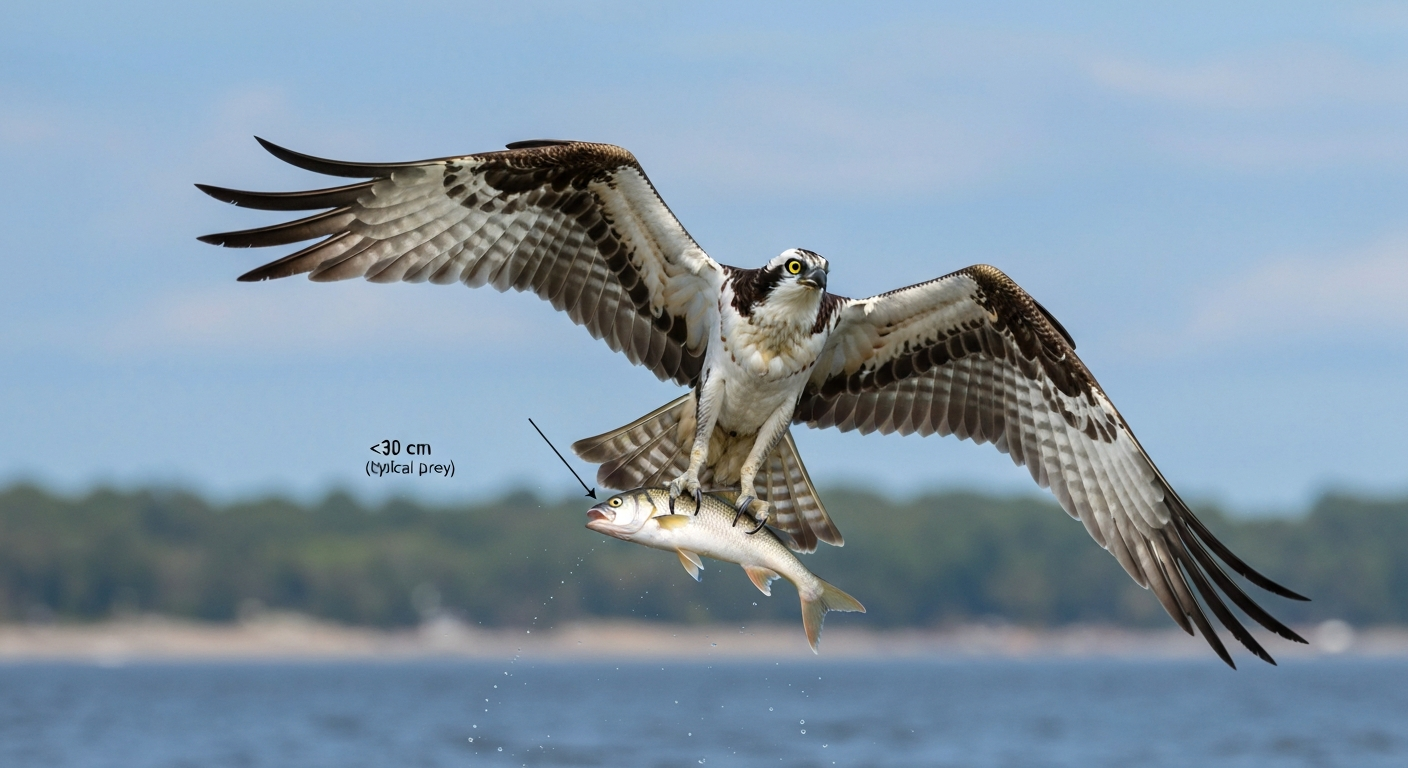
How much weight can an osprey carry: typical prey 0.5–2 kg (≈30–100% body mass); anatomy, flight limits and evidence.
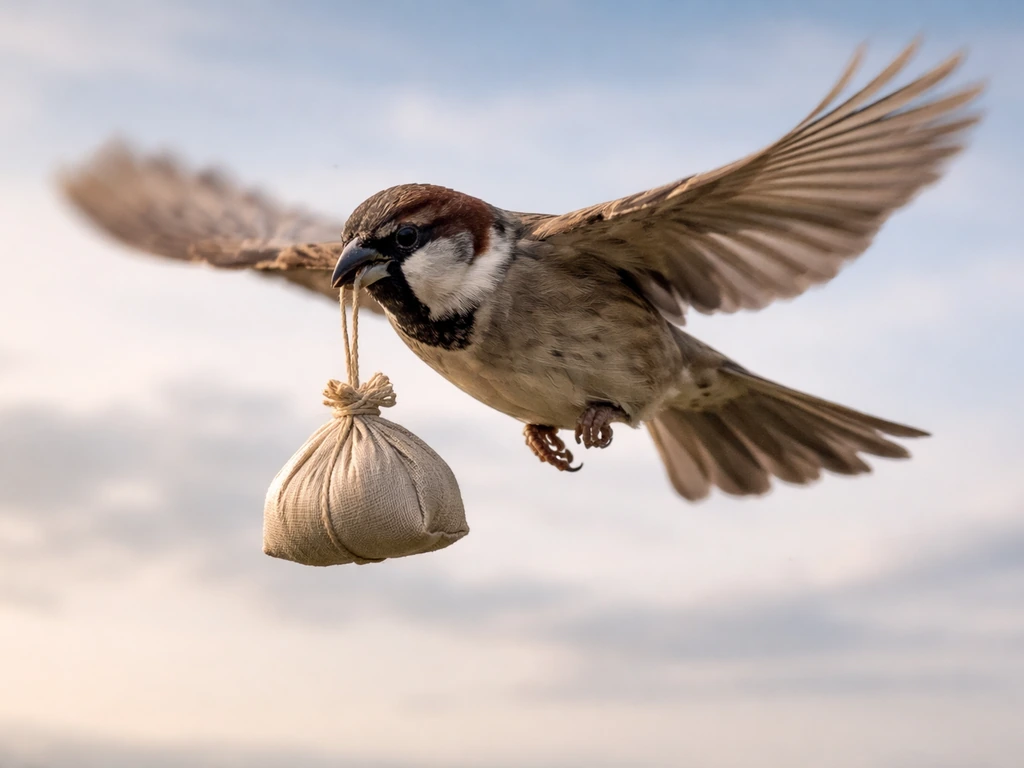
Realistic payload ranges for different birds plus a method to estimate how much weight they can carry safely.
Explains which bird has the highest heart rate, how it’s measured, key contenders, and how to compare readings fairly.