The short answer: the harpy eagle (Harpia harpyja) is the bird most credibly associated with carrying the greatest weight in flight. An adult female, which is larger than the male and can weigh around 9 kg (roughly 20 lb), has been documented grabbing prey of similar mass and transporting it without landing. Britannica gives typical body mass ranges for harpy eagles, with females around 6. 3, 9 kg and males about 3.
What Bird Can Carry the Most Weight While Flying?

Marcus Chen
22 Apr 2026
8, 5. 4 kg around 9 kg (roughly 20 lb).
Guinness World Records officially recognizes it as the bird of prey capable of killing and carrying away the largest animal. That said, the exact number you'll see quoted varies a lot depending on the source, and understanding why those numbers differ is almost as useful as the number itself.
What does "carry" actually mean for a bird?
This is genuinely the most important question to settle before comparing species. "Carry" can mean at least three different things, and the answer changes depending on which one you're asking about.
- Carrying in flight: gripping a load with the feet and sustaining powered, directed flight with it. This is the hardest version and the one most people are curious about.
- Transporting on the ground or from a low position: dragging, hopping, or short-burst flying a heavy prey item a short distance. Less demanding aerodynamically, but still physically taxing.
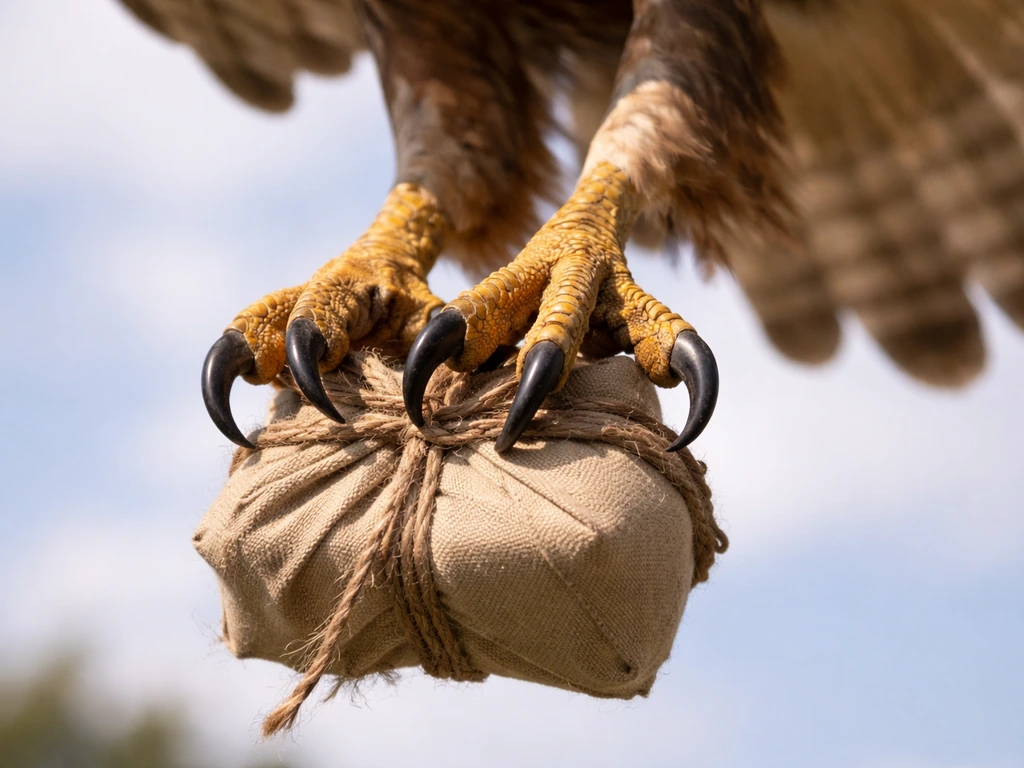
- Holding/gripping at rest: the maximum grip force a talon can exert while perched or stationary. This is a separate measurement entirely and does not equal "can fly while holding that." A red-tailed hawk, for example, has a talon-locking mechanism that passively maintains grip without continuous muscle effort, making it excellent at restraining prey it cannot actually lift off the ground.
Most sensational "this bird can carry 30 pounds!" headlines blur these categories together. A Forbes piece repeating a biologist's framing claimed the harpy eagle can carry up to 30 lb while flying, but that figure isn't backed by a rigorous, standardized field measurement. The more carefully sourced figure, cited by the Los Angeles Zoo and aligned with Audubon's reporting, is that a large female harpy eagle can carry roughly its own body weight, around 17 to 20 lb, in flight. That's already extraordinary. Just keep in mind whether any source is talking about grip, transport, or sustained airborne flight.
The anatomy that sets the limit
A bird's payload capacity isn't one number sitting somewhere in its DNA. It's the product of several interacting biological systems. Change any one of them and the ceiling shifts. Here's what actually sets the limit.
Flight muscles and power output
The pectoralis muscle is the main engine. It drives the downstroke of the wing and produces the majority of the lift and thrust needed for powered flight. In flying birds, this muscle typically accounts for somewhere between 8% and 15.5% of total body mass, a remarkable proportion compared to what you'd see in most land animals. The bigger and denser this muscle, the more mechanical power the bird can generate. Muscle fiber type also matters: fast-twitch fibers generate high peak force for short bursts, while slow-twitch fibers sustain output over time. A bird carrying a heavy load needs both: a burst to get airborne, then sustained power to keep moving.
Bones: light but not weak

Avian bones are pneumatized, meaning many are hollow and connected to the respiratory air sac system. This dramatically reduces skeletal mass without sacrificing structural integrity. But bones still have stress limits. A harpy eagle's leg bones and the ungual phalanges (the curved tip bones that form the talons) must bear the impact force of a strike and the sustained load of carrying heavy prey. Finite-element biomechanical modeling has shown that talon bone shape is closely matched to the mechanical stresses imposed by the relative size of prey, meaning the skeleton is effectively tuned to the typical load the bird encounters in the wild. Pushing well beyond that typical range risks fracture.
Wing loading and lift
Wing loading is the ratio of a bird's body mass to its wing area, usually expressed in grams per square centimeter or kilograms per square meter. A bird with high wing loading (heavy relative to its wing size) needs to fly faster to generate enough lift to stay aloft. Add a payload and the effective wing loading goes up immediately. The bird must either fly faster, flap harder, or both.
The harpy eagle actually has relatively short, broad wings for its body size, which suits maneuvering through dense forest canopy but means it isn't a soaring specialist. It compensates with raw muscle power. An eagle with longer wings, like a golden eagle, can soar more efficiently but the extra payload still demands more from the musculoskeletal system.
Feet, talons, and grip mechanics
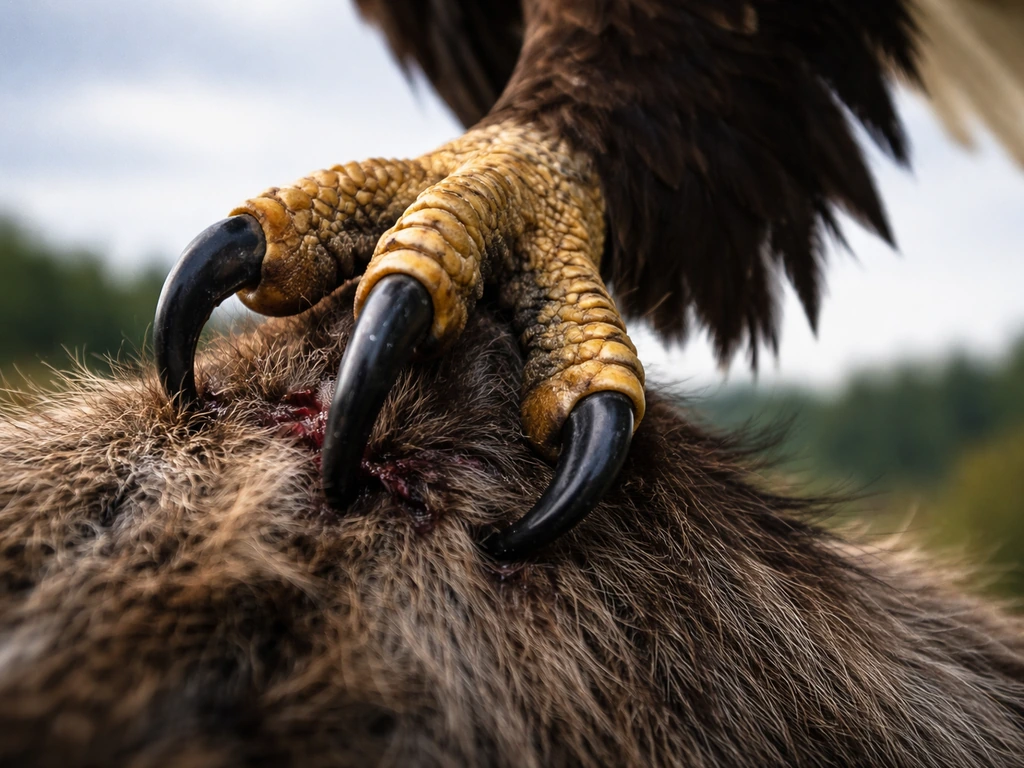
The harpy eagle has the largest talons of any living eagle, with rear talons reaching around 5 inches in length, comparable in size to a grizzly bear's claws. But size is only part of the story. Raptor feet use a tendon-locking mechanism that allows the toes to clamp shut and maintain grip passively, without continuous muscle contraction. This is similar in concept to how a ratchet works: the bird can secure prey even when exhausted. The USFWS cites bald eagle grip strength at around 400 psi, and grip force across raptors varies with toe and talon morphology. Importantly, grip force and lifting force are separate: a bird can hold something it cannot lift.
How payload records are actually measured (and why they're messy)
This is where I had to do a lot of digging, because the "X bird can carry Y pounds" claim gets repeated constantly with very little transparency about how it was measured. The honest answer is that most figures come from one of three sources, none of which is a standardized controlled experiment.
- Nest/diet ecology records: researchers weigh prey items brought to nests, which tells you what a bird actually transported under real field conditions but not the maximum it could carry under ideal conditions.
- Observed predation events: naturalists or researchers witness a bird strike and fly off with prey, then estimate prey weight from species identification. Estimates can be rough.
- Expert-stated maximums: biologists or zoo staff give figures based on body weight ratios and professional experience, not a controlled payload test. The Los Angeles Zoo's "about its own body weight" figure is an example of this reasonable but unverified category.
The golden eagle situation illustrates the controversy well. blank" rel="noopener noreferrer">Wikipedia's dietary biology page notes that "it has been claimed" golden eagles can lift more than their own body weight in flight, but alternate views suggest this may only be achievable with strong updrafts or running starts, not in standard conditions. The Raptor Resource project has noted in public discussions that getting solid measurements of maximum carry is genuinely hard, and field conditions (wind, terrain, prey struggling vs limp) all affect what a bird can do on a given day. So treat any specific weight figure as an informed estimate, not a laboratory result.
Likely winners depending on your scenario

The answer shifts a bit depending on exactly what you're trying to find out. Here's a quick breakdown by scenario.
| Scenario | Most likely winner | Notes |
|---|---|---|
| Maximum weight carried in sustained flight | Harpy eagle (female) | Best-documented case; up to ~17–20 lb cited by reputable sources; Guinness-recognized |
| Maximum absolute weight gripped (not necessarily flown) | Harpy eagle or golden eagle | Grip force is separate from lift; large eagles can restrain prey far heavier than they can fly with |
| Best weight-to-body-mass carry ratio | Contested; various raptors including accipiters | Smaller raptors like Cooper's hawks carry prey close to their own body weight proportionally |
| Largest non-flying bird that moves heavy loads | Ostrich or emu | Can carry weight on their backs under domestication; unrelated to aerial payload |
| Most weight carried over long distance in flight | Harpy eagle or golden eagle | Golden eagles documented transporting prey across significant terrain in mountainous habitat |
It's worth noting that this question is closely related to which bird can lift the most weight, but lifting (getting something off the ground) and carrying (transporting it through flight) aren't identical. A bird might lift something briefly and drop it, or carry something lighter for a much longer distance. The biological challenge of sustained transport is greater than a single-strike lift.
Why birds can't just carry anything: biology's strict tradeoffs
There's a real ceiling here, and it's enforced by physics and biology simultaneously. Carrying extra weight isn't just tiring: it's potentially injurious and metabolically expensive in ways that compound quickly.
- Bone fracture risk: talon and leg bones are shaped for a specific stress range. Prey significantly heavier than the bird's typical quarry can exceed bone tolerance, especially during the high-impact strike.
- Flight instability: a heavy, asymmetric load (one foot gripping, one free, or prey that shifts mid-flight) creates unpredictable aerodynamic moments. The bird must constantly correct, burning more energy and risking loss of control.
- Energy cost scales steeply: the metabolic cost of flight increases nonlinearly with added load. A bird carrying half its body weight may spend several times more energy per minute than unloaded flight, which limits how far and how long it can transport prey.
- Muscle fatigue and injury: the pectoralis and hindlimb muscles working at or near maximum output are at elevated risk of strain. This is why even very capable raptors sometimes abandon large prey mid-transport.
- Predator vulnerability: a heavily loaded bird is slower and less maneuverable, making it more vulnerable to being stolen from (kleptoparasitism) or attacked itself.
This is why the scientific literature, including work in the Journal of Experimental Biology on raptor grip forces and the Journal of Ornithology on flight muscle scaling, emphasizes that real-world carry behavior reflects a biological optimum, not a maximum. Birds generally don't carry prey at the absolute ceiling of their capacity because doing so would be unsustainable and risky. The records we observe in the wild are already impressive precisely because they represent the upper edge of what's biologically safe. If you want to switch gears from weight limits to hydration needs, you might also be wondering what bird drinks the most water.
How to estimate a bird's payload from its body structure
You don't need a laboratory to make a reasonable estimate. If you're looking at a bird species and want to get a rough sense of its carrying capacity, here's a practical framework using body structure and what we know about avian physiology.
- Start with body mass: as a rough rule, most raptors can carry between 25% and 100% of their own body weight in flight, depending on species and conditions. Female harpy eagles (around 8–9 kg) sit at the high end of that range for body size.
- Check the pectoralis: in a well-muscled raptor, the breast area feels very full and deep relative to the keel bone. A flat or shallow keel with thin muscle coverage signals lower power output and reduced payload capacity.
- Assess wing shape: broad, rounded wings (like a harpy eagle's or a hawk's) provide more lift at lower speeds, which helps when carrying a heavy load. Narrow, pointed wings (like a falcon's) are built for speed, not load-carrying.
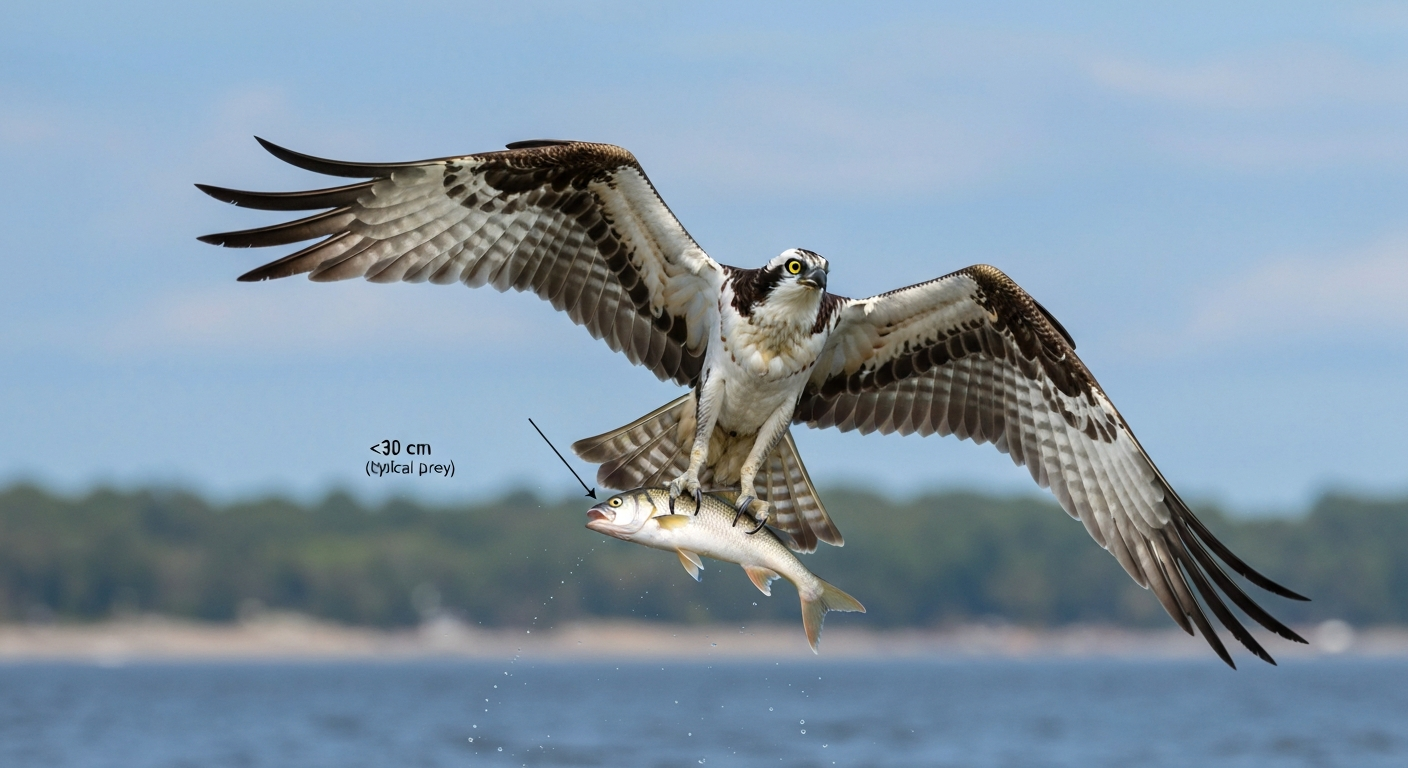
- Look at the feet: large, heavily curved talons with long hind toes (the hallux) suggest a bird built for seizing and restraining heavy prey. Harpy eagles and great horned owls have this morphology. Ospreys have a reversible outer toe, optimized for gripping slippery fish rather than massive loads.
- Consider sex: in most raptors, females are significantly larger than males. For the harpy eagle, the female is up to twice the mass of the male. The female's larger muscle mass and heavier build are directly linked to higher payload capacity.
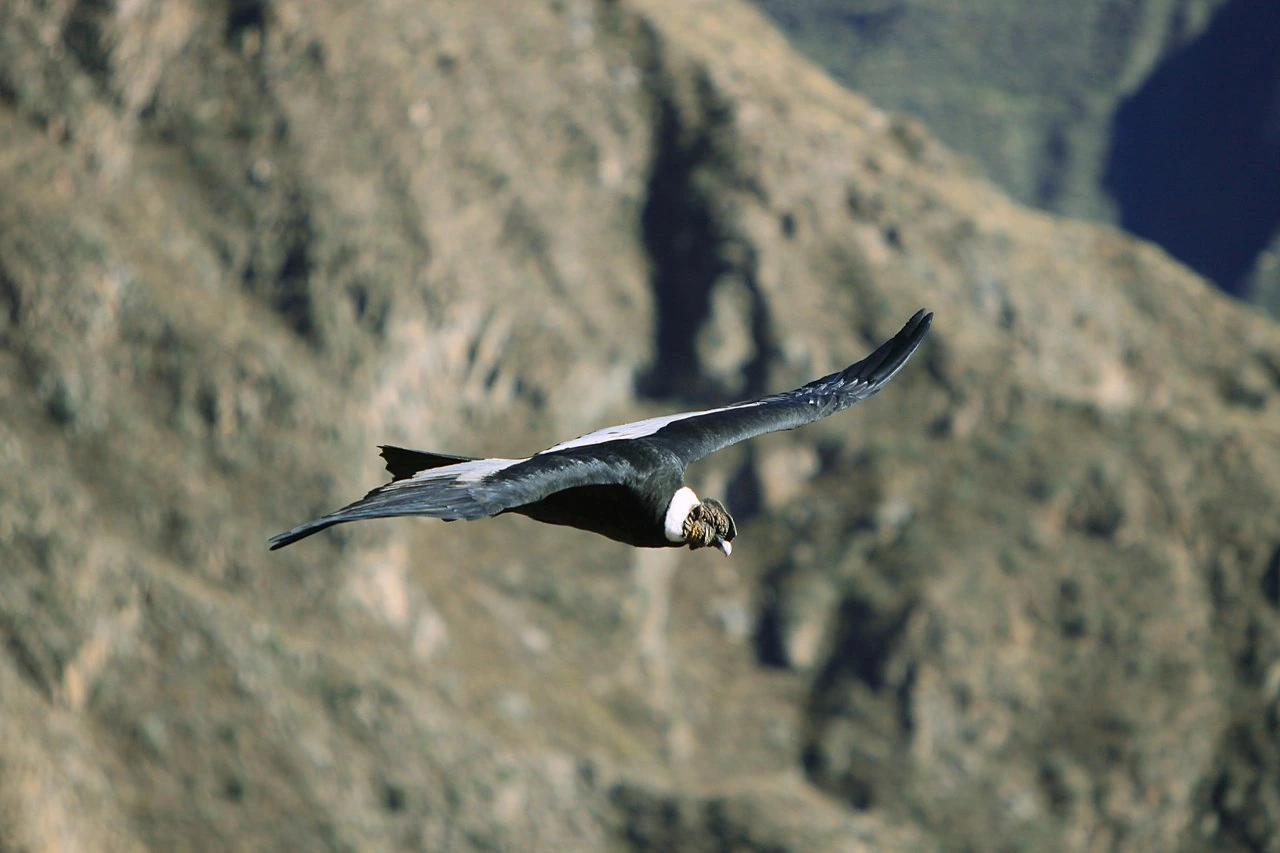
- Factor in flight style: a bird that rarely soars and relies on powered flapping flight (like a harpy eagle in dense forest) has a different muscle fiber composition than an obligate soarer (like a condor). Flappers generally have more fast-twitch capacity for burst lift with a load.
One honest caveat: these are estimation tools, not precise calculators. The actual ceiling for any individual bird on any given day also depends on wind, altitude, prey behavior, and the bird's own nutritional state. If you're curious about a specific species, the best real-world data comes from nest ecology studies that record the actual mass of prey items transported, which is the closest thing to a verified payload measurement science currently has.
If this question sent you down a broader rabbit hole about how bird body mass affects flight and biology generally, it connects naturally to questions about which birds weigh the most overall and how size scales with different biological functions. This is why questions about what bird weighs the most in the world are related, even if they focus on body mass rather than payload in flight. The heaviest flying birds in the world, like the kori bustard, face a completely different set of constraints than a harpy eagle, and the biology of why some large birds eventually stop flying altogether is its own fascinating thread.
FAQ
Does “carry the most weight” mean the bird can fly long distances with it?
Yes. Even for harpy eagles, “maximum carry” claims are highly condition-dependent. A bird may be able to lift or hold prey for a short burst, but sustained transport often requires a lighter effective payload because flapping effort, oxygen demand, and balance become limiting faster than grip.
Can a bird carry something it cannot actually lift?
It can, because grip and lift are not the same system. Raptors can clamp shut and keep hold of heavy prey (tendon-locking helps), yet still lack the wing and muscle power to accelerate and sustain flight with that same mass.
How can I tell whether a “pounds carried in flight” number is credible?
Look for descriptions of how the number was obtained. Reliable reports usually reference observed prey transport or clearly defined biomechanical assumptions, while sensational headlines often compress categories (lift vs transport, grip vs flight, short burst vs sustained flight) into one value.
Does the top carrying bird change depending on whether the flight is in open air vs forest canopy?
Wing loading and maneuvering matter. Short, broad wings can be excellent for forest navigation but may be less efficient for sustained hovering or long-distance cruising under heavy payload, so the “best” carrying bird depends on the type of flight scenario being assumed.
Why do maximum carry numbers vary so much between accounts and locations?
Altitude, wind, and temperature can shift the practical ceiling. Higher altitude means thinner air and lower oxygen availability, stronger winds can either help (updrafts) or hinder (turbulence), and prey struggle level can dramatically change the forces required during the carry.
Can an individual bird carry more weight than its species average?
Yes, diet and condition affect the outcome. A bird in good nutritional state with recent successful hunting is more likely to sustain higher output, while fasting, injury, or heavy molt can reduce effective power and increase risk of muscle or bone stress.
Do raptors always take the heaviest prey they can physically grip?
Often, but not always. Birds with high gripping capacity may still avoid carrying extremely heavy prey if the expected transport duration is long or if the prey is likely to wriggle unpredictably, increasing variable force on talons and legs.
If I want real evidence, what kind of data should I look for?
Nest ecology is one of the best real-world approaches because it measures actual transported prey mass. Instead of relying on maximum claims, it captures what the bird routinely carries to nests under natural constraints.
Is the bird that lifts the most in a single strike always the same as the bird that transports the most?
If your goal is “most weight lifted off the ground,” that can yield a different answer than “most weight transported through sustained flight.” Brief lift may be limited by muscle power and takeoff mechanics, while transport adds the full cost of maintaining flight over time.
Why can one source say a bird carries X pounds and another say it cannot?
Yes. “Carry” can mean different endpoints, for example, short-distance transport, crossing a gap, escaping a predator, or flying directly to a perch. The longer and more controlled the transport scenario, the lower the effective payload is likely to be for any species.
Next Article
How Much Weight Can an Osprey Bird Carry: Numbers & Limits
How much weight can an osprey carry: typical prey 0.5–2 kg (≈30–100% body mass); anatomy, flight limits and evidence.