Wing clipping trims a bird's longest flight feathers (the primaries) so the bird loses enough lift to prevent sustained, high-speed flight. The developmental biology of feather follicles (review) notes that Feather follicles produce feathers by a localized keratinizing growth zone; damaging follicles (repeated trauma, deep cuts, surgical removal) can lead to abnormal regrowth, feather cysts (ingrown feathers), or chronic follicle pathology. Done conservatively and correctly on a healthy bird, it can reduce escape risk and make handling safer in a busy household. Done badly, or on the wrong bird in the wrong situation, it can cause injuries, stress, muscle loss, and behavioral problems. There is no universal right answer here, and I say that as someone who spent a lot of time assuming there was one.
Pros and Cons of Clipping Bird Wings: Safety vs Welfare

What wing clipping actually is (and what it is not)
Wing clipping is the selective trimming of flight feathers, specifically the large primary remiges at the outer edge of each wing, to reduce aerodynamic performance. It is not surgical, it does not harm bone or muscle directly, and the feathers will grow back after the next molt. The RSPCA describes it as typically trimming up to around 10 of the main flight feathers. What clipping is not: a permanent solution, a guarantee against escape, or a substitute for a secure enclosure. Owners sometimes confuse clipping with pinioning, which is the surgical removal of part of the wing itself. Pinioning is permanent, is not recommended by any major avian welfare body for companion birds, and is a completely different procedure.
The goal of clipping is not to ground a bird entirely. A properly clipped bird can still flap, glide downward, break a fall, and move around a room. The idea is to limit altitude gain and directional control so the bird cannot fly out a door or across a room at speed. How much function is lost depends on which feathers are trimmed, how many, and the individual bird's body weight and wing shape.
The feathers and wing structures involved
Before you can understand what clipping changes, it helps to understand what feathers do. For related avian anatomy details, see what are bird claws made of for information on claw structure and composition. A bird's wing carries two main groups of flight feathers, called remiges. The primaries attach to the bones equivalent to the hand and outer wrist. These are the longest, outermost feathers and generate most of the thrust and lift during active flapping. The secondaries attach to the ulna (the inner wing bone) and contribute to the inner wing's lift surface, which is more like a conventional airfoil. Clipping almost always targets the primaries.
Something I found genuinely fascinating when I looked into this: primary feathers are not just passive flat surfaces. Research on avian feathers shows they passively deform under aerodynamic load in flight, a property called aeroelastic deflection, and that deformation actually affects lift and drag in ways that improve efficiency. They are mechanically engineered structures, not just overgrown hairs. A comparative study of 19 parrot species also found that feather strength and dimensions scale with body mass across the wing, which means a macaw's primaries and a budgerigar's primaries are not equivalent in either size or structural importance. That matters when thinking about how much is lost by clipping.
One critical detail every owner needs to know: feathers go through a growth phase called the blood feather or pin feather stage. During this phase, the feather shaft contains a live blood supply running up from the follicle. Cutting a blood feather causes real bleeding and is painful. The feather follicle itself is vascularized and innervated during growth. Cutting a blood feather by accident is one of the most common injuries in amateur clipping attempts, and it can occasionally require veterinary help to stop the bleeding.
How birds actually fly (and why it matters here)
Flight in birds involves four forces: lift (upward), weight (downward), thrust (forward), and drag (backward). The wing generates lift by moving air faster over its curved upper surface than its lower surface, creating a pressure difference. The primaries at the wingtip generate thrust on the downstroke, and their slotted arrangement at the tip reduces a phenomenon called induced drag, which is the energy penalty for generating lift. A wind tunnel study on a Harris's hawk directly showed that clipped wingtips increased drag compared with intact slotted tips, because those natural slots reduce the strength of the vortex that trails off each wingtip. Takeoff requires the highest power output, and landing requires controlled deceleration and a precise stall to touch down safely. Both depend heavily on the outer wing.
Gliding and controlled descents also depend on feather area and wing loading (body weight divided by wing area). Remove primary surface area, and the bird has to flap harder to stay airborne, or it descends faster and steeper than normal. An experiment on domestic laying hens that had their primaries and secondaries clipped found measurable changes in descent velocity and angle compared with unclipped birds, confirming that even in a heavy-bodied, ground-preferring species, feather removal alters landing kinematics in ways you can quantify.
How clipping changes what a bird can do in the air
Once primary feathers are shortened, several things change at once. Total wing area drops, which increases wing loading and reduces lift at any given airspeed. The slotted wingtip structure that reduces induced drag is gone or compromised, so drag increases for the lift generated. The bird can no longer build enough speed or altitude for sustained directional flight. It may still manage short, descending glides and can flap hard enough to slow a fall, but it cannot climb efficiently or maintain level flight across a room.
Balance during perching and walking is also affected, though this is something that does not always get mentioned. A bird uses its wings constantly for micro-adjustments, even when standing. See how are claws helpful to a bird for how claws complement wing-based balance during perching and micro-adjustments. Reduced feather surface means reduced ability to correct a stumble or an unexpected perturbation. Some clipped birds, especially those clipped too aggressively, fall from perches more frequently and may injure their keel (breastbone), face, or feet on impact. The Association of Avian Veterinarians specifically emphasizes bilateral, symmetrical clipping for this reason: clipping only one wing creates an asymmetric imbalance that makes controlled descent much harder.
Over longer periods, reduced flight activity means reduced cardiovascular and pectoral muscle workload. Flight muscles in birds are enormous relative to body mass because flapping flight is metabolically expensive. A bird that cannot fly fully will use those muscles less, and sustained inactivity contributes to muscle atrophy and reduced cardiovascular fitness. This is a slower effect than the acute balance and drag changes, but it is a real one.
Why owners clip: the common reasons
The most common reason owners give is safety: preventing escape through an open door or window, reducing the risk of a bird flying into a ceiling fan, hot stove, or a mirror. For a focused discussion of common justifications and the risks involved, see why clip bird wings. For new bird owners still learning to read their bird's behavior, clipping reduces the consequences of a startled bird making a panicked flight. It also makes initial training and taming easier, since a bird that cannot escape has to engage with the owner rather than flee. Some veterinary clinics clip birds before procedures for handling safety.
There are also household-specific situations where clipping makes sense on a case-by-case basis: a home with young children and a large bird, an environment where containing the bird's movement is genuinely difficult to achieve otherwise, or a rehabilitation setting where a tame bird is being prepared for supervised outdoor time. The key phrase in all of these is case-by-case. The World Parrot Trust's position statement pushes back strongly against routine clipping as a default, arguing that it reduces agency and can produce negative behavioral outcomes without clear, species-specific justification. That position is worth taking seriously.
The benefits: what clipping genuinely offers
- Reduces escape risk in households with doors and windows that open frequently
- Lowers the chance of high-speed collision injuries (fans, windows, walls) during panicked flights
- Makes initial taming and recall training more achievable for inexperienced owners
- Reduces handling stress for the owner, which indirectly reduces handling stress for the bird
- Allows supervised outdoor time with reduced flight-away risk in birds not yet trained to return
- Can be part of a transitional management plan while flight training and recall are being established
It is worth noting that the safety benefit, while real, is not absolute. Survey research from Brazil published in 2025 found that clipped birds are not uniformly safer: some clipped birds still escape, and owners who clip frequently still report welfare tradeoffs. Clipping reduces certain risks while it introduces others, which is exactly why it should be a deliberate, informed decision rather than an automatic one.
The downsides: welfare, injury, and behavioral consequences
Physical and injury risks
- Cutting blood feathers (pin feathers still in active growth) causes hemorrhage and pain; it requires careful inspection before each clip
- Trauma to feather follicles from repeated aggressive cutting or damage to the base can cause follicle pathology, abnormal regrowth, or feather cysts (ingrown feathers)
- Falls from perches are more common in clipped birds, especially those clipped too aggressively, and keel bruising or fractures can result
- Asymmetric clips cause uncontrolled spinning descents that increase fall injury risk
- Clipped birds that attempt flight in a panic can still hit objects but with less control, making some collision injuries more likely rather than less
Feather regrowth timing
Clipping is not permanent, but regrowth is not quick either. Measured primary feather growth rates across species range from roughly 2 to 6 mm per day depending on the species and feather size, meaning large parrots replacing their longest primaries can take months before full flight is restored. Owners need to track molt and reassess clipping decisions at each molt cycle rather than treating the first clip as a set-and-forget solution.
Behavioral and welfare consequences
This is the area where the science is most interesting and, honestly, the most uncomfortable for owners who clip routinely without thinking about it. Behavioral research led by van Zeeland and colleagues found that voluntary free flight in galahs produced more 'optimistic' responses in a cognitive bias task compared with non-flight days, suggesting that flight has genuine positive affective consequences for at least some species. A controlled study found that flight opportunities increased appetitive behaviors and general activity. These are not soft anecdotes; cognitive bias tasks are a validated method in animal welfare science for measuring emotional state.
There is also physiological evidence to consider. Feather corticosterone measurements, which capture chronic stress signals deposited in feathers during growth, have been used to compare birds under different flight-restraint regimes. A study in flamingos found differences in feather corticosterone levels associated with types of flight restraint, supporting the idea that flight restriction has measurable stress-related physiological consequences. The mechanism is not fully mapped yet, and scientists continue to debate how generalizable these findings are across species. But the direction of the evidence is consistent: flight restriction is not a neutral intervention for a bird's welfare.
Long-term behavioral changes in clipped birds can include feather-destructive behavior, increased fearfulness or aggression (particularly in species with high flight motivation), reduced physical fitness, and in some cases obesity from reduced activity. None of these are inevitable, and the severity depends on the species, the individual bird, how much clipping is done, and how much enrichment and supervised flight time the bird gets in other ways.
Clipped vs. unclipped: a practical comparison
| Factor | Clipped Bird | Unclipped Bird |
|---|---|---|
| Escape risk indoors | Reduced (cannot sustain level flight) | Higher without training and secured environment |
| Collision injury risk | Mixed: less altitude, but less control in panic | Higher speed collisions possible; better steering |
| Fall and perch injury risk | Higher: reduced ability to self-correct | Lower: can use wings to stabilize |
| Flight muscle condition | Declines with sustained restriction | Maintained with regular flight opportunity |
| Behavioral welfare indicators | Flight restriction linked to stress in some species | Flight opportunity linked to positive affect in studies |
| Handling/taming difficulty (new bird) | Easier initially; less flight-escape option | Requires more structured training from the start |
| Outdoor supervision safety | Reduced but not eliminated flight-away risk | High risk outdoors without trained recall or harness |
| Feather follicle risk | Present at each clipping session | No clipping-related follicle risk |
The comparison makes it clear that neither state is risk-free. The decision is really about which risk profile fits your bird, your household, and your management capacity, not about finding the objectively correct answer. For a concise side-by-side overview of clipped bird wings vs unclipped, see the dedicated comparison article.
Species and size: it is not one size fits all
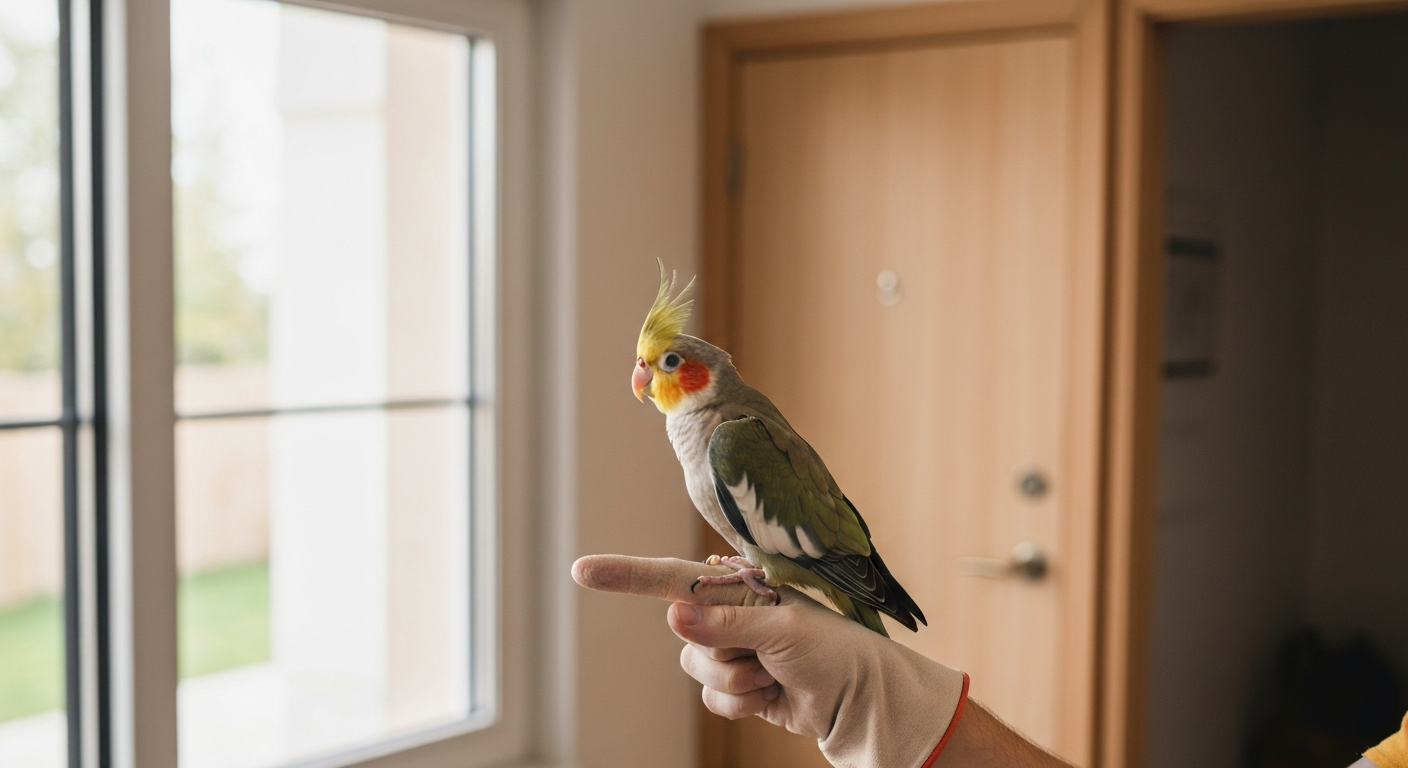
A budgerigar and a blue-and-gold macaw are not the same clipping calculation. Larger, heavier parrots have more wing loading to begin with, so removing primary surface area has proportionally larger effects on their ability to control descent. The parrot feather strength study mentioned earlier found that feather mechanical properties scale with body mass, meaning the structural role of any given primary feather is proportionally greater in a large bird. Cockatoos, macaws, and Amazon parrots also tend to have stronger flight motivation than, say, a caique or a lovebird, so the behavioral welfare costs of restriction may be higher for those species. Small birds like budgerigars and cockatiels lose flight control very quickly with even a conservative clip, which increases fall injury risk disproportionately.
How to clip safely: what the guidelines say
- Inspect every feather before cutting: hold each primary up to a light source and look for a dark blood supply in the shaft. Do not cut any feather that is still in active growth (a blood feather)
- Clip both wings symmetrically. Asymmetric clips cause uncontrolled spinning descents and increase fall injuries
- Trim conservatively: start by removing the tips of the outermost 4 to 6 primaries rather than the full 10, then test glide control before cutting more
- Cut straight across the feather shaft below the level of the overlying coverts so the trimmed shafts are not exposed and sharp
- Have styptic powder (e.g., cornstarch or a commercial styptic) on hand in case of accidental blood feather cut
- Have the first clip performed by a veterinarian or experienced avian handler and watch the technique before doing it yourself
- Reassess at each molt: clipping decisions should be revisited as feathers regrow and the bird's training or household situation changes
The Association of Avian Veterinarians recommends that wing trim records be kept and that owners receive counseling about flight's importance to birds, not just a quick pre-clip chat. If you are uncertain about any step, a veterinary visit is the right call, not a YouTube video and a pair of scissors.
Alternatives worth considering before you clip
Many of the safety benefits that drive clipping decisions can be achieved through environmental management and training instead. Flight recall training teaches a bird to return to the owner on cue, which addresses the escape-outside risk more durably than clipping, since clipping eventually grows out. A flight harness allows supervised outdoor time without grounding the bird at home. Securing doors and windows with bird-safe barriers, using screen doors, and establishing an airlock-style entry routine are household changes that address the escape risk without any feather intervention. The IAATE position statement and the World Parrot Trust both recommend that non-clipping alternatives be considered first, with clipping reserved for situations where there is a clear, specific justification.
Red flags that need a vet, not a pair of scissors
- Any blood feathers present: do not clip until these have fully matured, or have a vet manage the timing
- A bird that has just been clipped and is falling repeatedly or crashing heavily: the clip may be too aggressive for that individual's weight and body shape
- Feather cysts, abnormal feather growth, or skin inflammation around follicles after a previous clip
- A bird showing severe behavioral changes after clipping (self-mutilation, complete withdrawal, aggression escalation): consult an avian veterinarian and ideally an avian behaviorist
- Any bleeding that does not stop within a few minutes of applying pressure and styptic powder
- First-time clipping of a large parrot species with no prior professional guidance
Making the call: a decision framework
After reading all of this, here is how I would frame the decision. Ask yourself what specific risk or problem you are trying to solve. If the answer is 'I'm afraid my bird will fly out the front door,' ask whether environmental management (door barriers, trained recall) could solve that instead. If the answer is 'my bird is untamed and I cannot safely handle it without it flying at me,' that is a more specific, time-limited justification where a conservative clip while training is established makes sense. If the answer is 'I just think clipped birds are easier,' that is worth sitting with a little longer, because the welfare evidence suggests flight restriction has real costs for at least some species.
If you do decide to clip, do it conservatively, symmetrically, with blood feather checks every time, and with a plan for providing flight opportunities in safe, supervised contexts as the bird's training develops. Clipping is a management tool, not a permanent state. The goal should always be to move toward an unclipped bird in an environment you can both manage confidently.
FAQ
What is wing clipping and how does it differ from other flight‑restriction methods?
Wing clipping is the partial trimming of a bird’s flight (remige) feathers—usually the outer primaries and sometimes some secondaries—to reduce lift and control rather than remove the wing or surgically alter the bird. Clipping is temporary (feathers regrow) and differs from permanent methods like pinioning, which surgically prevents flight by removing or disabling flight‑capable tissues. Professional and welfare bodies recommend non‑permanent approaches when flight restriction is considered.
How do feathers and wing structure produce flight, and what happens aerodynamically when feathers are clipped?
Flight depends on wing shape, feather area and interaction among primaries and secondaries. Primaries are asymmetric, interlock to form smooth distal wing tips and often have slotted tips that reduce induced drag and wingtip vortices. Clipping removes feather area and changes wingtip geometry and aeroelastic behavior, lowering lift and reducing control authority. Experimental work (e.g., hawk wind‑tunnel, feather aeroelasticity studies) shows clipped wingtips can increase drag and change lift/deflection patterns; in heavy birds, clipping alters descent kinematics and landing performance.
What are evidence‑based benefits (pros) of clipping for companion birds?
Main benefits are risk reduction in specific contexts: reduced ability to gain high or sustained altitude (lowered escape risk indoors or from small enclosures), fewer high‑speed collisions in cluttered homes, and easier household management (reduced access to fragile or dangerous areas). Veterinary and avian organizations acknowledge clipping can be a pragmatic safety tool when combined with appropriate husbandry and owner education.
What are the well‑documented downsides (cons) and welfare concerns of clipping?
Downsides include reduced flight competence (impaired lift, control, and landing), altered behavior and activity patterns, potential chronic welfare impacts (evidence from cognitive‑bias and hormone studies shows flight restriction can affect affective state), injury risk if birds attempt uncontrolled flights or make poor landings, and medical risks if growing (blood/pin) feathers are cut. Long‑term or routine clipping without justification can reduce agency and physical exercise.
Do different species react differently to clipping?
Yes. Feather morphology and strength scale with body mass and vary by species; primaries and secondaries contribute differently to flight across taxa. Heavy‑bodied species (e.g., some galliforms) and larger parrots take longer to replace large remiges and may suffer more landing and descent impairment. Smaller, agile species may retain more maneuverability with modest trims. Species‑specific anatomy, behavior, and usual flight ecology should guide decisions.
How long does it take clipped feathers to regrow?
Regrowth times depend on feather size and species. Primary feather molt/growth commonly ranges from a few weeks for small species to several months for large parrots, following allometric patterns. Expect large parrot primaries to take many weeks to months to fully regrow; owners should plan for prolonged reduced flight during regrowth.
How Much Weight Can an Osprey Bird Carry: Numbers & Limits
How much weight can an osprey carry: typical prey 0.5–2 kg (≈30–100% body mass); anatomy, flight limits and evidence.