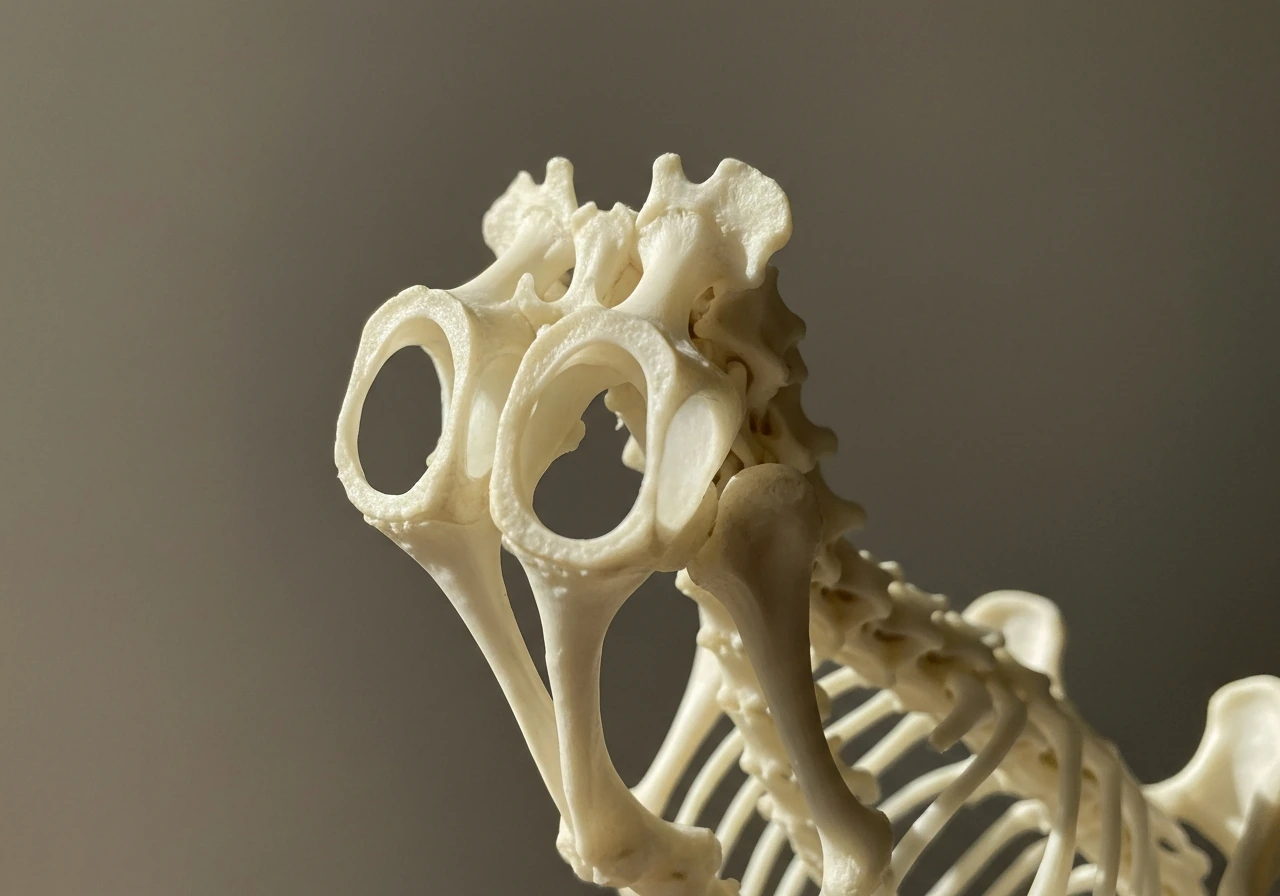
Direct answer: yes, bird bones are hollow (but with a catch)
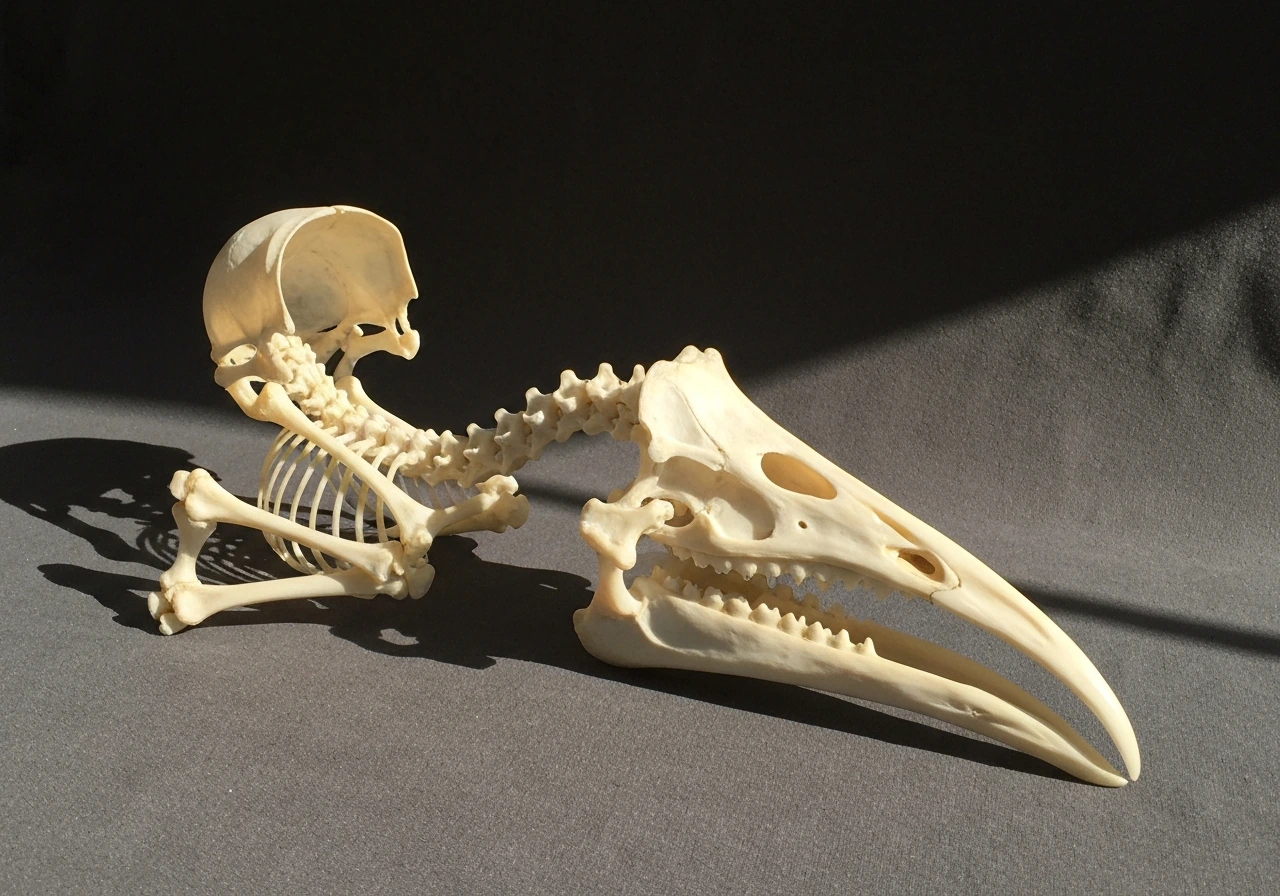
Bird bones are hollow, but not every single bone in a bird's body is hollow in the same way. The technical term for these hollow bones is "pneumatic" bones, which just means bones that are filled with air rather than solid tissue. The big caveat that most explanations gloss over: not all bones in a bird's skeleton are pneumatic. Some bones, like the leg bones in many species, remain denser and more solid. So the answer is: yes, bird bones are hollow, but only some of them, and how hollow they are depends on the species and which bone you're looking at.
Which bones are hollow and which ones aren't
When you look at a bird skeleton, you'll notice that the bones doing the heaviest lifting during flight, like the humerus (upper wing bone), the furcula (wishbone), and parts of the vertebral column, tend to be the most pneumatized. The skull is another big one: in most bird species, the skull bones are extensively pneumatized. The bones of a bird that bear the most weight on the ground, especially in the legs and feet, are often denser and less hollow, because those bones need to absorb impact forces that flight bones don't.
The degree of pneumaticity also varies across species. Birds that fly long distances, like albatrosses or frigatebirds, have much more extensive pneumatization throughout their skeletons than, say, a flightless ostrich. In flightless birds, the skeleton looks much closer to a reptile's, with denser, marrow-filled bones that would be terrible for sustained aerial flight but are perfectly fine for running. So "hollow bones" is a spectrum, not a binary on-or-off switch.
Why birds evolved hollow bones in the first place
The short version: weight reduction. Flight is metabolically expensive, and every gram a bird carries costs energy. The bones in a bird are hollow, reducing its weight to a point where the bird's muscles can actually generate enough lift to get airborne and stay there. This isn't a small effect either. The entire skeleton of a pigeon weighs only about 4.4% of its total body weight. Compare that to a mammal of similar size, where the skeleton makes up closer to 8 to 10% of body weight, and you start to see how much that matters.
There's also an efficiency argument beyond just raw weight. A lighter skeleton means the flight muscles don't have to work as hard to accelerate the wings through each stroke. Over millions of wingbeats in a migratory season, that adds up enormously. Evolution essentially trimmed every gram of unnecessary bone tissue it could, then compensated for the structural loss with clever internal architecture (more on that in a moment).
How hollow bones connect to breathing and air sacs
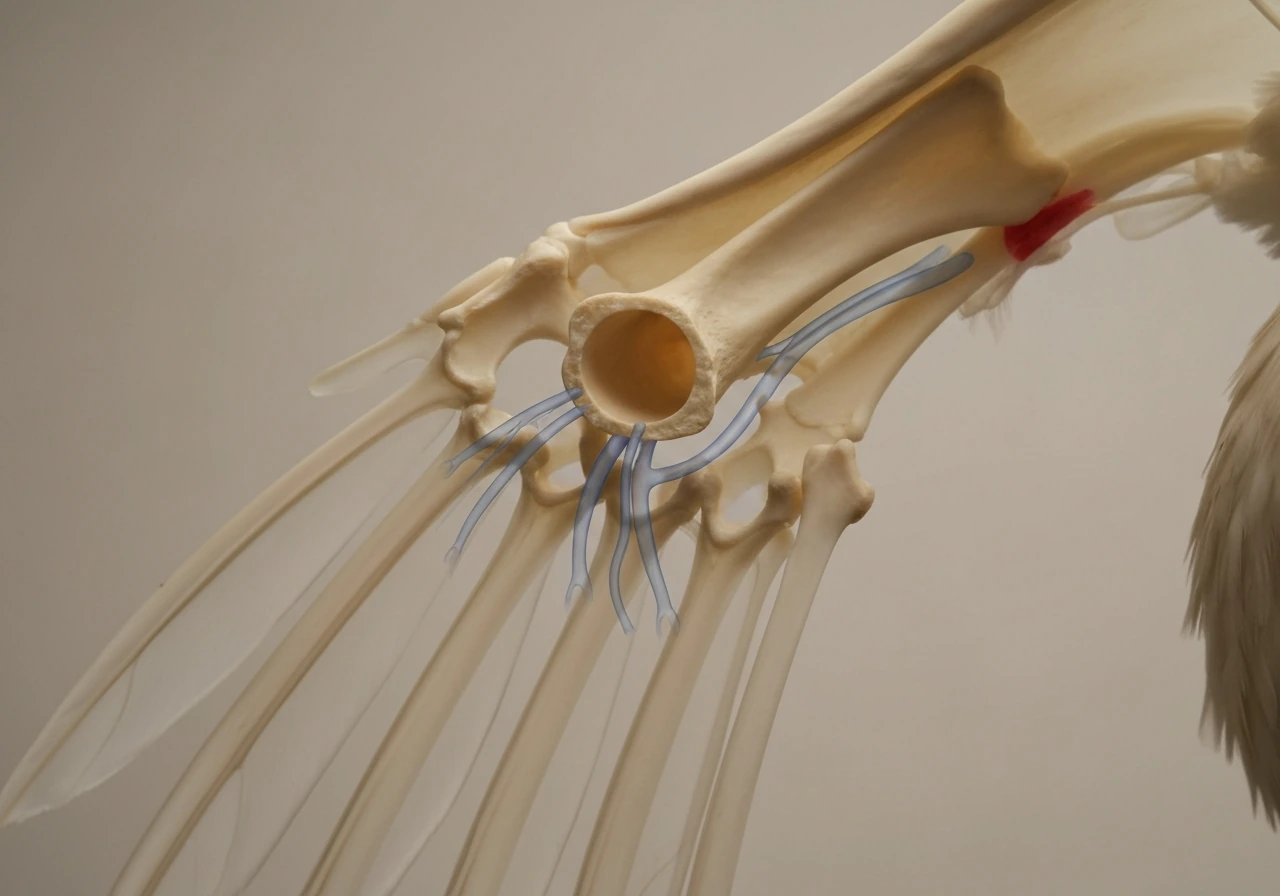
Here's the part that genuinely surprised me when I first looked into this: bird bones aren't just passively hollow. They're actively connected to the bird's respiratory system through a network of air sacs. Birds have a unique breathing system that uses nine air sacs distributed through their body cavity, and several of these air sacs extend directly into the hollow spaces inside the bones. This means the air inside a bird's pneumatized bones is the same air cycling through its respiratory system.
Bird bones have air pockets in them that form part of this continuous respiratory circuit, which is part of why birds can sustain the oxygen demands of powered flight at high altitudes where the air is thinner. The air sac system allows for a near-continuous flow of fresh air across the gas exchange surfaces in the lungs, even during both inhalation and exhalation. The bones are essentially structural extensions of this respiratory infrastructure.
This is also why a broken bone in a bird can sometimes be more dangerous than it sounds. If a pneumatized bone fractures and the connection to the air sac system is disrupted, it can interfere with breathing, not just movement. Veterinarians who treat birds are well aware of this complication.
Hollow but not fragile: the internal structure that keeps bones strong
A hollow tube is actually a pretty efficient structural shape. Engineers use hollow tubing all the time in aerospace and construction because it resists bending forces nearly as well as a solid rod of the same material, at a fraction of the weight. Bird bones exploit this same principle. But they take it further by adding internal struts called trabeculae (pronounced tra-BEK-yoo-lee), which are tiny bony crossbeams that brace the inside of the hollow bone wall. Think of them as the internal scaffolding inside a hollow column.
Are bird bones lighter than mammal bones of the same size? Yes, significantly, but the trabeculae arrangement means they're not proportionally weaker. The thin outer walls combined with internal bracing distribute stress efficiently across the bone surface. The result is a bone that can handle the intense compression and tension forces of a wingbeat without fracturing, while still being light enough for flight to be possible.
Common misconceptions worth clearing up
The biggest misconception I see repeated is that all bird bones are hollow and that this makes them universally fragile. Neither is fully true. As covered above, not all bones are pneumatized, and the ones that are have internal reinforcement that maintains structural integrity. The second misconception is that hollow means "empty." Pneumatized bones are filled with air that connects to the respiratory system, so they're doing active biological work, not just sitting there as open cavities.
Another one worth flagging: people sometimes assume that because bird bones are hollow, they must float in water. The reality is more nuanced than that. Do bird bones float in water is actually its own interesting question, because whether a bone sinks or floats depends on bone density, the presence of marrow in non-pneumatized bones, and the specific bone in question. Don't assume "hollow" automatically equals "floats."
A quick way to check what you're actually looking at: if you have access to a museum bird skeleton (natural history museums often display these), you'll notice the bones look and feel papery thin compared to a mammal skeleton of similar size. Some bones, when held up to light, will show a slight translucency at the walls. That visual thinness is the physical evidence of pneumatization you can see without any special equipment.
How hollowness connects directly to flight mechanics
Flight puts enormous demands on a bird's body, and the skeleton is central to how those demands are met. The bones of the wing form a lever system that transmits force from the flight muscles (the pectorals are the big ones) into actual wing movement. For that system to work efficiently, the bones need to be stiff enough not to flex under load, but light enough that the muscles can accelerate them fast enough to generate lift. Pneumatized bones with trabeculae hit that balance almost perfectly.
The fused bones in a bird's skeleton, like the carpometacarpus (the fused wrist and hand bones in the wing), are often among the most pneumatized, because they need to be rigid and light simultaneously during the power stroke. Meanwhile, the ribcage benefits from a combination of pneumatization and articulated joints that allow the thorax to expand during breathing even while flight muscles are contracting. The whole system is integrated in a way that makes the skeleton, the respiratory system, and the flight mechanics impossible to fully separate from each other.
It's also worth noting that birds aren't the only animals that need to be light to function in their environment. Can birds swim well despite this lightweight skeleton? Some absolutely can, because the same low bone density that helps with flight also helps with buoyancy in water, though swimming birds like ducks have modified their skeletal density in ways that balance both needs. The tradeoffs between flight efficiency and other physical demands are part of what makes avian skeletal anatomy so fascinating to dig into.
A quick comparison: pneumatic vs. non-pneumatic bones in birds
| Bone Type | Examples in Birds | Hollow/Air-Filled? | Main Function | Typical Location |
|---|
| Pneumatic (highly) | Humerus, skull, vertebrae, pelvis | Yes, extensively | Reduce weight, connect to air sacs | Wing, head, torso |
| Pneumatic (partially) | Femur (in some species) | Partially, varies by species | Weight reduction with load bearing | Upper leg |
| Non-pneumatic (denser) | Tibiotarsus, tarsometatarsus | No, denser with marrow | Support body weight, absorb impact | Lower leg and foot |
| Fused/rigid pneumatic | Carpometacarpus, synsacrum | Yes, hollow and fused | Structural rigidity for flight | Wing tip, lower back/pelvis |
If you want to go deeper on the structural side of this, the key terms to search for in any anatomy reference are "avian pneumatization," "trabeculae in bird bones," and "air sac diverticula." Those three concepts together explain basically everything about how and why bird skeletons are built the way they are. What starts as a simple question about hollow bones ends up being a window into one of the most elegant pieces of evolutionary engineering in the vertebrate world.